Loading blog post...


ZK Rollups Explained: Scaling Blockchain Without Sacrificing Security
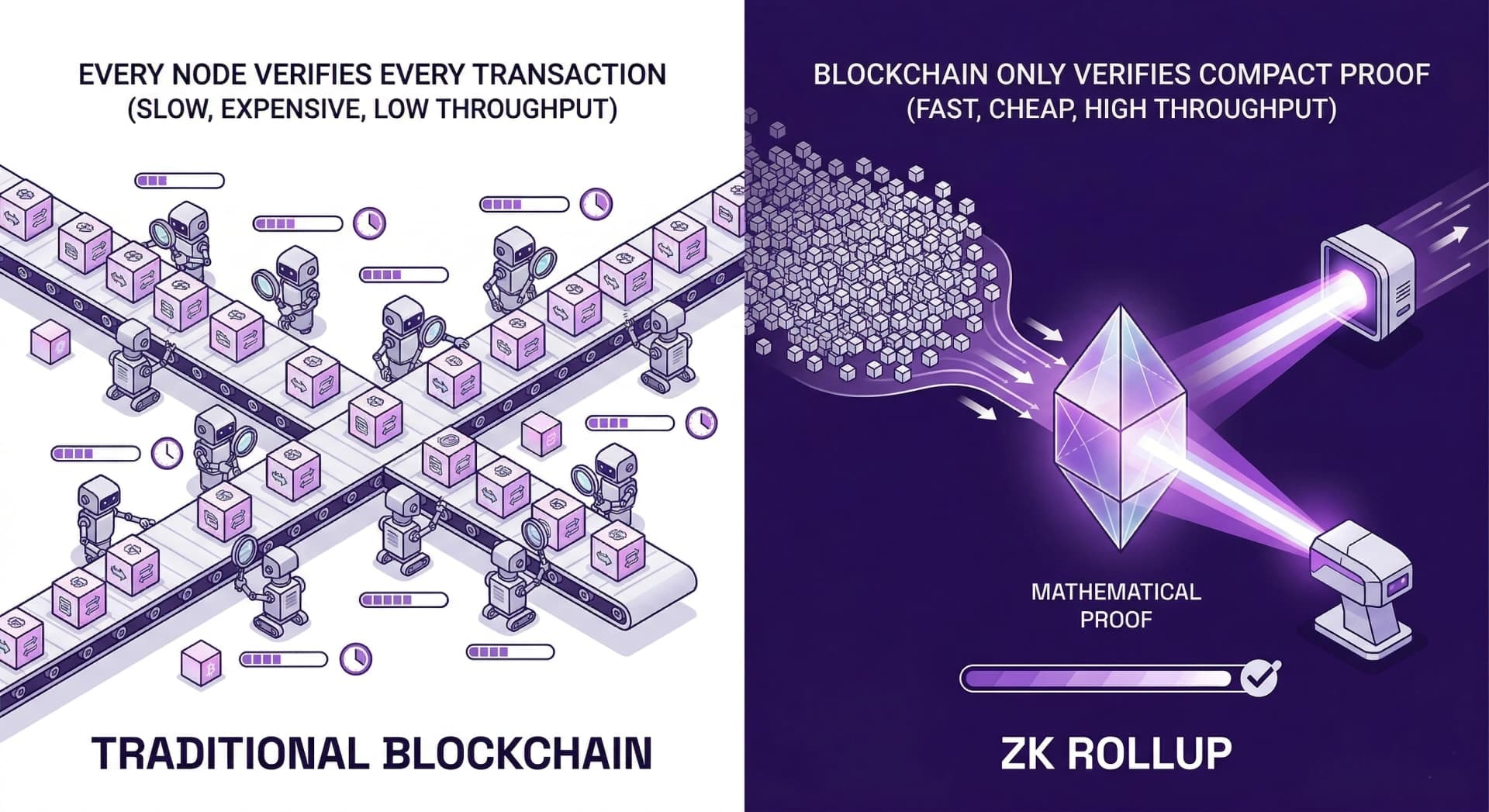
Every blockchain faces an uncomfortable trade-off: speed or security. ZK rollups are the first technically credible answer that refuses to compromise. By moving transaction processing off-chain and returning a mathematical "validity proof" to Ethereum, ZK rollups allow the network to verify thousands of transactions in an instant. In this guide, we break down why math, not trust is the future of web3 scaling.
Every blockchain faces the same uncomfortable trade-off. Make it fast and cheap, and you usually compromise on security or decentralisation. Make it secure and decentralised, and it gets slow and expensive.
Ethereum processes around 15 transactions per second on mainnet. Visa processes tens of thousands. For blockchain to handle real-world scale, something had to give and for years, the honest answer was that nothing satisfactory had been found.
ZK rollups are the most technically credible answer the space has produced. Not a compromise, but a genuine advancement, a way to process transactions at scale while preserving the blockchain security guarantees that make the base layer worth trusting in the first place.
The Problem They Actually Solve
To understand ZK rollups, it helps to understand exactly what they are solving.
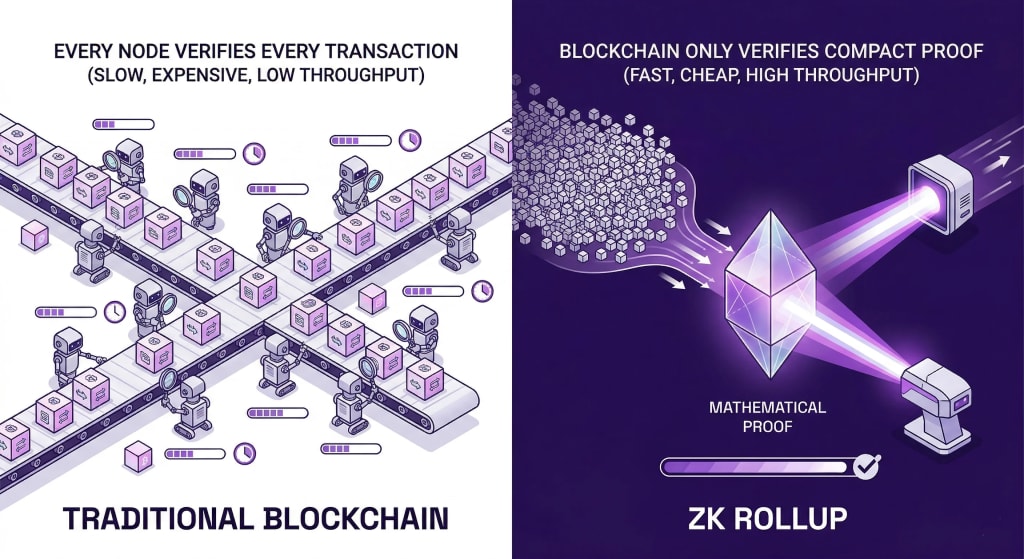
Every transaction on a blockchain needs to be verified by every node in the network. That is what makes it trustless because no single party's word is taken for anything. But it is also what makes it slow. When everyone has to check everything, throughput is limited by the slowest and least powerful participants in the network.
The naive solution is to make the blockchain bigger so as to allow more transactions per block, increase the block size, speed up block times. This works in the short term and breaks blockchain security in the long term, because it pushes out smaller validators and centralises the network.
ZK rollups take a completely different approach. Instead of making the blockchain process more transactions directly, they move the transaction processing off-chain and only bring the proof back onchain. The blockchain does not need to re-execute every transaction. It only needs to verify that the execution was correct.
That distinction between re-executing and verifying is where all the efficiency comes from.
What Zero Knowledge Proofs Actually Do Here
The "ZK" in ZK rollups stands for zero knowledge proof, a cryptographic technique that allows one party to prove to another that a statement is true without revealing any information beyond the truth of the statement itself.
In plain terms: imagine proving you know a password without ever typing it. The verifier becomes convinced the proof is valid without learning what the password is.
In the context of rollups, ZK proofs work like this:
- Thousands of transactions are collected and processed off-chain by a sequencer
- A zero knowledge proof is generated, a compact mathematical certificate proving that all those transactions were executed correctly, according to the rules
- That proof, plus a compressed summary of the state changes, is posted to the main blockchain
- The blockchain verifies the proof which takes a fraction of the computational work of re-running every transaction
The result: the security guarantee of the main chain, at a fraction of the cost and a multiple of the throughput. The blockchain does not trust the sequencer's word. It verifies the mathematics.
ZK Rollups vs. Optimistic Rollups: The Key Difference
Both ZK rollups and optimistic rollups are Layer 2 scaling solutions. Both move transaction execution off-chain. But their security models are fundamentally different, and that difference has real practical implications.
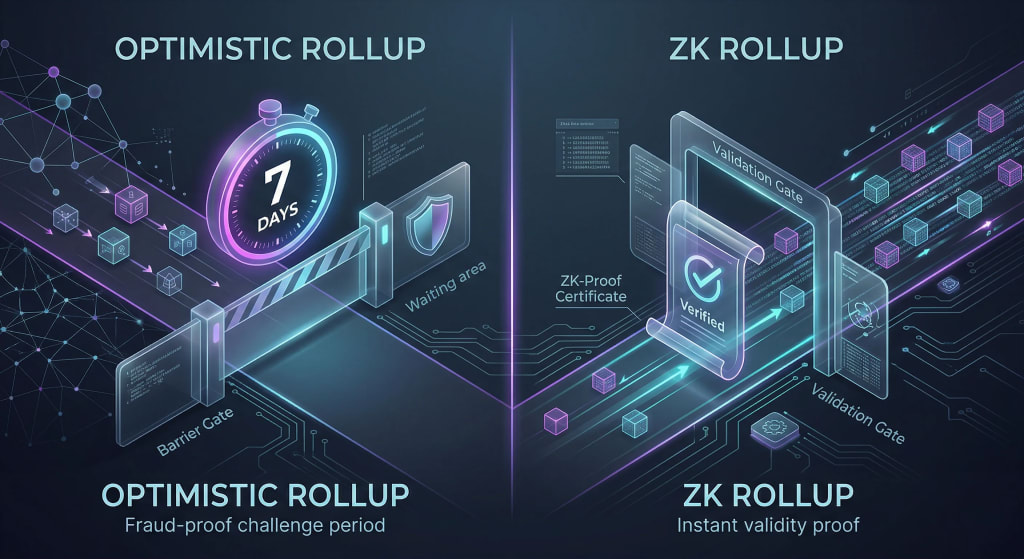
Optimistic rollups assume transactions are valid by default, hence "optimistic." They post transactions on-chain and allow a challenge window (typically seven days) during which anyone can submit a fraud proof if they believe a transaction was invalid. This model works, but the seven-day window creates a genuine problem: if you want to withdraw funds from an optimistic rollup back to Ethereum mainnet, you typically wait seven days for the challenge period to expire.
ZK rollups do not assume validity, they prove it. Every batch comes with a cryptographic proof that is verified on-chain immediately. No challenge window. No waiting period. Withdrawals can be near-instant because the security is mathematical, not game-theoretic.
The trade-off has historically been that generating ZK proofs is computationally expensive, which added cost and complexity to the ZK rollup approach. In 2026, that gap has narrowed significantly as proof generation hardware and software have both improved considerably.
Blockchain Security in ZK Rollup Architecture
This is where things get important for anyone evaluating web3 security properties of different systems.
A common misconception is that using a Layer 2 means trusting the Layer 2 operator. With ZK rollups, that is not quite right and the distinction matters enormously for crypto security.
The blockchain security model of a ZK rollup works like this:
- The sequencer collects and orders transactions. It can potentially censor transactions (refuse to include them) but it cannot steal funds or produce invalid state transitions, the ZK proofs make invalid execution provably detectable.
- The prover generates the cryptographic proof. This is computationally intensive work that is increasingly being decentralised across multiple provers to reduce centralisation risk.
- The verifier contract on the main chain checks the proof. This is the security anchor, it lives on Ethereum mainnet and inherits all of Ethereum's blockchain security properties.
The practical implication: even if the entire ZK rollup operator infrastructure were compromised, an attacker could not steal funds without generating a valid ZK proof of an invalid state transition, which is computationally infeasible. The worst realistic outcome from sequencer compromise is censorship, not theft.
This is materially stronger than many alternative scaling approaches from a web3 security perspective.
Crypto Keys and How ZK Rollups Handle User Security
One dimension of crypto security that gets less attention in ZK rollup discussions is key management - how users' assets are actually protected.
In a ZK rollup, user assets are held in a smart contract on the main chain. The rollup operator processes transactions and updates state, but the underlying assets never leave the custody of that on-chain contract. A user's crypto key, the private key to their wallet is what authorises transactions within the rollup.
A few properties worth understanding:
- Self-custody is preserved. Users hold their own keys and their own assets. The rollup operator cannot move user funds without valid signatures.
- Exit mechanisms are robust. If the entire rollup operator disappears, goes offline, becomes hostile, or simply shuts down, users can exit their funds directly to the main chain using only their own crypto key and the on-chain contract. No operator cooperation required.
- Proof verification is the security backbone. The on-chain verifier contract is the piece that cannot be compromised without breaking Ethereum itself. As long as Ethereum's blockchain security holds, the ZK rollup's fundamental security holds.
This architecture means that the trust assumptions in a well-designed ZK rollup are much narrower than in most alternative scaling approaches.
Where ZK Rollups Are Being Used Today
The technology has moved well past theoretical interest. Several production ZK rollup systems are live with meaningful usage.
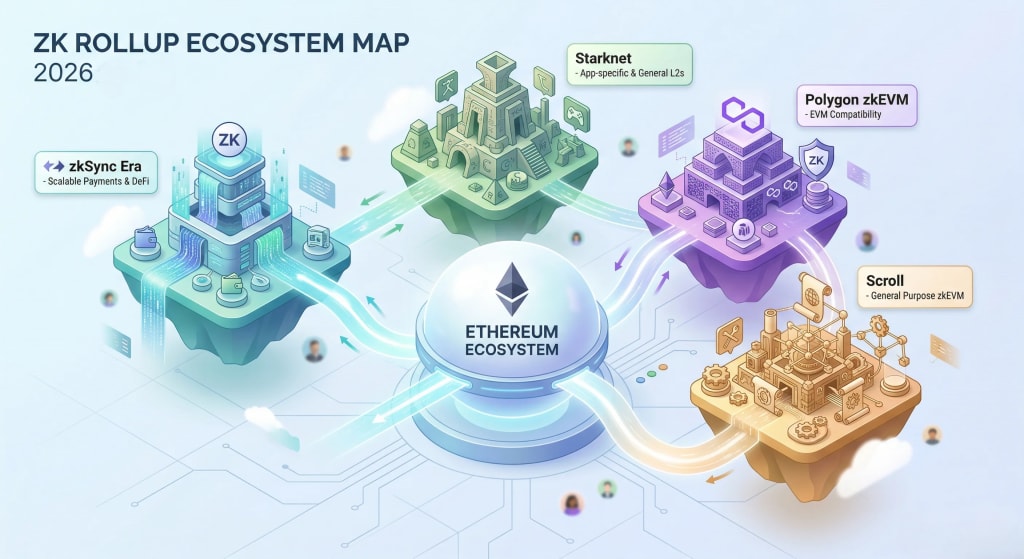
- zkSync Era is one of the most actively developed ZK rollup environments, with a growing ecosystem of DeFi applications, payments infrastructure, and developer tooling. Its focus on EVM compatibility — allowing Solidity developers to deploy with minimal changes — has driven significant adoption among web3 development teams.
- Starknet uses a different proof system (STARKs rather than SNARKs) which is post-quantum secure and requires no trusted setup. It has attracted fully onchain game development and complex DeFi applications, particularly through its native Cairo programming language which is optimised for provable computation.
- Polygon zkEVM brings ZK rollup scaling to the Ethereum ecosystem with full EVM equivalence, meaning existing Ethereum contracts can deploy with essentially no modifications. For teams with existing Ethereum deployments, this dramatically lowers the migration barrier.
- Scroll and Linea (developed by Consensys) are additional EVM-compatible ZK rollups with active ecosystems and different performance and decentralisation trade-offs.
If your team is evaluating which ZK rollup environment fits your application, our Blockchain Development Services includes Layer 2 architecture assessment as part of protocol design engagements. Get in touch with our blockchain experts to secure your architecture.
The Remaining Challenges Worth Knowing
ZK rollups are the most promising scaling technology in production today. They also have genuine open challenges worth understanding honestly.
- Proof generation cost and speed — generating ZK proofs for complex transactions, particularly those involving general smart contract execution, is computationally intensive. This adds cost and latency to the proof generation step. Hardware acceleration and algorithmic improvements are both active areas of development, and the gap to optimistic rollups has narrowed considerably — but it has not fully closed.
- EVM compatibility complexity — proving EVM execution in ZK is genuinely hard. Different teams have made different trade-offs between full equivalence (proving every EVM opcode exactly) and practical compatibility (supporting most common patterns). The differences matter for edge cases in complex smart contracts.
- Sequencer centralisation — most production ZK rollups today run centralised sequencers for performance reasons, with decentralised sequencer roadmaps planned but not yet live. A centralised sequencer cannot steal funds, but it can censor transactions, a meaningful web3 security limitation that decentralised sequencing is designed to address.
- Proof system trust assumptions — zk-SNARKs require a trusted setup ceremony to generate the initial parameters. If that ceremony is compromised, the proof system's security assumptions break. zk-STARKs avoid this but produce larger proofs. Both represent engineering trade-offs that application developers need to understand when choosing between systems.
Frequently Asked Questions
Q: What is a ZK rollup in simple terms?
A: A system that processes thousands of transactions off-chain and posts a cryptographic proof to the main blockchain confirming they were all valid. The blockchain verifies the proof rather than re-running every transaction, achieving scale without sacrificing security.
Q: How is a ZK rollup different from an optimistic rollup?
A: Optimistic rollups assume transactions are valid and allow a challenge window (typically seven days) to dispute them. ZK rollups prove validity cryptographically and immediately, no waiting period, no game-theoretic security assumption.
Q: Can a ZK rollup operator steal my funds? A: No. User assets are held in a smart contract on the main chain. The operator cannot produce a valid ZK proof of an invalid state transition which is what would be required to steal funds.
Q: What is the difference between zk-SNARKs and zk-STARKs?
A: Both are types of ZK proofs used in rollup systems. SNARKs produce smaller proofs and verify faster but require a trusted setup ceremony. STARKs require no trusted setup and are post-quantum secure but produce larger proofs. Starknet uses STARKs; most other ZK rollups use SNARKs.
Q: Are ZK rollups ready for production use?
A: Yes, zkSync Era, Starknet, Polygon zkEVM, Scroll, and Linea are all live with meaningful usage. The primary considerations for production deployment are EVM compatibility requirements, sequencer decentralisation timeline, and proof system trade-offs for your specific use case.
Conclusion
ZK rollups represent the most technically substantive answer to the blockchain scaling problem, not by relaxing blockchain security assumptions, but by making verification radically more efficient through cryptographic proof.
The core insight is simple even if the mathematics is not: instead of every node re-running every transaction, every node verifies a compact proof that the transactions were correct. The security comes from mathematics, not from trust.
For builders evaluating Layer 2 infrastructure, the ZK proof ecosystem has matured to the point where production deployment is viable across a range of applications with the trade-offs now centered on EVM compatibility, prover costs, sequencer decentralisation timelines, and proof system design rather than fundamental security assumptions.
This is also where implementation quality starts to matter. At EthElite, ZK-focused architecture decisions are approached from the product side first - selecting the rollup environment, bridge logic, contract interaction model, and upgrade path according to how the application is expected to scale under real usage.
Blockchain scaling and blockchain security are no longer in opposition. What matters now is choosing the right cryptographic infrastructure and integrating it without introducing avoidable complexity.
Share with your community!