Loading blog post...


Web2 vs Web3 Website Development: What's Actually Different
A landing page is a landing page, right? Not in Web3. While the structure remains universal, the psychological 'starting point' of your visitor has shifted. From replacing SOC 2 badges with smart contract audits to navigating the 'wallet connection' friction, this guide breaks down the practical differences between Web2 and Web3 web development that determine whether your protocol actually converts or just looks good.
A landing page is a landing page, right? Hero section, value proposition, CTA, social proof. The fundamentals do not change just because the product is a blockchain protocol instead of a SaaS tool.
That is mostly true and the "mostly" is where teams get tripped up. The structure of a good landing page is universal but what goes inside that structure, what trust signals matter, what the CTA leads to, and what the visitor is actually evaluating. These shift significantly between web2 sites and web3 sites.
This is the practical difference.
The Visitor's Starting Point Is Different
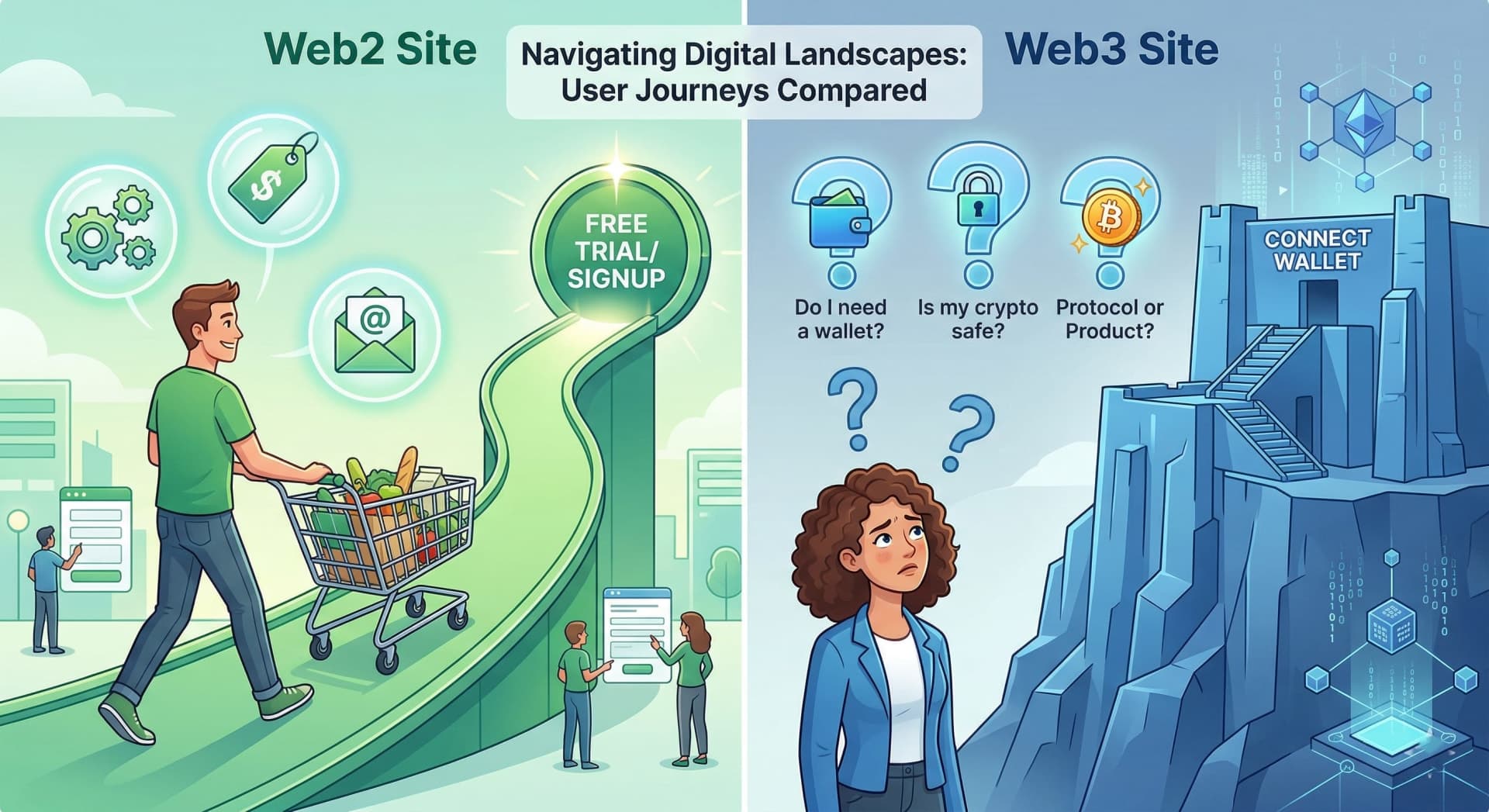
In web2 website development, a landing page visitor arrives with a reasonably formed mental model. They understand what software does. They know what a free trial means. They have signed up for things before and understand what happens next.
A web3 website landing page visitor often arrives with genuine uncertainty about what they are looking at even if they are crypto-native. Is this a protocol or a product? Do I need a wallet to use it? What happens to my funds? Who controls this?
These are not questions a web2 site visitor typically asks. They are questions every web3 website landing page needs to answer, whether or not the visitor explicitly voices them.
The practical implication: web3 landing pages carry a higher education burden than equivalent web2 websites. The copy needs to do more work, earlier, to get a visitor to the same level of confidence that a web2 visitor arrives with by default.
Trust Signals Are Completely Different
This is the most concrete difference between web2 and web3 landing page design and the one most often handled badly by web development companies making their first web3 landing page.
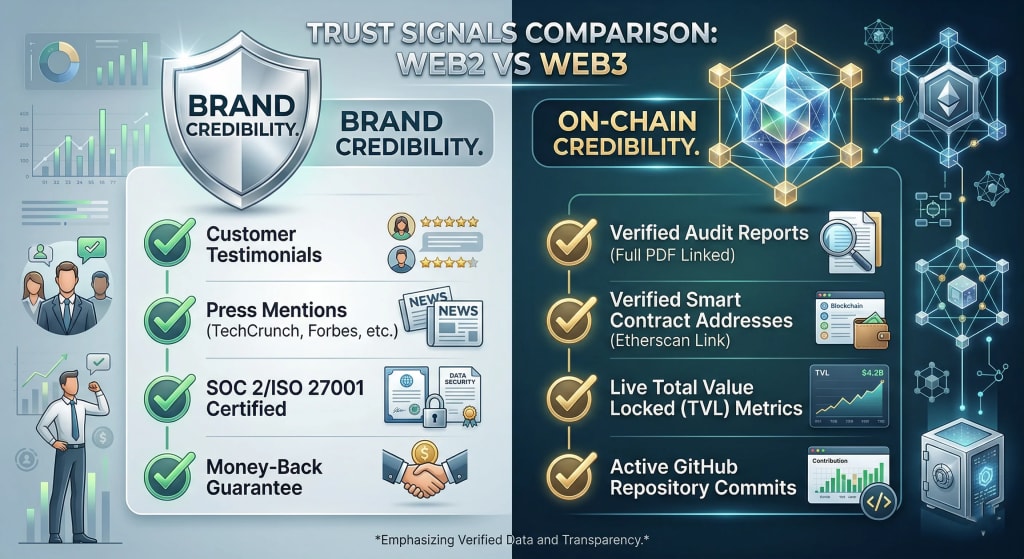
On a web2 website, trust is built with:
- Customer logos and testimonials
- Press mentions
- Security certifications (SOC 2, ISO 27001)
- Money-back guarantees
- Live chat availability
These signals answer the implicit web2 visitor question: is this company legitimate and will they treat me well?
On a web3 website, the visitor is asking something different: is this protocol safe for my money and can I verify that independently?
The trust signals that answer that question:
- Audit reports — not a logo badge, but a named firm with a linked full report. Visitors who are serious will click through and read it.
- Smart contract addresses — verified on the relevant block explorer, linked directly from the landing page. This tells a technical visitor they can check the code themselves.
- Total value locked or transaction volume — real on-chain metrics that anyone can verify, not self-reported user counts.
- GitHub activity — a linked repository with recent commits signals the protocol is actively maintained.
- Team with verifiable backgrounds — not necessarily fully doxxed, but founders with traceable professional histories and prior work that can be assessed.
A freelance web developer or website development company building a web3 website landing page that applies web2 trust patterns to a blockchain product will produce a page that feels off to crypto-native visitors not because it looks wrong, but because it is answering the wrong questions.
Studios that work exclusively in the Web3 space like EthElite understand the required blockchain architecture decisions natively. They build pages where the trust hierarchy is designed around on-chain credibility first, not only brand credibility.
If you are in early architecture or rebuilding after a launch that underperformed, connect today to get the first consultation for free.
The CTA Leads Somewhere Fundamentally Different
On a web2 website, the primary call to action typically leads to a sign-up form. Enter an email, create a password, start a free trial. Friction is low, commitment is low, and the user's personal data handles the identity layer.
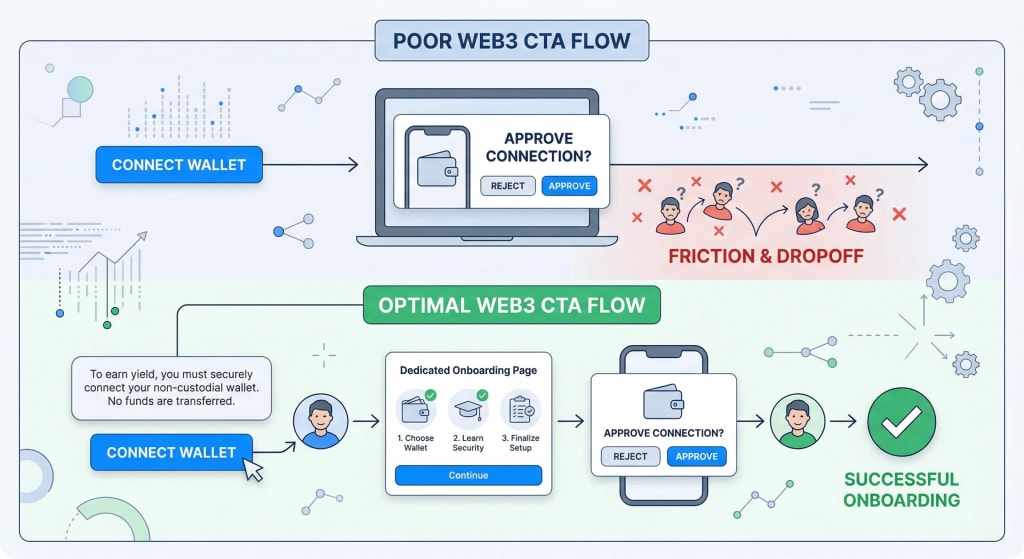
On a web3 website landing page, the primary CTA typically leads to one of a few things: connecting a wallet, bridging to the protocol's chain, or being directed to a community channel before the product is live. None of these are as familiar as a sign-up form.
This creates a design challenge that web2 website development never encounters:
- For wallet connection CTAs — the button that says "Launch App" or "Connect Wallet" should be preceded by enough context that the visitor understands what connecting a wallet means, what they are committing to, and what happens next. Many web3 website landing pages drop visitors directly into a wallet connection prompt with no preamble. For crypto-native visitors this is fine. For anyone newer, it is a cliff.
- For pre-launch community CTAs — many new crypto projects launch a landing page before the product is live. The CTA here is typically "Join the Waitlist" or "Join our Discord/Telegram." This is closer to web2 patterns but the implicit promise is different — community membership in web3 means something more participatory than an email waitlist, and the landing page should reflect that.
- For bridge or onboarding CTAs — protocols on specific chains often need to direct new users through an onboarding flow before they can actually use the product. The landing page CTA that drops a visitor into a multi-step bridge-and-onboard flow without preparing them for it produces abandonment at every step.
The custom website development work here is designing the path from landing page to first product interaction with enough context at each step that the visitor knows where they are and why.
What Web2 Websites Optimise For vs. What Web3 Websites Need
Web2 website landing pages are optimised around a well-understood conversion funnel. Email capture, trial sign-up, demo booking, the metrics are clear and the patterns for improving them are well-established. A website development agency with strong web2 conversion rate optimisation experience knows exactly what to test.
Web3 website landing pages are optimising for something more layered:
- Understanding — does the visitor leave knowing what this web3 protocol does?
- Trust — does the visitor believe this protocol is safe enough to interact with?
- Intent — does the visitor have a reason to come back to this web3 product when they are ready to use it?
These are harder to measure than email conversion rates and require different approaches to optimisation. A web3 website landing page that generates many wallet connections from visitors who immediately disconnect and never return has a higher "conversion rate" but worse actual performance than one that generates fewer connections from visitors who become active users.
The content architecture that serves these goals:
- Above the fold — what this is and who it is for, with the primary action immediately visible
- Second section — the problem it solves, in terms the target user would use themselves
- Third section — trust signals: audits, metrics, team, security
- Fourth section — how it works, layered for both technical and non-technical visitors
- Fifth section — social proof from the ecosystem: integrations, partners, protocol users
This sequence is not very different from a strong web2 website landing page structure. What fills each section is entirely different.
The Copy Requirements Are More Demanding For Web3 Websites
Web2 website landing page copy can lean on established category language. "Project management software," "CRM platform," "email marketing tool" - these categories are understood and copy can build from that shared understanding.
Web3 website copy has no such shorthand with mainstream audiences, and even within crypto-native audiences the shorthand varies significantly by segment. A DeFi power user and someone new to crypto both landing on the same page need very different entry points to the same content.
This means web3 website landing page copy needs to:
- Define before it assumes. Terms that are obvious to the team like liquidity pool, smart contract, gas, slippage are not obvious to a significant portion of visitors. Landing pages that use these terms without brief contextual explanation lose non-technical visitors at every instance.
- Lead with outcomes, not mechanisms. The mechanism is interesting to a small audience. The outcome, what the user can do, earn, or avoid by using the protocol is interesting to everyone. Web3 website copy that leads with "a decentralised automated market maker using concentrated liquidity" loses most visitors before they reach the outcome.
- Address the elephant in the room. Crypto has a trust problem with mainstream audiences built up over years of scam projects, rugpulls, and dramatic collapses. A web3 website landing page that does not acknowledge the legitimate scepticism a new visitor brings and address it directly is leaving a significant conversion barrier unaddressed.
A freelance website developer or a random web design team building web3 landing pages needs either genuine crypto market familiarity or close collaboration with someone who has it. The copy failures on most web3 website landing pages are not writing failures, they are market understanding failures.
If your team needs landing page development that bridges technical protocol complexity and genuine user clarity, our Web3 Website Development services covers the full design and copy process for crypto project landing pages.
Technical Implementation: Where Web2 and Web3 Landing Pages Actually Diverge
For most of the landing page, the implementation is identical between web2 and web3. React or Next.js, a CSS framework, standard performance optimisation, the same SEO fundamentals. A web developer experienced in web2 website development can build 80% of a web3 website landing page without any new skills.
The divergence points are specific:
- Live on-chain data display — many web3 website landing pages display real-time protocol metrics: TVL, transaction count, active users. These pull from RPC nodes or subgraphs rather than an internal database. The implementation requires handling loading states, potential RPC failures, and data freshness in ways that web2 technologies do not encounter.
- Wallet connection on the landing page itself — some landing pages include a direct wallet connect button rather than routing to a separate app. This requires integrating a wallet connection library into what would otherwise be a static marketing page, with all the multi-wallet support and mobile compatibility requirements that entails.
- Token gating for early access — new crypto projects that offer whitelist or early access tied to token holdings need to verify wallet holdings from the landing page. This is a web3-specific implementation pattern with no web2 equivalent.
Frequently Asked Questions
Q: What is the biggest difference between a web2 and web3 landing page?
A: The trust signals and the visitor's starting point. Web2 visitors arrive with established mental models and respond to familiar trust signals. Web3 visitors often arrive with genuine scepticism and need protocol-specific credibility signals that have no web2 equivalent.
Q: Does a web3 landing page need special technical development?
A: For a purely informational page, the technical implementation is similar to web2 website development. The divergence comes when the landing page displays live on-chain data, includes wallet connection functionality, or implements token-gated early access, each requiring web3-specific development patterns.
Q: How should a web3 landing page handle visitors who don't have a crypto wallet yet?
A: With onboarding context before the CTA, not after. A button that says "Connect Wallet" with no preceding explanation loses visitors who are interested but unfamiliar. Brief copy explaining why it is needed converts curious visitors that a bare CTA would lose.
Q: What metrics matter for web3 landing page performance?
A: Beyond standard conversion metrics, web3 website landing pages should track wallet connection quality, community join-to-active-member ratios for pre-launch pages, and return visit rates - indicators of genuine interest versus accidental traffic.
Conclusion
The bones of a good landing page are the same regardless of whether the product is a SaaS tool or a blockchain protocol. Clear value proposition, compelling trust signals, a path to the next step.
What goes inside those bones is where web2 and web3 website landing pages diverge - in the trust signals that actually work, in the education burden the copy needs to carry, in what the CTA leads to, and in the scepticism the visitor arrives with.
Best web development companies and web design and development services that understand both environments can build landing pages that serve the technical credibility requirements of crypto-native audiences while remaining accessible to visitors encountering the space for the first time which is why firms like EthElite combine Web3 product understanding with execution across design, development and messaging.
That balance of technical credibility and genuinely accessibility is what separates high-performing web3 website landing pages from the ones that look impressive and convert nobody.
Share with your community!