Loading blog post...


Understanding the Real Costs Behind Building and Securing Blockchain Systems
Most blockchain cost estimates are wrong because they only account for the visible surface, contract deployment and basic code. In reality, the true price of a production-ready system includes rigorous security audits, complex indexing layers, and the high-stakes engineering required to survive an adversarial mainnet environment. This guide maps the real cost landscape to help teams plan for long-term success rather than just a launch.
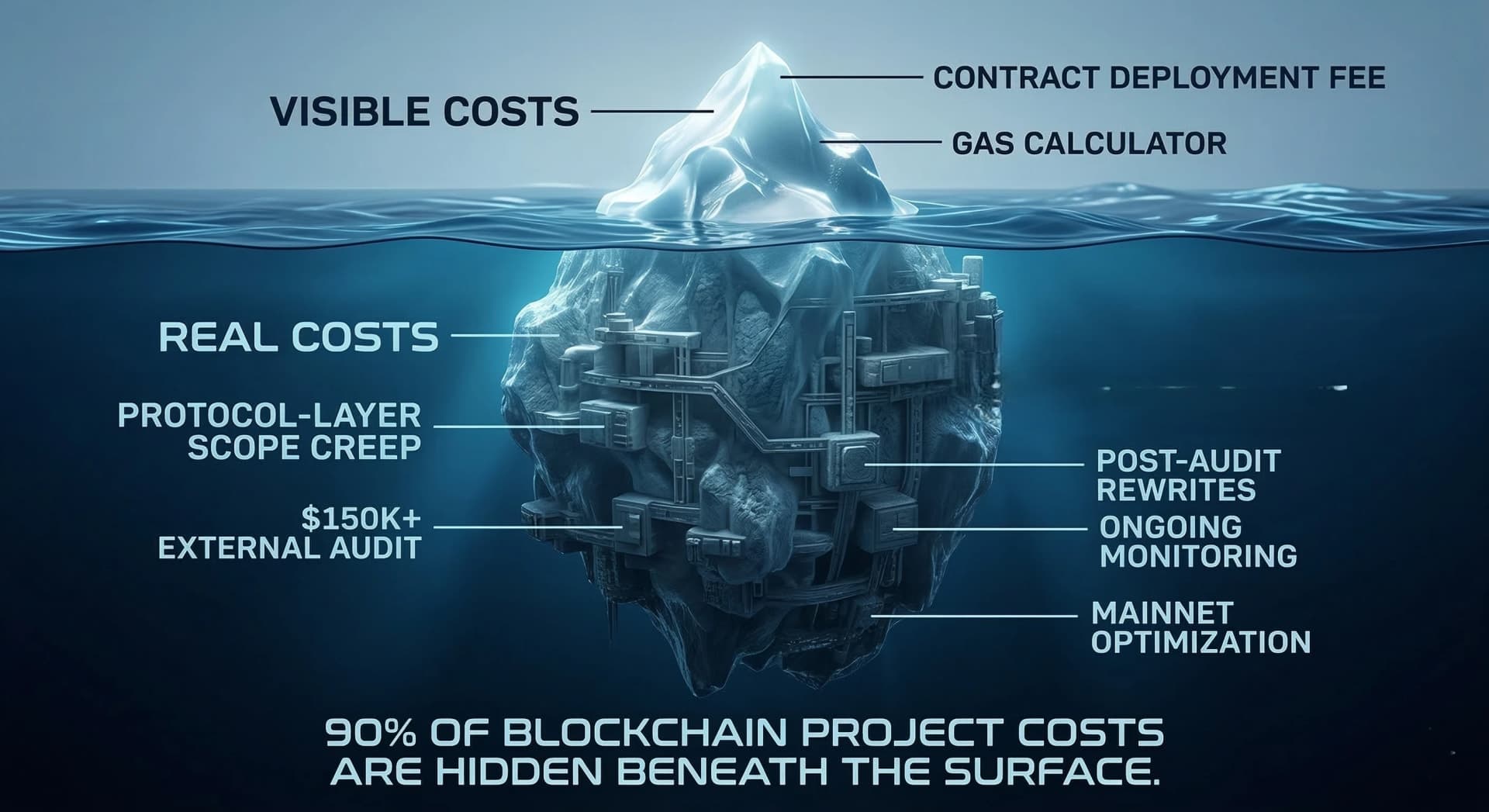
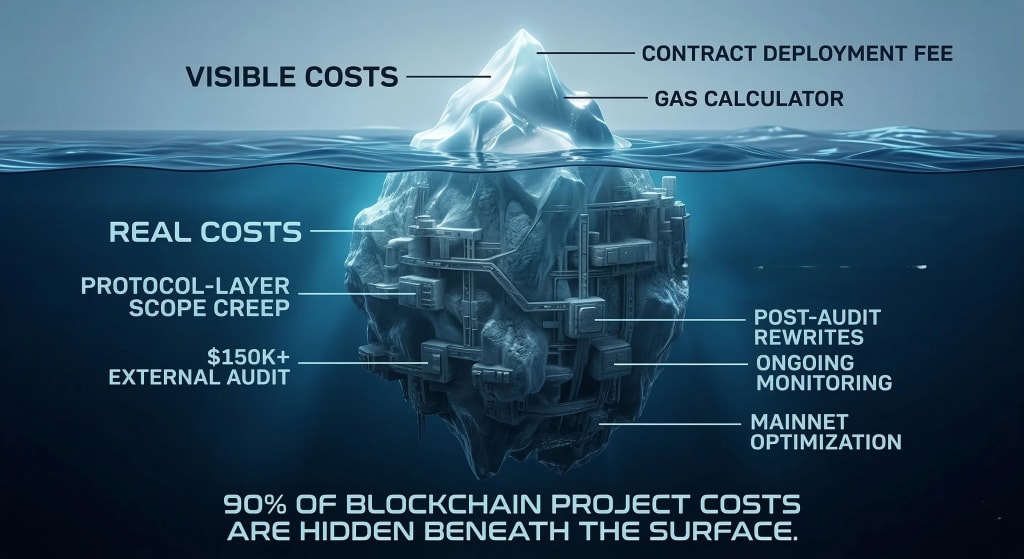
Most cost estimates for blockchain development are wrong not because the people writing them are careless, but because the visible costs are only a fraction of what building and securing a production system actually requires.
The contract deployment fee is visible. The gas cost calculator is easy to find. What does not show up in early estimates is the cost of the audit that finds a critical vulnerability two weeks before launch, the rewrite that follows, the ongoing monitoring infrastructure, and the engineering time to keep pace with a blockchain technology ecosystem that moves faster than almost any other in software.
This blog is an attempt to map the real cost landscape, not to discourage teams from building, but to help them plan honestly.
Why Blockchain Development Cost Estimates Almost Always Run Over
Blockchain programming operates in an environment that punishes underestimation more severely than traditional software development does. In conventional software, a bug can be patched. In smart contract development, a bug in a deployed contract is often permanent or the fix requires a migration that costs more than the original build.
The reasons estimates run over fall into a few consistent patterns:
- Scope creep at the protocol layer — teams start with a simple use case and discover mid-build that the blockchain they chose does not natively support what they need
- Security requirements land late — audits are often treated as a final step rather than a continuous process, and audit findings require development work that was never budgeted
- Integration complexity is underestimated — connecting smart contracts to frontends, oracles, indexers, and existing systems takes significantly longer than the contract work itself
- Testnet behavior does not predict mainnet costs — gas prices, transaction ordering and MEV behavior on mainnet introduce edge cases that testnet never surfaces
A blockchain developer who has shipped production systems will tell you that the gap between "it works on testnet" and "it works safely on mainnet" is where most of the real cost lives.
The Actual Components of a Blockchain Build: What You're Really Paying For
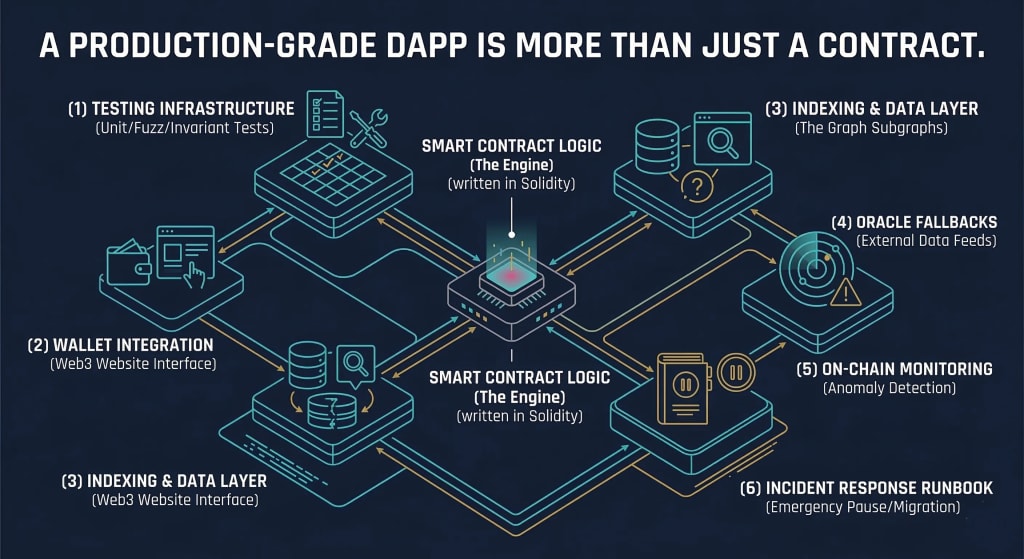
Before pricing anything, it helps to understand what a complete blockchain app development project actually consists of. Most people see the smart contract as the product. It is closer to the engine, necessary but not sufficient, and surrounded by infrastructure that costs as much or more.
A complete production dApp development build typically includes:
- Smart contract architecture and development — the core logic, written in Solidity programming or equivalent, including access controls, upgrade patterns, and state management
- Testing infrastructure — unit tests, integration tests, invariant tests, and fuzz testing. Skimping here is how you arrive at audit findings that require full rewrites
- Frontend and wallet integration — the web3 website or application interface, wallet connection, transaction state management, and error handling that users actually interact with
- Indexing and data layer — subgraphs or custom indexers that make blockchain data queryable at the speed a frontend needs
- Oracle integration — if the contract needs external data, the oracle setup, monitoring, and fallback logic is its own engineering surface
- Deployment and verification — contract deployment scripts, on-chain verification, and the operational runbooks for doing this safely
- Monitoring and incident response — on-chain monitoring for anomalous behavior, alerting systems, and documented response procedures
Each of these is a real engineering cost. The projects that budget only for the smart contract and the frontend are the ones that scramble for budget when everything else surfaces.
If you're scoping a full build and want a structured breakdown, our Blockchain Development Services outlines what's included in production-grade engagements and where the complexity typically concentrates. Get a free consultation and get started today.
Smart Contracts Explained: Why The Security Costs What It Does
The reason smart contract development carries such significant security costs is architectural. Once a contract is deployed to a public blockchain, it is executable by anyone, its code is visible to everyone, and its vulnerabilities are permanent until a migration is executed, if a migration is even possible given the contract's design.
This combination of public code, public executability, irreversible state means that adversarial analysis is not optional. Every serious smart contracts explained resource makes this point: the threat model for a deployed contract is not "someone might find a bug." It is "someone is actively looking for a bug, has unlimited time, and will be financially rewarded if they find one."
Security costs in smart contract development include:
- Internal security review — before any external audit, a serious team conducts their own adversarial review. This is typically a senior blockchain engineer's time, not a junior developer's.
- External audit — reputable audit firms charge between $15,000 and $150,000+ depending on contract complexity and scope. Projects with significant TVL (total value locked) should expect to pay at the higher end and engage more than one firm.
- Formal verification — for the highest-stakes contracts, formal verification tools like Certora or Halmos provide mathematical proof of correctness for specific properties. This is expensive and time-consuming but is increasingly standard for protocols managing significant assets.
- Bug bounty programs — post-launch, a continuous bug bounty signals to the community that the team takes security seriously and provides ongoing adversarial review at a cost that scales with findings rather than time.
The teams that treat audit as a checkbox rather than a genuine engineering process tend to be the ones in post-mortems explaining what went wrong while teams that take it seriously often bring in experienced smart contract audit services through firms like EthElite early enough for findings to influence engineering decisions.

Learning Blockchain Development: The Hidden Cost of Skill Gaps
Learning blockchain is not simply learning a new framework, it requires understanding a different execution model, a different threat landscape, and a different relationship between code and state than most software engineers have encountered.
The cost of skill gaps shows up in three ways on real projects:
- work from incorrect assumptions — a web3 developer who brings web2 security assumptions to blockchain coding will write contracts that look correct but have subtle vulnerabilities. Reentrancy, front-running susceptibility, improper access control, these are not obvious to engineers encountering blockchain programming for the first time.
- Slow velocity on unfamiliar tooling — Solidity programming, Hardhat, Foundry, ethers.js, The Graph, the web 3.0 technology stack has its own idioms and its own failure modes. Teams assembling for a first blockchain development project should budget for a learning curve that extends well into the build.
- Audit findings that require architectural changes — when the engineer learning blockchain makes structural decisions early in the project that an auditor flags as problematic, the fix is rarely a small patch. It is often a design change that cascades through the entire codebase.
The mitigation is straightforward but costly: engage experienced blockchain developer talent from the start of architecture, not from the start of implementation. Decisions made in the first two weeks of a project are the ones that determine whether the audit is a polish pass or a rebuild.
Gas Costs and On-Chain Economics: The Operating Costs Nobody Budgets For
Every blockchain developer understands gas costs in theory. Fewer build them into total cost of ownership estimates in practice and the gap between theory and practice is where production budgets quietly blow up.
Gas costs on blockchain systems are not fixed, not predictable over long time horizons, and not uniformly distributed across contract operations. A few realities worth internalizing:
- Deployment is a one-time cost, but interaction is ongoing. If your contract requires users to call multiple functions to complete a workflow, each call costs gas. At scale, this either costs your users money (and drives them away) or costs your protocol money if you're subsidizing it.
- Storage is the most expensive operation. Writing new data to blockchain state costs significantly more than reading it or updating existing slots. Contract architectures that minimize storage writes through careful data packing, off-chain storage with on-chain commitments, and calldata optimization can reduce ongoing costs by meaningful percentages.
- L2 deployment changes but doesn't eliminate the calculus. Deploying on Layer 2 networks reduces transaction costs substantially, but introduces bridge costs, different sequencer behaviors, and occasionally different security assumptions that have their own engineering implications.
The teams doing web3 development at scale build gas cost modeling into their architecture reviews from day one, not as an afterthought when users complain about transaction costs. Consult with EthElite’s blockchain experts to get started.
The Cost of Choosing the Wrong Blockchain Development Partner
Most blockchain development companies can write smart contracts. Fewer have the depth to catch the security issues that surface under adversarial conditions, architect systems that remain maintainable as requirements evolve, or provide the post-launch support that production systems require.
The cost of choosing wrong here is not just the wasted engagement fee, it is the cost of fixing what was built incorrectly, often under time pressure and with a launch already announced.
What separates strong blockchain development services providers from the rest:
- Security-first development process — security review is embedded throughout the build, not added at the end
- Protocol-specific experience — a team that has deployed on your target chain understands its quirks, its tooling, and its failure modes in ways that generalists do not
- Audit relationships — established relationships with reputable audit firms matter when audit slots are scarce and launch timelines are fixed
- Post-launch capability — monitoring, incident response, and upgrade management are operational capabilities that many pure development shops do not offer
For teams evaluating partners, the right question is not "can you build this?" It is "what has broken in systems you've built before, and how did you handle it?" The answer to that question tells you more about a blockchain development partner than their portfolio does.
Our Blockchain Consulting services covers the specific questions worth asking during a partner selection process.
Ongoing Maintenance: The Cost That Continues After Launch
Blockchain app development projects do not end at deployment. The ongoing maintenance cost of a production web3 system is real and frequently underestimated.
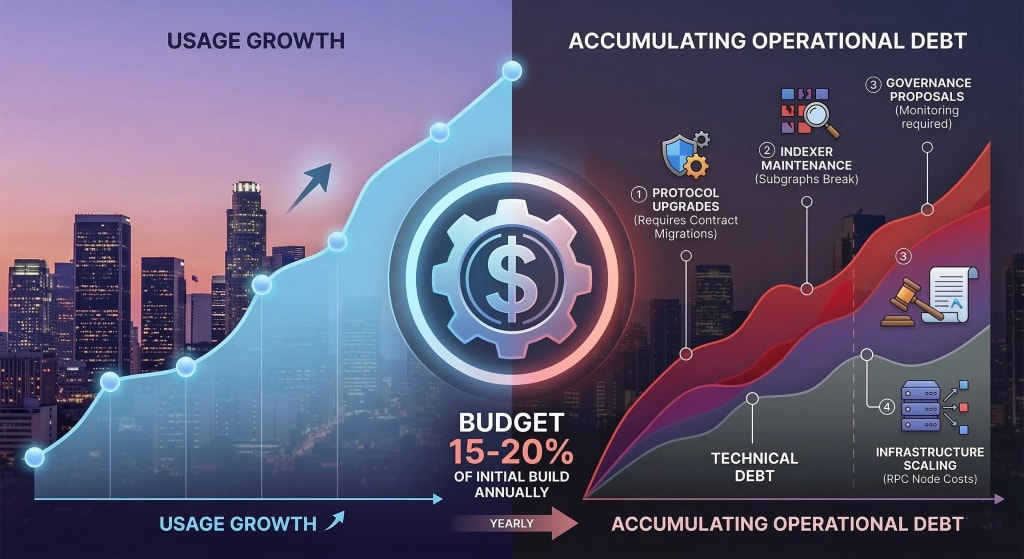
The web 3 technology ecosystem evolves quickly. Dependencies change, networks upgrade, tooling deprecates. A contract that was optimally written for the current version of a protocol may need updates when that protocol upgrades. An indexer that worked correctly against one version of a subgraph schema may break when the underlying blockchain changes its event structure.
Ongoing costs to budget for:
- Dependency monitoring and updates — keeping libraries, oracles, and protocol integrations current
- On-chain monitoring — continuous surveillance for anomalous transaction patterns, unusual gas consumption, or unexpected contract state changes
- Governance participation — if the system uses smart contracts governed by token holders, someone needs to monitor proposals, assess their impact, and ensure the team's position is represented
- Infrastructure costs — RPC nodes, indexing infrastructure, monitoring services, and the frontend hosting for a web3 website all carry ongoing costs that scale with usage
A reasonable rule of thumb for production blockchain systems: budget 15–20% of the initial build cost annually for maintenance and monitoring. Less than that, and you are likely either under-monitoring or accumulating technical debt.
Frequently Asked Questions
Q: How much does blockchain development typically cost?
A: It varies enormously by scope and chain, but a complete production dApp development project, including smart contracts, frontend, indexing, audit, and deployment can typically run from $80,000 to $500,000+.
Q: Why is smart contract security so expensive?
A: Because the threat model is uniquely severe. Smart contracts on a public blockchain are visible to everyone, executable by anyone and permanent once deployed. Adversarial review - internal, external audit and ongoing bug bounty is not optional for systems managing real value. The cost of an audit is typically a small fraction of what a successful exploit costs.
Q: What does a blockchain developer need to know that a traditional developer doesn't?
A: A blockchain engineer needs to internalize a different execution model (deterministic, gas-constrained, publicly visible), a different threat landscape (adversarial actors with financial incentives), and the specific idioms of blockchain coding in languages like Solidity. The mental models from web2 development transfer partially but not completely.
Q: Is deploying on Layer 2 significantly cheaper?
A: Yes, transaction costs are substantially lower. But L2 web3 development introduces its own complexity like bridge security, sequencer behavior, finality assumptions, and occasionally different toolchain support. It is cheaper to operate, not simpler to build.
Q: How do I evaluate blockchain development companies?
A: Look for protocol-specific experience on your target chain, a security-first development process, established relationships with reputable auditors, and evidence of post-launch support capability. Ask specifically about what has gone wrong in previous engagements and how they responded, that answer is more informative than any portfolio.
Q: What ongoing costs should I budget for after launch?
A: Budget 15–20% of initial build cost annually for monitoring, dependency management, governance participation, infrastructure, and periodic security reviews. Blockchain app development projects that go dark after launch tend to accumulate technical debt and security exposure quietly.
Conclusion
The real costs of blockchain development are not hidden; they are just spread across more categories than most initial estimates account for. Security is not a line item at the end of the build; it is a continuous investment that begins at architecture and continues after launch. Skill gaps in blockchain programming and Solidity programming compound early and cost late. Gas economics and on-chain operating costs are a function of architectural decisions, not just network conditions.
None of this means blockchain app development is prohibitively expensive. It means the teams that budget honestly, invest in security continuously and choose partners with genuine depth are the ones that ship systems that hold up often by working with technically mature providers such as EthElite when deeper protocol expertise is needed. The ones that treat smart contract development as cheaper than it is tend to find out what it actually costs at the worst possible moment.
Web 3 development done right may be expensive. Done wrong, it costs more.
Share with your community!