Loading blog post...


Twitter/X, Telegram, Discord: Which Platforms Matter Most for Web3 Projects
Web3 projects often overspread themselves across too many social platforms, resulting in mediocre communities. This article breaks down the unique strategic functions of the big three: Twitter/X (credibility), Telegram (real-time chat), and Discord (structured ecosystem) and maps out which specific combination best fits different project types, from technical DeFi protocols to mainstream-facing ventures.
Every web3 project eventually asks the same question: where should we actually be? The instinct is to say everywhere - Twitter, Telegram, Discord, Farcaster, Reddit, YouTube. The reality is that being present on every platform without genuine strategy produces mediocre results on all of them while spreading the team too thin to do any of them well.
The three platforms that matter most for most crypto projects at present are Twitter/X, Telegram, and Discord. Each serves a genuinely different function. Understanding what each one is actually for and which combination fits which type of project is more useful than any growth hack.
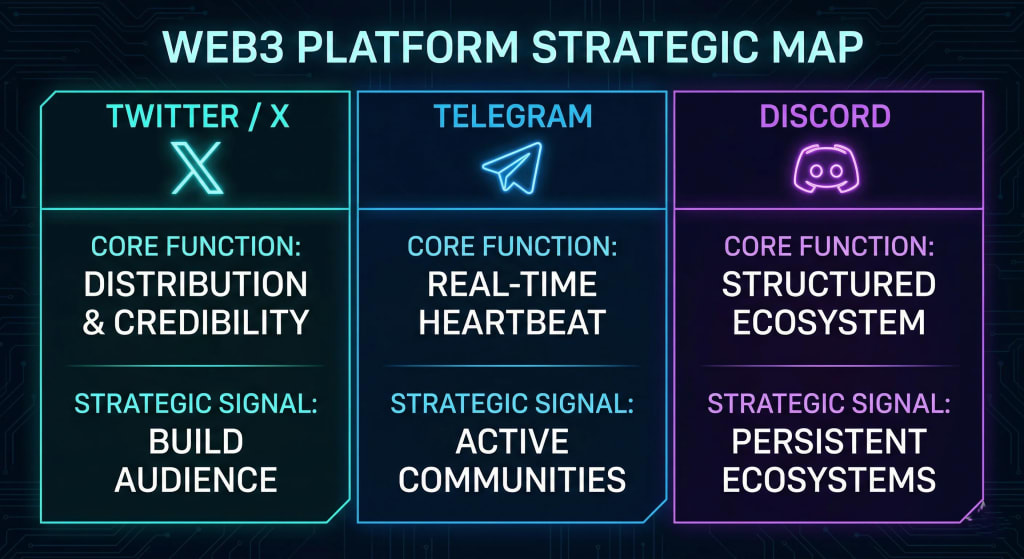
Why Platform Choice Is a Strategic Decision, Not a Tactical One
The platform a blockchain project centres its community on shapes what kind of community it builds. Twitter builds audiences. Telegram builds real-time communities. Discord builds structured, persistent ecosystems.
These are not the same thing, and conflating them produces communities that feel off. Too formal where they should be casual, too noisy where they should be organised, too passive where they should be interactive.
The choice also signals something to the outside world. A crypto project with a thriving Discord and a thin Twitter presence reads differently to investors and partners than one with strong Twitter momentum and an active Telegram. Neither is universally better. But the combination should be deliberate.
Twitter/X: Where Crypto Community Lives and Dies
For the crypto community, Twitter/X is still the town square. It is where new crypto projects announce launches, where researchers share findings, where debates happen in public, and where the industry's collective attention gets directed each morning.
The practical function of Twitter for web3 projects is distribution and credibility. A project that can build a genuine following on Twitter has proven it can communicate ideas clearly and that people find those ideas worth sharing. That is a meaningful signal to investors, partners and potential community members evaluating whether to pay attention.
What works on Twitter for blockchain projects:
- Founder-led accounts often outperform brand accounts. People follow people. A founder who shares genuine perspective, technical insight, and honest updates builds trust faster than a polished brand account posting announcement graphics. The most effective crypto community builders on Twitter are individuals, not logos.
- Specificity beats enthusiasm. "We are building the future of DeFi" competes with thousands of identical statements. "Here is a specific thing we learned about AMM mechanics this week and why it surprised us" is a reason to follow someone.
- Engagement is not optional. Twitter rewards accounts that participate in conversations, not just broadcast. Responding to relevant threads, sharing and commenting on others' work, and being present in the discourse around the project's subject area builds presence faster than any posting frequency.
The honest limitation: Twitter is a high-noise environment where organic reach is increasingly difficult without an existing audience or paid amplification. For crypto projects in early stages, Twitter should be treated as a credibility layer and a distribution channel for content that lives elsewhere, not as the primary community infrastructure.
Telegram: The Real-Time Heartbeat of Crypto Communities
Telegram is where the crypto community actually lives day to day. For most blockchain projects and DeFi projects, Telegram is the first community channel launched and the one that sees the most daily activity throughout the project's life.
The reason is simple: Telegram online is always accessible, always real-time and the format of group chat matches how crypto communities naturally want to interact. Announcements, questions, debate, memes, market reactions, all of it flows through telegram crypto groups in a way that no other platform has replicated at the same adoption level.
What makes the difference between a telegram crypto group that builds genuine community and one that stagnates:
- Moderation is the product. The experience of being in a Telegram group is shaped almost entirely by what the moderators allow to stay and what they remove. Spam, scam links, unprompted price predictions, and off-topic noise left unaddressed drive away exactly the people worth having - thoughtful participants who have limited tolerance for a chaotic feed.
- Founder presence changes everything. A Telegram group where the founder appears regularly, answers questions directly, and treats community members as partners rather than an audience builds loyalty that no amount of marketing budget can replicate. A group that is managed entirely by moderators with no visible team presence feels hollow regardless of activity level.
- Announcement channels alongside community groups. For web3 projects with significant announcement volume, separating an announcement-only channel (one-way, no replies) from the community discussion group keeps important information findable without burying it in conversation.
The limitation of Telegram: conversations disappear into scroll. Information shared in a telegram crypto group is effectively ephemeral - searchable in principle, impossible to navigate in practice. For content that needs to be persistent and organised, Discord is the better home.
Discord: Structured Community for Technical Projects
Discord servers serve a fundamentally different function from Telegram. Where Telegram is a single river of real-time conversation, Discord is a building with multiple rooms, each with a specific purpose, where conversations can happen in parallel without one drowning out another.
This structure makes Discord the better home for blockchain projects with complex technical communities, multiple product areas or audiences with genuinely different needs.
A well-designed Discord for a crypto project might include dedicated channels for protocol discussion, developer questions, governance proposals, regional communities in different languages, and separate spaces for holders versus contributors. Each conversation happens in its appropriate context rather than competing for space in a single feed.
What makes discord servers work for web3 projects:
- Channel architecture matters more than most teams realise. Too few channels and everything becomes noise. Too many channels and nothing has activity. The right structure depends on where members actually want to talk which means observing where conversation organically concentrates in the early days and designing around that.
- Roles and permissions create belonging. Discord's role system allows projects to give different members different access based on their level of engagement, token holdings, or contribution. Members with a "contributor" or "validator" role feel differently about the community than members who are just "user." That feeling is real and affects retention.
- Bots can automate but not replace. Discord bots can handle welcome messages, role assignments, token gating, and moderation assistance. They are infrastructure, not community. Projects that rely heavily on bots for community feel produce a community that feels automated because it is.
The honest limitation of Discord: it has a steeper learning curve than Telegram, particularly for users newer to crypto. For new crypto projects targeting audiences outside the existing crypto ecosystem, Discord as the primary community channel creates unnecessary friction. Telegram's simpler interface removes a barrier that Discord adds.
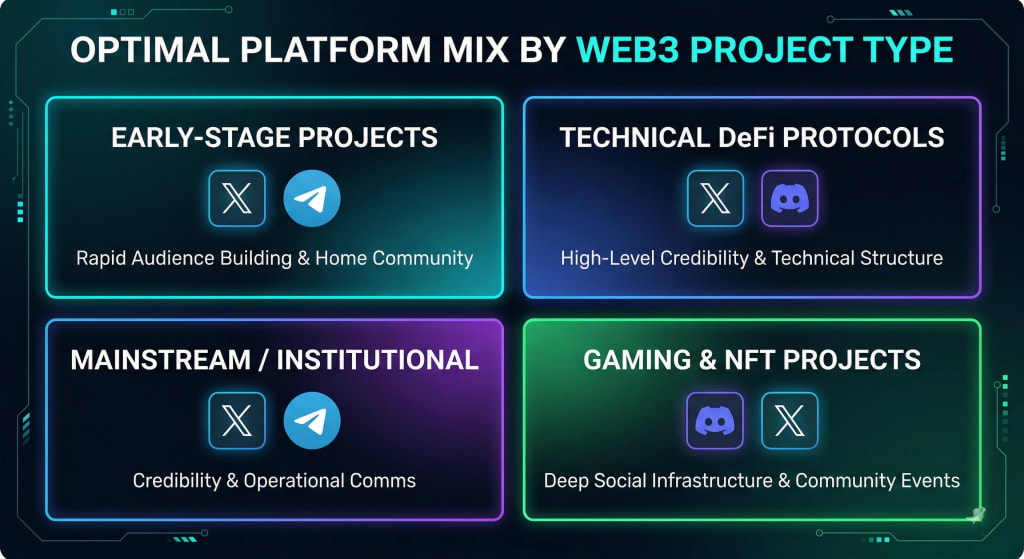
Which Combination Fits Which Type of Project
No single platform is right for every crypto project. The right combination depends on who the community is, what they want to do together, and what the team has capacity to manage well.
- For early-stage projects with limited team bandwidth: Twitter for distribution and credibility, Telegram as the community home. These two cover 80% of what most new crypto projects need in the first six to twelve months. Add Discord when the community has enough volume and diversity to justify the structural overhead.
- For DeFi protocols with technical communities: Twitter plus Discord. The technical depth of DeFi discussion benefits from Discord's structure. Developer documentation, governance discussion, and protocol mechanics all live better in organised Discord channels than in a Telegram feed. Telegram can serve as a lighter-touch announcement and discussion channel.
- For gaming and NFT projects: Discord is often the primary community home, because gaming communities have already adopted Discord as their native platform. The social infrastructure - voice channels, events, role-based access to game features fits Discord's capabilities better than any alternative.
- For projects targeting mainstream or institutional audiences: Twitter is the primary credibility layer, with Telegram serving operational community needs. These audiences are less likely to adopt Discord and more likely to evaluate a project's legitimacy through its Twitter presence and the quality of its public communication.
For projects that want this handled well, EthElite offers Web3 social media management built around platform fit, clear communication, and sustainable community growth. Connect today to get the first consultation for free.
The Cross-Platform Mistake That Kills Engagement
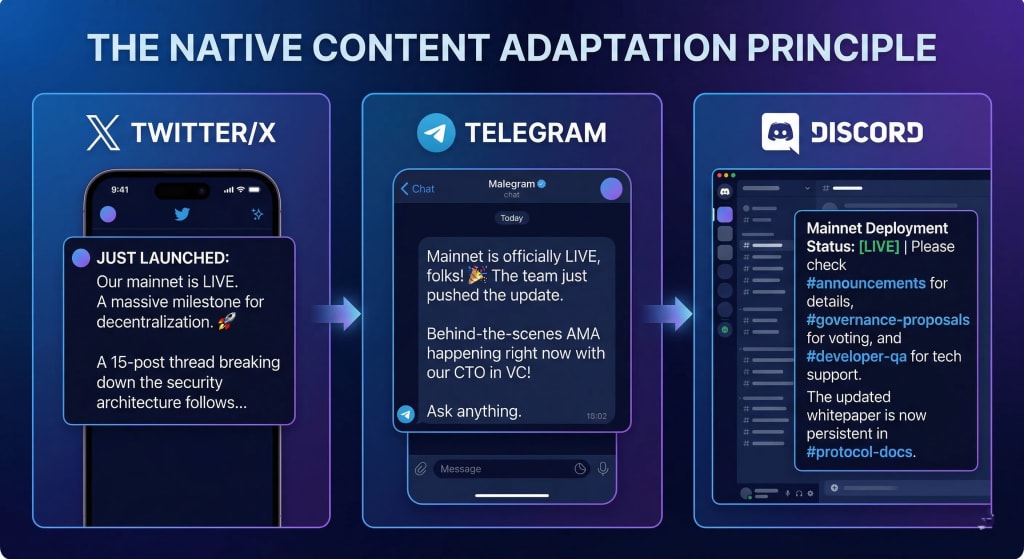
The most common platform mistake crypto projects make is treating all three platforms as identical distribution channels by posting the same content in the same format across Twitter, Telegram and Discord simultaneously.
This fails for reasons that are obvious in retrospect. Each platform has different context, different norms, and different audiences expecting different things. A Twitter thread posted verbatim into a Telegram group feels lazy. A Telegram announcement copy-pasted into Discord channels with no formatting adaptation gets ignored. A Discord governance discussion summarised into a tweet without any translation for the public audience confuses people who have no context.
Content should be native to the platform it lives on:
- Twitter gets punchy, self-contained observations, threads that work as standalone arguments, and announcements framed for people encountering the project for the first time
- Telegram gets real-time updates, behind-the-scenes moments, and the kind of direct team communication that builds relationship rather than broadcasting information
- Discord gets structured, persistent content - governance proposals, technical documentation, organised discussion threads that benefit from Discord's searchability and channel structure
The team capacity to do this well is a constraint that should be planned around honestly. Three platforms done natively requires more bandwidth than most early-stage blockchain projects have. Starting with two and doing them well produces better community outcomes than three done poorly.
Emerging Platforms Worth Watching for Crypto Social Media
Crypto social media is not static. Several platforms have gained meaningful traction among web3 projects and crypto-native audiences and are worth understanding even if they are not yet primary community infrastructure.
- Farcaster is a decentralised social protocol with a growing native crypto audience. Its users skew toward builders and researchers, the exact audience that influences whether a blockchain project is taken seriously in technical circles. Early presence on Farcaster reaches a concentrated, influential audience that has largely migrated away from Twitter.
- Lens Protocol pursues a similar goal with a different technical architecture - social graph ownership on-chain. For web3 projects whose values include user data sovereignty and decentralised infrastructure, building on Lens is consistent with those values in a way that building exclusively on centralised platforms is not.
- YouTube and long-form video serve a different function from real-time community platforms, they are where educational content lives for audiences who want depth rather than brevity. For crypto projects with complex technical products, a YouTube channel producing genuinely educational content builds credibility with audiences that Discord and Telegram never reach.
None of these replace Twitter, Telegram, or Discord as primary community infrastructure for most crypto projects today. They extend reach into specific audience segments that the core three do not cover well.
Frequently Asked Questions
Q: Which platform is most important for a new crypto project?
A: It depends on the project type and audience. For most new crypto projects, Twitter and Telegram together cover the essential functions like public credibility and real-time community. Discord becomes more important as the community grows and develops enough diversity and volume to benefit from structured channels.
Q: How do telegram crypto groups differ from Discord servers?
A: Telegram is a single real-time chat stream - immediate, accessible, and informal. Discord servers are structured buildings with multiple channels for different conversations. Telegram works better for unified real-time community; Discord works better for complex communities with multiple distinct interests and audiences.
Q: Should crypto projects be on Farcaster and Lens?
A: For web3 projects targeting crypto-native builders and researchers, early presence on Farcaster in particular reaches a concentrated influential audience. Neither replaces the core three platforms yet, but both are worth monitoring and participating in for projects whose values align with decentralised social infrastructure.
Q: How much team bandwidth does managing three platforms require?
A: More than most early-stage crypto projects have. Three platforms done natively and at quality requires dedicated community management and not founder time split with product and fundraising.
Conclusion
The platform question for web3 projects is not which one is best, it is which combination serves the specific community being built, managed at the quality level the team can actually sustain.
Twitter builds public credibility and distributes ideas. Telegram builds real-time community and keeps people connected day to day. Discord structures complex communities and creates persistent, organised spaces for different kinds of conversation.
Most blockchain projects need some version of all three eventually. The mistake is treating them as interchangeable rather than complementary or trying to run all of them at full quality before the team has the bandwidth to do any of them well.
For teams that need that executed consistently, EthElite has a dedicated team doing social media management across Web3 channels, aligning platform strategy with community stage and communication goals.
Start with the platform that matches the audience and the team's capacity. Build it to genuine quality. Add the next one when the first is working. That sequencing produces communities that compound rather than communities that sprawl.
Share with your community!