Loading blog post...


Multi-Chain Liquidity Strategy: How to Concentrate Depth Across Chains Without Fragmentation
Spreading liquidity across multiple chains without a plan doesn't multiply your reach; it divides your depth. For token teams, this results in high slippage, poor user experience, and value being drained by arbitrageurs. This blog explores how to move past reactive expansion and instead utilize frameworks like shared liquidity layers and canonical routing to concentrate depth across chains, turning multi-chain presence into a true competitive advantage.
Expanding to multiple chains feels like a growth move. More chains mean more users, more ecosystems, more surface area. What teams discover after doing it is that spreading liquidity across chains without a strategy does not multiply reach, it divides depth.
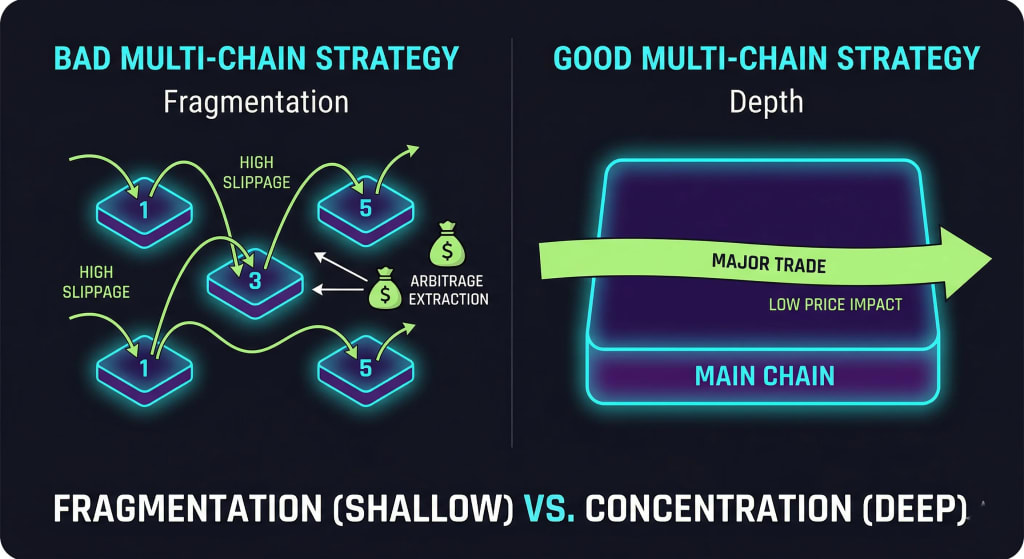
A token trading across five chains with shallow pools on each is worse than the same token with one deep pool on a single chain. Price impact is higher, arbitrage is cheaper, and the user experience on every chain is mediocre. Multi-chain liquidity done poorly produces the appearance of expansion with the economics of fragmentation.
Done well, it is a genuine competitive advantage. This blog is about the difference.
Why Liquidity Depth Matters More Than Liquidity Presence
When someone trades against a liquidity pool, the price moves in proportion to the trade size relative to the pool's total depth. A large pool absorbs large trades with minimal price impact. A shallow pool gets moved by modest ones.
This compounds in ways that matter:
- Traders avoid shallow pools because slippage eats their returns
- Arbitrageurs exploit price gaps between thin pools cheaply, extracting value from liquidity providers
- Institutional participants require depth as a prerequisite, they will not trade in markets where their order size visibly moves the price
The implication for multichain deployments is direct. The goal is not to be present on every chain, it is to be meaningfully deep on the chains that matter.
Map Where Your Liquidity Actually Lives Before Adding More
The first step in any serious multi-chain liquidity strategy is understanding the current picture honestly. Most teams have a rougher view of this than they realise, liquidity gets deployed reactively, and the aggregate picture never gets assessed.
A basic audit should cover: total liquidity by chain and pool, volume and fee generation per pool, price impact at standard trade sizes, and who is providing liquidity and why.
This almost always reveals the same pattern: 80% of meaningful volume is happening in 20% of the pools. The rest exist but contribute little. That concentration is not a problem, it is a signal about where capital is actually working.
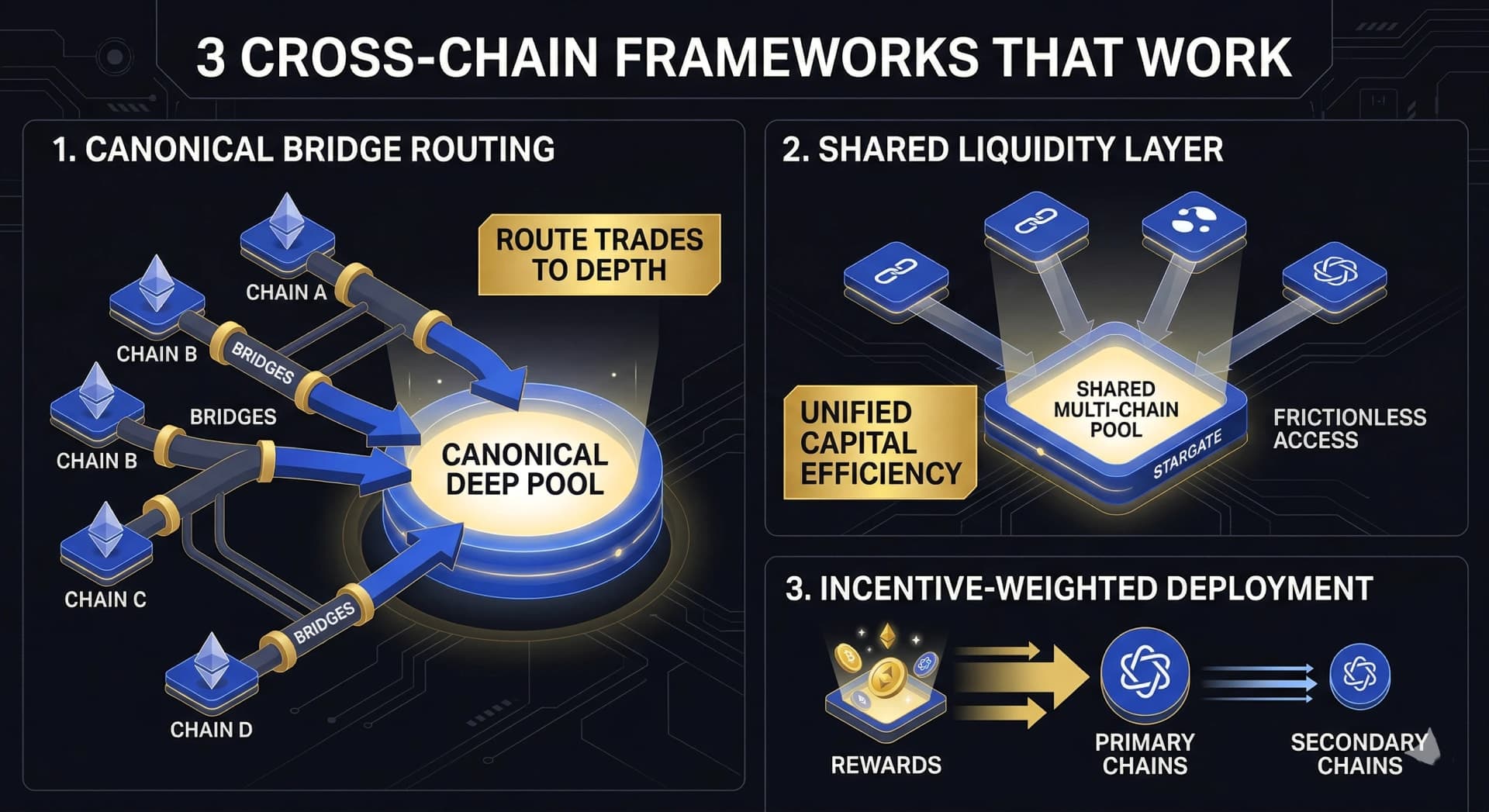
Cross-Chain Liquidity: Three Frameworks That Actually Work
The core tension in cross chain liquidity design is coverage versus concentration. Every unit deployed on a new chain is a unit removed from existing pools unless new capital fills the gap.
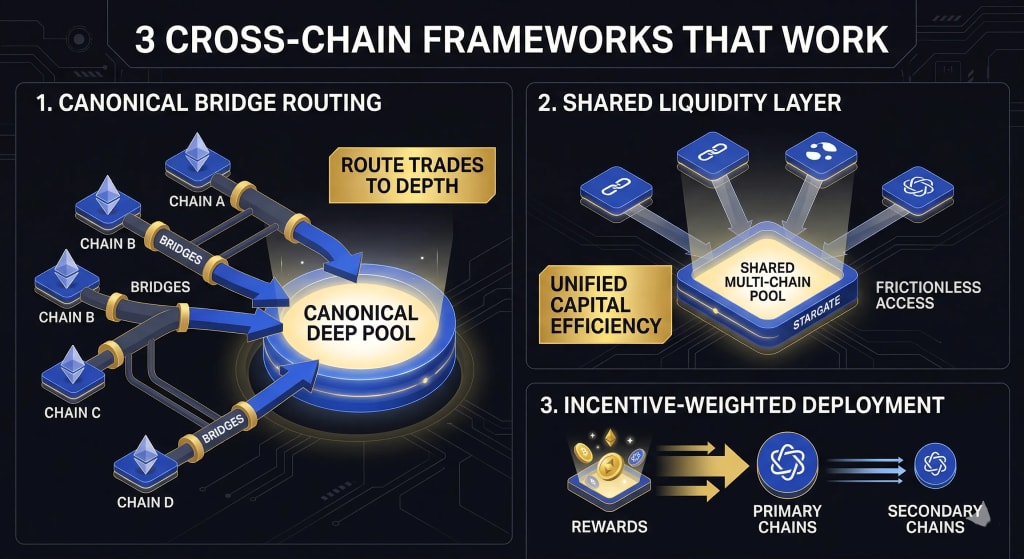
- Canonical chain with bridge routing. Concentrate the deepest liquidity pool where volume and ecosystem activity are highest. Route large trades from secondary chains to the canonical pool through bridges rather than maintaining independent deep liquidity everywhere. Users get execution quality from one deep pool; the protocol does not split its capital trying to be deep in five places.
- Tiered chain strategy. Explicitly classify chains: primary chains where liquidity is actively managed and incentivised, secondary chains where thin presence serves awareness without significant capital, and monitored chains being tracked before any commitment. This prevents the reactive sprawl where liquidity spreads across an ever-growing chain list with no strategic logic.
- Incentive-weighted deployment. Instead of distributing liquidity mining rewards evenly, concentrate them where depth-to-volume ratios are most efficient. A chain generating 40% of volume with 15% of incentive allocation is working well. A chain generating 2% of volume with 10% of allocation is a drain. Good multichain liquidity strategy adjusts these weights based on actual data, not historical inertia.
If your team is building infrastructure for a multi-chain liquidity deployment, our Blockchain Development Services covers cross-chain architecture and liquidity management contract design.
The Technical Architecture Options for Multichain Liquidity Pools
How multichain liquidity pools are technically structured determines how fragmentation gets managed.
- Independent pools per chain is the simplest model with each chain has its own pool, its own liquidity providers, its own price. Arbitrage keeps prices aligned across chains but at the cost of extracting value from LPs. Easy to deploy, difficult to manage well at scale.
- Shared liquidity layers are the more sophisticated approach. Protocols like Stargate implement unified pools servicing multiple chains simultaneously. When a user bridges tokens, they draw from shared depth rather than a chain-specific pool. Fragmentation is reduced at the architecture level rather than managed after the fact.
- Concentrated liquidity with active management: Uniswap v3-style ranges offer significant capital efficiency gains but require active position management. Across a multichain deployment this means automated vault strategies or active management agents on every chain. The efficiency gains are real; so is the operational overhead.
Incentive Design That Attracts Sticky Liquidity, Not Tourists
Any multi-chain liquidity strategy lives or dies on incentive design. Get it wrong and you attract capital that exits when yields elsewhere tick up, leaving pools shallow when you need them most.
- Fee tiers should match volatility. High-volatility pairs face higher impermanent loss risk and need higher fees to compensate LPs. A low-fee pool for a volatile token produces thin depth because providing liquidity is unprofitable. Matching fee structure to actual volatility is unglamorous but important.
- Protocol-owned liquidity provides a permanent floor. Unlike rented liquidity from incentive programs, protocol-owned liquidity does not leave when token emissions change. Building a base layer of owned liquidity across priority chains means depth does not evaporate in bear markets.
- Longer incentive programs beat short bursts. Two-week liquidity mining attracts capital that plans to exit in two weeks. Longer programs with gradually declining rewards attract capital aligned with the full duration. For cross chain liquidity programs specifically, longer horizons with regular performance reviews produce more stable outcomes.
What to Monitor and When to Act
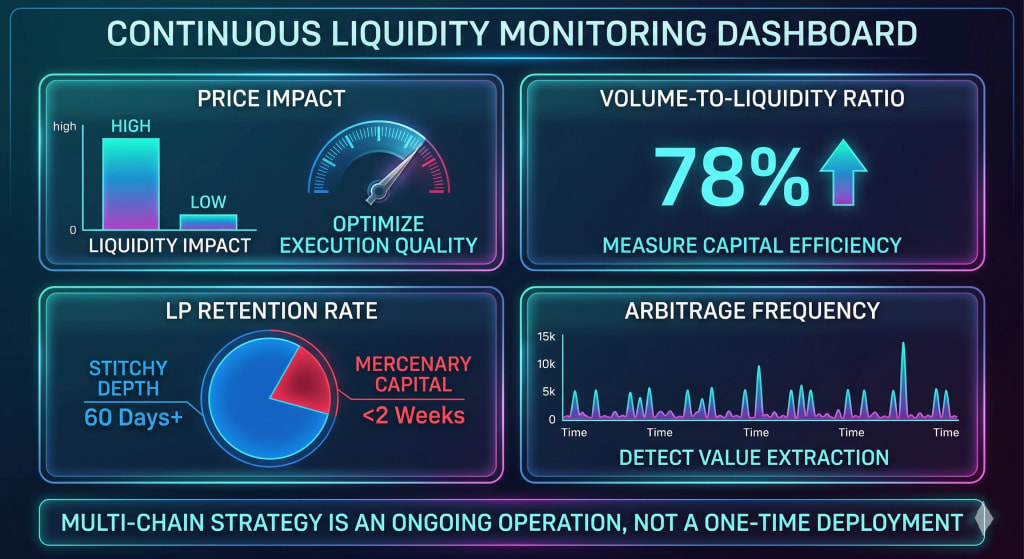
A multi-chain liquidity strategy is an ongoing operational function, not a one-time deployment. The metrics worth tracking continuously:
- Price impact at standard trade sizes — more useful than raw TVL because it reflects actual execution quality
- Volume-to-liquidity ratio by chain — high ratio means good capital efficiency; low ratio means the chain is over-capitalised relative to usage
- LP retention rate — what percentage of providers have been in the pool longer than 60 or 90 days? High churn means mercenary capital. Low churn means sticky depth.
- Cross-chain arbitrage frequency — frequent large arb trades between your pools signal price gaps costing your LPs and indicate where cross chain liquidity connections need tightening
Acting on this data means regularly rebalancing incentive allocation, deprecating pools that are not generating volume, and being willing to concentrate capital rather than defend every chain deployment out of inertia.
EthElite’s process covers the monitoring infrastructure and smart contract patterns for teams managing active liquidity programs. Connect today to get a free consultation.
Frequently Asked Questions
Q: What is multi-chain liquidity fragmentation?
A: When total liquidity is spread thinly across many chains instead of concentrated in deep pools on key chains, producing high price impact and poor execution everywhere.
Q: Why does liquidity pool depth matter more than presence?
A: Depth determines price impact. A shallow pool means high slippage for traders, cheap arbitrage for extractors, and avoidance by institutional participants. Presence without depth is accessibility without substance.
Q: What is protocol-owned liquidity?
A: Liquidity the protocol owns rather than rents from external providers. Unlike incentive-driven liquidity, it does not exit when rewards change, providing a permanent depth floor across multichain deployments.
Q: How should a protocol decide which chains to prioritise?
A: By measuring volume-to-liquidity ratios and price impact at standard trade sizes across all deployments. High volume with insufficient depth means add capital. High liquidity with low volume means reallocate.
Q: What technical models reduce cross-chain fragmentation?
A: Shared liquidity layers like Stargate's unified pool model, canonical chain strategies with bridge routing, and concentrated liquidity with automated management. Each involves trade-offs between capital efficiency, complexity, and bridge trust assumptions.
Conclusion
Multi-chain liquidity is not a deployment you make once. It is a strategy you manage continuously by adjusting incentives, rebalancing depth, monitoring arbitrage, and making explicit decisions about which chains deserve concentrated capital.
The teams that do this well treat their multichain liquidity pools as infrastructure requiring active management. They have clear chain prioritisation frameworks, metrics that reflect execution quality rather than TVL, and incentive designs that attract durable capital.
In practice, that also means building the surrounding execution layer correctly - bridge logic, routing assumptions, reward mechanics, and treasury controls all influence whether liquidity remains usable across networks, which is why EthElite usually approach liquidity architecture as part of protocol design rather than a post-launch add-on.
Cross chain liquidity fragmentation is the default outcome when expansion happens reactively. Depth concentration is the result of deliberate strategy. The difference shows in trading experience, LP profitability, and whether the protocol can sustain the liquidity it needs at scale.
Share with your community!