Loading blog post...


How Top Blockchain Development Companies Structure Their Engineering Teams
In the world of Web3, there is a version of blockchain development that looks like a regular software agency and then there is the version that actually works for production systems holding real assets. The difference isn't just talent; it’s organization. From why security must be embedded in every sprint to the specialized roles like Token Engineers and Protocol Architects, we pull back the curtain on how elite engineering teams are structured to handle the unique, high-stakes demands of public blockchain infrastructure.
There is a version of blockchain development that looks like a regular software agency, a project manager, some developers, a designer, ship it and done. And there is the version that actually works for production systems holding real assets: specialised, security-first, and built around the unique demands of public Web3 infrastructure.
The difference between top blockchain development companies and the rest is rarely talent in isolation. It is how teams are organised, what disciplines sit together, and whether security is part of the process or an afterthought.
Why Blockchain Teams Cannot Be Structured Like Regular Software Teams
Think about what makes smart contract development fundamentally different. Once a contract is deployed, the code is public, permanent, and holds real money. Anyone in the world can interact with it. There is no pushing a patch at midnight.
This single fact shapes everything. It is why best blockchain development companies invest in roles and processes that would look over-engineered to a conventional software team. It is not overhead, it is rather risk management dressed as engineering.
The Core Roles That Every Serious Team Carries
Every credible blockchain software development company has some version of the same core structure, even if titles vary.
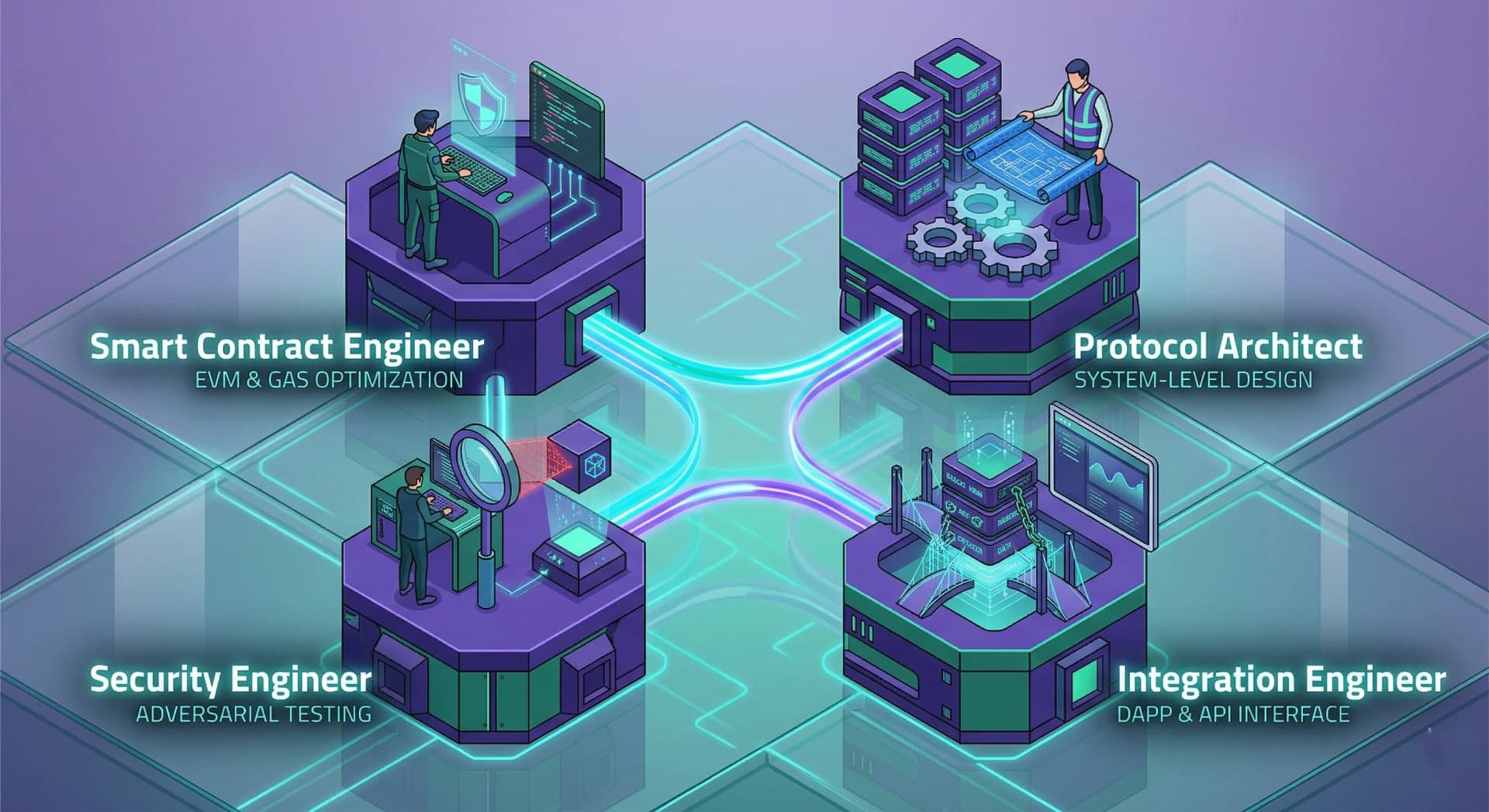
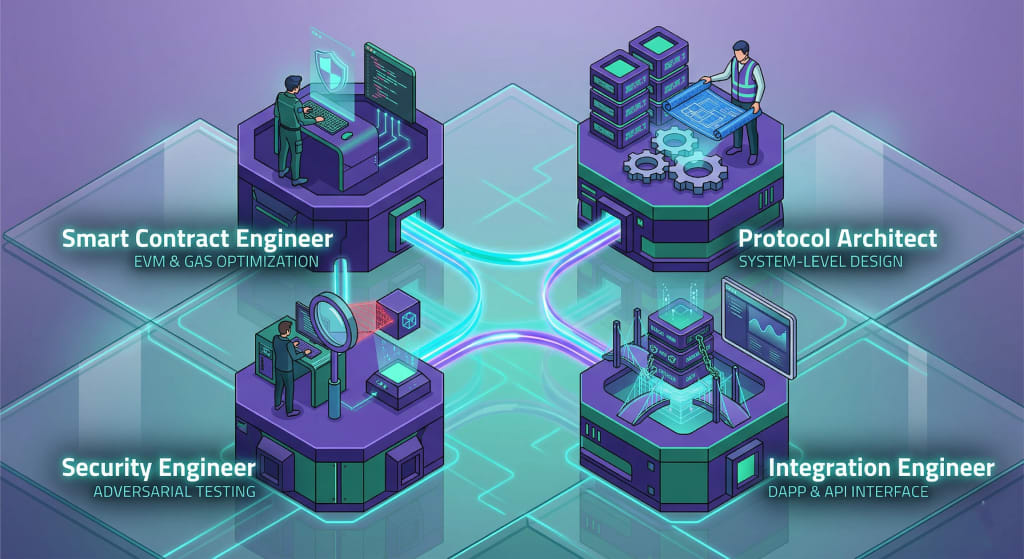
- Smart contract engineers are the centre of gravity — not regular backend developers who picked up Solidity, but engineers who understand the EVM execution model, gas optimisation, storage layout, and the attack vectors specific to on-chain systems. The best ones think like auditors while they write.
- Protocol architects handle system-level design — how contracts interact, what the upgrade path looks like, how tokenomics integrate with technical implementation. In smaller blockchain development companies this is the most senior smart contract engineer. In larger teams it is its own role.
- Security engineers should be dedicated, not shared. The most effective top blockchain development companies have people whose entire job is to break what the contract engineers built. A developer reviewing their own code has blind spots a dedicated reviewer does not.
- Integration engineers connect smart contracts to the rest of the product — frontends, APIs, indexers, oracles. This is where most dapp development services live. It requires understanding both the on-chain and off-chain worlds and translating fluently between them.
How Security Gets Embedded, Not Added at the End
Ask any blockchain development company about security and you will hear "we do audits." Ask the best blockchain development companies and you hear something more specific.
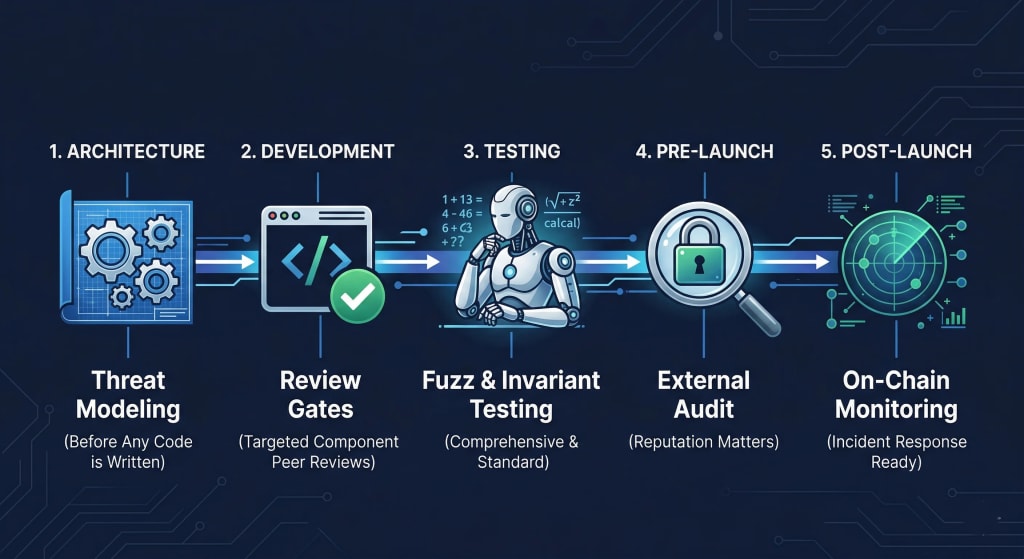
The process in well-structured teams looks like this:
- Threat modelling before any code is written — mapping the attack surface, trust assumptions, and privileged roles at architecture stage. This changes design decisions before they become expensive to fix.
- Review gates during development — code does not move to testing without a second set of eyes. Not a full audit, but a focused review of each component by someone other than the author.
- Fuzz and invariant testing as standard — not optional. Comprehensive testing infrastructure is a delivery requirement, not a nice-to-have.
- External audit before mainnet — serious smart contract development companies engage reputable firms early, sometimes during development, and respond thoroughly to every finding.
- On-chain monitoring post-launch — production systems need alerting infrastructure and documented incident response. Security does not end at deployment.
If you want to understand what a security-first process looks like across the full lifecycle, our Smart Contract Audit services does it in detail.
The Specialisations That Separate Good Teams From Great Ones
Core roles get a system built. Specialisation is what makes it worth trusting.
- DeFi specialists understand the mechanics of AMMs, lending protocols, and liquidation systems at a depth general blockchain development teams do not. DeFi development services done well requires knowing not just how to build these mechanisms but how they interact with the broader ecosystem and where they get exploited.
- Token engineers sit at the intersection of economics and code. Crypto token development services require understanding vesting mechanics, emission schedules, and governance integration, not just deploying an ERC-20. The gap between a technically correct token and a well-designed one is significant.
- Enterprise specialists handle permissioned chains, compliance integration, and connection to existing business systems. An enterprise blockchain development company building supply chain infrastructure is doing fundamentally different work from a team building a consumer DeFi protocol. The specialisation reflects that difference.
- Cross-chain engineers have become essential as web3 development services increasingly span multiple chains. Bridge architecture and cross-chain messaging require specific expertise that is still genuinely scarce.
What Good Client Engagements Actually Look Like
The best web3 development company relationships are collaborative, not transactional. Teams that have shipped real production systems carry knowledge clients typically do not, they have seen what goes wrong, and which shortcuts are safe versus which ones compound into problems at scale.
What distinguishes serious blockchain development services engagements:
- Discovery before development. Chain selection, contract architecture, upgrade strategy, and risk model documented before any code is written. Skipping this is how gaps get discovered later at greater cost.
- Security throughout, not at the end. The best crypto development company partners treat security as a delivery requirement embedded in every sprint and not a separate audit track bolted on before launch.
- Post-launch support as standard. Production blockchain app development requires ongoing monitoring, parameter management, and incident response capability. Any web3 development company that does not discuss this proactively is either inexperienced or not planning to be around after delivery.
Our Blockchain experts covers the specific questions worth asking before engaging any top blockchain development company. Connect today to avail a free consultation.
Red Flags Worth Knowing Before You Sign
The space has many teams that can write smart contracts competently and far fewer that can ship secure, production-grade systems. The gap is not always visible upfront.
Watch for these patterns:
- Security is a phase, not a process. If a team treats security review as something that happens after development is complete, they are not doing security-first work, they are doing development followed by a checkbox.
- Audit history is vague. Ask specifically: which firms, which protocols, what findings, how resolved? Top blockchain development companies have detailed answers. Teams that get defensive or generic usually have not shipped enough to have the track record.
- No mention of post-launch support. Any blockchain app development company that does not raise monitoring, incident response, and upgrade management is leaving you to manage complex infrastructure alone.
Frequently Asked Questions
Q: What roles should a blockchain development company have?
A: At minimum: smart contract engineers, a protocol architect, a dedicated security engineer, and integration engineers. Serious smart contract development companies also carry DeFi specialists, token engineers, and cross-chain expertise.
Q: How do top blockchain development companies handle security?
A: As an embedded process, threat modelling at architecture, review gates during development, comprehensive testing, external audits before mainnet, and on-chain monitoring after launch.
Q: What should I ask when evaluating blockchain development services?
A: Ask about audit history specifically, how security is integrated during development, and what post-launch support looks like. Vague answers to any of these are worth taking seriously.
Q: What is enterprise blockchain development?
A: Building on permissioned chains with compliance integration, identity management, and connection to existing business systems, different from consumer DeFi or NFT work in both technical requirements and regulatory considerations.
Q: What is the difference between a web3 development company and a regular agency?
A: The threat model, tooling, and cost of mistakes are categorically different. A web3 development company needs smart contract expertise and adversarial security thinking that a conventional agency simply does not carry.
Conclusion
The structure of a blockchain development company's engineering team is not just an internal detail, it directly affects architecture quality, delivery reliability, security outcomes, and long-term maintainability.
At EthElite, our team structure is built around specialised execution: protocol engineers, smart contract developers, auditors, frontend Web3 specialists and deployment-focused support working as a coordinated unit rather than isolated contributors. That separation matters because complex systems fail when critical responsibilities overlap without ownership.
Top blockchain development companies cost what they cost for real reasons: specialised talent, security-first processes, audit readiness, and genuine post-launch capability. Teams that cut corners on engineering structure often produce work that appears complete at delivery but becomes expensive when scaling, upgrading, or handling live user activity.
When evaluating blockchain development services, understanding how a company is organised, how decisions are reviewed, how security is handled and how production support is maintained. These are one of the clearest indicators of what you will actually receive.
Share with your community!