Loading blog post...


How to Evaluate New Crypto Projects Using a Due Diligence Framework
The difference between elite crypto investors and those who lose it all isn't intelligence, it’s process. Every cycle, 'the next big thing' collapses into a rugpull or bad math. This guide provides a battle-tested due diligence framework to help you look past the hype, analyze smart contract audits, and verify on-chain data before you hit buy.
Every cycle produces the same story. A new crypto project appears, the community calls it the best crypto to buy now, price goes up, early buyers celebrate, and then quietly or dramatically, it falls apart. Sometimes it is a rugpull. Sometimes it is just bad economics that were obvious in retrospect. Sometimes it is a legitimate project that was never going to work.
The difference between people who navigate this well and people who do not is rarely intelligence. It is process. A consistent crypto investment evaluation framework applied before buying beats instinct applied after the fact, almost every time.
This is that framework.
Start With the Problem, Not the Token
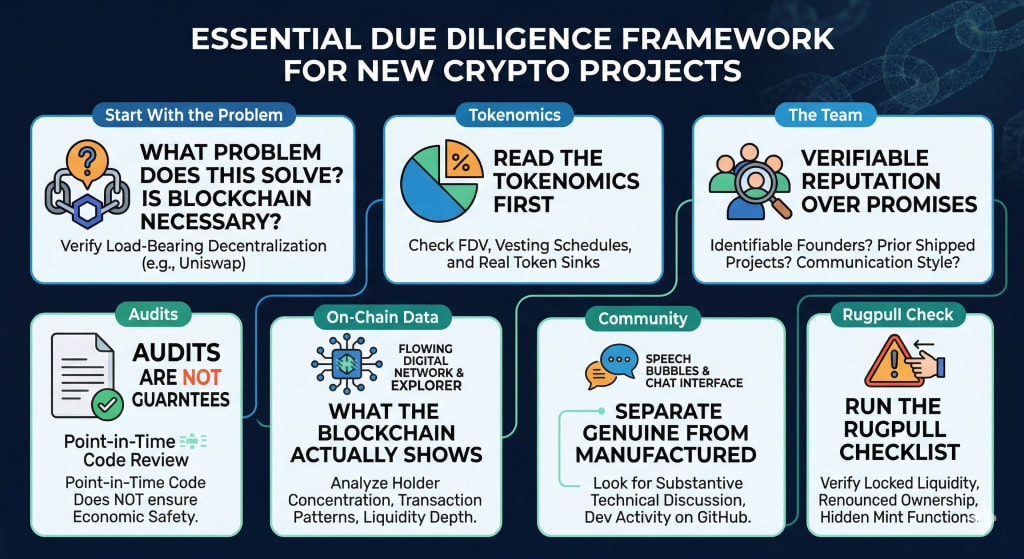
The first question to ask about any crypto project is the one most people skip: what problem does this actually solve, and does solving it require a blockchain?
It sounds basic. Most project whitepapers never answer it clearly. They describe a vision, a token economy, a roadmap but the underlying problem and why a decentralised solution outperforms a centralised one is either vague or absent.
DeFi projects that have lasted are ones where the blockchain is load-bearing where decentralisation is what makes the product trustworthy. Uniswap works because no one can stop you from trading. Aave works because lending rules are enforced by code, not by a company's goodwill.
If the answer to "why blockchain?" is "for transparency" or "for efficiency" without specifics, that is not an answer. Most cryptocurrency projects that collapsed under scrutiny failed this test first.
Reading the Tokenomics Before You Buy Crypto
Crypto prices at launch tell you what the market thinks right now. Tokenomics tell you what the math will do to price over time. The second is more useful.
When evaluating any new crypto mining project or token launch, the tokenomics section should answer:
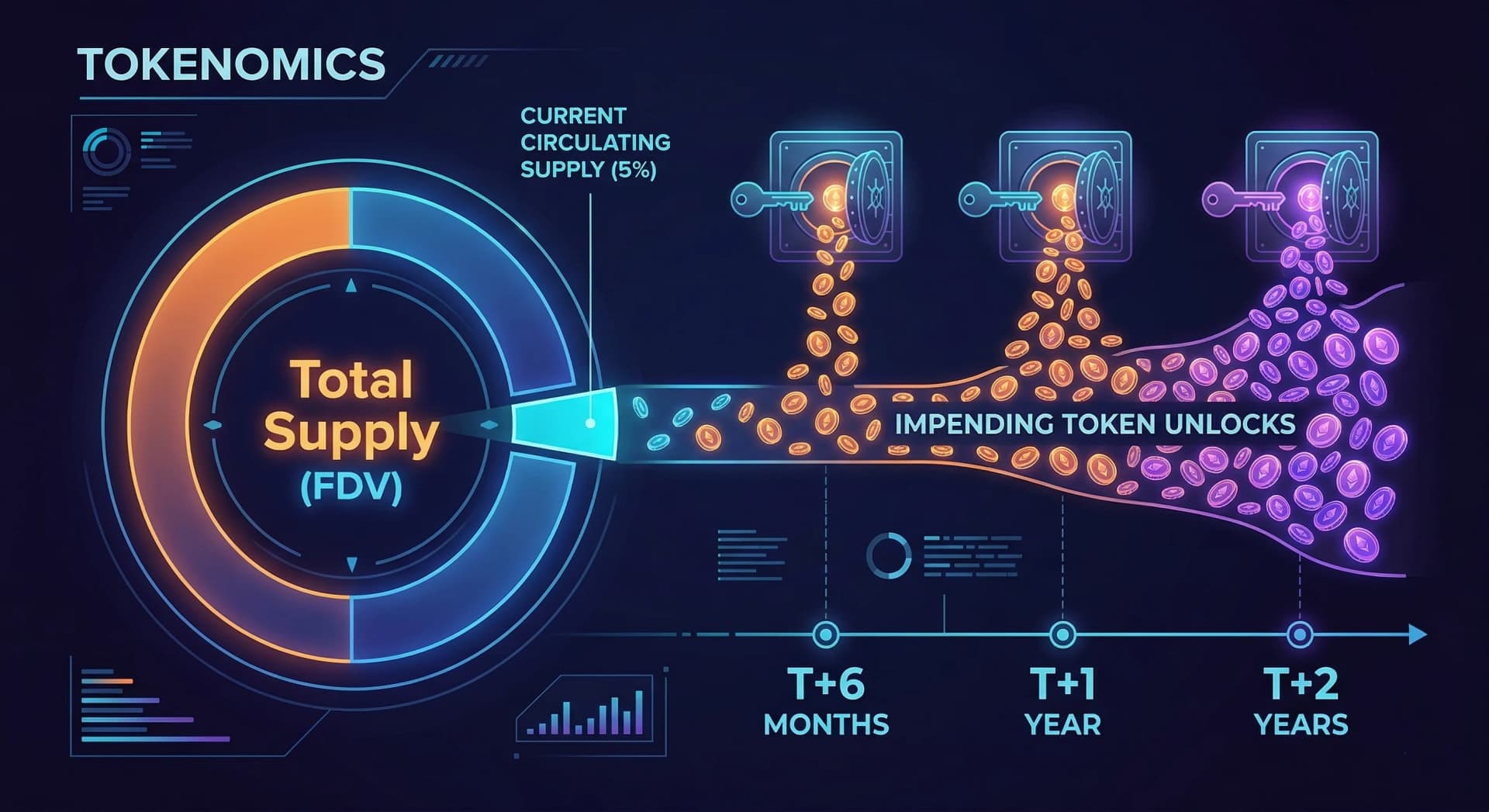
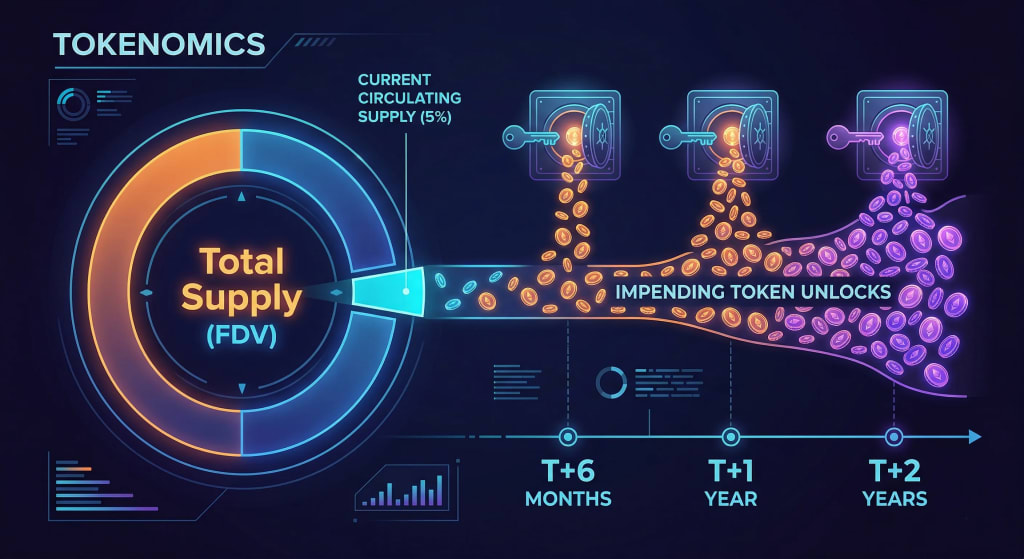
- What is the total supply, and how much is already circulating? A token trading at a $500M market cap with 5% of supply circulating has an implied fully diluted valuation of $10 billion. That is what you are actually paying for.
- Who holds the largest allocations, and when can they sell? Team and investor vesting schedules are the most important numbers in any crypto project evaluation. Short vesting with no cliffs means insiders can sell quickly. Four-year vesting with a one-year cliff means they are aligned with the project's long-term health.
- What are the token sinks? If the only reason to hold the token is the expectation that someone else will pay more, that is speculation, not utility. Tokens with genuine sinks like fees, staking requirements, governance have structural demand that outlasts the initial excitement.
The newest crypto coins with the most aggressive "to the moon" community energy are frequently the ones with the most extractive tokenomics. That correlation is not a coincidence.
The Team: Verifiable Reputation Over Anonymous Promises
Anonymous teams are not automatically a red flag in crypto. Some legitimate projects have launched pseudonymously. But anonymous teams with no verifiable track record, no audited code, and no public accountability are a very different matter.
For any crypto project you are seriously considering:
- Are the founders identifiable? Not necessarily named publicly, but is there a track record attached to their pseudonym? Prior projects, GitHub contributions, on-chain history?
- What have they shipped before? Founding a project is easy. Shipping working code, maintaining a community through a bear market, and handling an incident transparently are harder. Look for evidence of the harder things.
- How do they communicate when things go wrong? Every project has problems. The ones worth investing in cryptocurrency are the ones where the team communicates honestly about setbacks rather than going quiet or spinning bad news.
A team whose entire public presence is marketing copy and price speculation is telling you something important about their priorities.
Smart Contract Audits: What They Mean and What They Don't
An audit is not a guarantee of safety. It is a time-bounded review of the code as it existed at a specific moment, conducted by humans who are working within scope and time constraints. Understanding what audits actually mean prevents two mistakes: dismissing unaudited projects too quickly and treating audited projects as risk-free.
What an audit does tell you:
- Whether the team was willing to spend money on security before launch - a meaningful signal about priorities
- Whether known vulnerability classes were checked for and addressed
- Whether the audit firm has a credible reputation
What an audit does not tell you:
- That the code is free of all vulnerabilities
- That subsequent updates did not introduce new issues
- That the economic design is sound
For new crypto projects in DeFi specifically, check whether the audit covers not just the contracts but the economic attack surface such as oracle dependencies, governance mechanisms, flash loan exposure. Many audits check code correctness without evaluating whether the economic design can be manipulated.
If you want to understand what production-grade smart contract security actually looks like, our smart contract audit services covers the full evaluation process step by step. Connect now to get started.
On-Chain Data: What the Blockchain Actually Shows You
One of the advantages of cryptocurrency over traditional investment is that the data is public. Everything that happens on-chain is visible to anyone with a crypto wallet and a block explorer. Most people do not look.
For any crypto project you are evaluating, on-chain data reveals:
- Token holder concentration — if the top ten wallets hold 60%+ of supply, the project's price is at the mercy of those holders' decisions. That is not necessarily fatal, but it is a risk that should be priced into your evaluation.
- Transaction activity — is there genuine usage, or are most transactions transfers between a small number of wallets? Real DeFi projects have diverse, organic transaction patterns. Projects manufacturing activity to look legitimate tend to have recognisable patterns if you look at wallet-level behaviour.
- Liquidity depth on the decentralized exchange — how much can you sell before the price moves significantly? A crypto project with $50,000 of liquidity on a decentralized exchange cannot absorb meaningful selling pressure. That is not a sign of early-stage opportunity; it is a sign of genuine risk.
- Sniper activity at launch — on-chain data often shows whether a small number of wallets (frequently sniper bots) acquired large token positions in the first few blocks of trading. Heavy sniper concentration means a portion of the supply is held by participants with no interest in the project, only in selling into retail demand.
Community and Social Signals: Separating Genuine From Manufactured
Community is one of the strongest signals for a crypto project's long-term viability and one of the easiest to fake. Large follower counts, high engagement metrics, and enthusiastic Telegram groups can all be purchased.
The signals that are harder to manufacture:
- Quality of technical discussion — are community members asking substantive questions about how the protocol works? Or is it primarily price speculation and "to the moon" content?
- How criticism is handled — projects with genuine communities engage with critical questions. Projects whose moderators delete or ban critical voices are protecting a narrative, not a product.
- Developer activity — is the GitHub repository active? Are commits recent and substantive, or was the repository active for a month and then abandoned?
- Who is talking about it outside the project's own channels — organic coverage in credible newsletters, developer forums, and independent research is harder to manufacture than social media engagement.
The newest crypto projects with the loudest communities and the most aggressive price predictions warrant more scrutiny, not less. Noise is cheap. Substance is not.
For projects looking to build that kind of credibility, EthElite also offers social media management services focused on real structured communication, community positioning and audience trust across Web3 channels.
The Rugpull Checklist: Red Flags Before You Buy
Rugpulls are where developers abandon a project and take investor funds, follow recognisable patterns. Not every project with these characteristics is a rugpull, but every rugpull typically has several of them.
Before you buy cryptocurrency in any new crypto project, check:
- Is contract ownership renounced or held by a multisig? A contract with a single owner who can upgrade, pause, or drain it at any time is a trust assumption most investors do not realise they are making.
- Is the liquidity locked? Liquidity that can be removed by the team at any time means the decentralized exchange pool can be drained instantly. Locked liquidity (verifiable on-chain) reduces but does not eliminate this risk.
- Are there hidden mint functions? Some contracts include functions that allow unlimited token minting, effectively unlimited dilution at the developer's discretion. Audits should catch this; unaudited projects may not disclose it.
- Does the marketing emphasis price over product? Projects whose entire communication strategy is cryptocurrency prices, influencer promotions, and countdown timers are more likely selling a trading opportunity than building something durable.
None of these checks takes more than twenty minutes with a block explorer and a basic understanding of how to read contract code. That twenty minutes has saved more money than any amount of community research.
How to Actually Size a Crypto Investment Position
Even after thorough due diligence, investing in cryptocurrency, especially in new crypto projects, carries genuine risk. The evaluation framework reduces that risk; it does not eliminate it.
Position sizing is where the framework translates into practice:
- Size positions by conviction and liquidity, not by upside narrative. A project with a credible team, audited contracts, genuine token utility, and organic community growth warrants a larger position than one that only has price momentum. Liquidity matters too if you cannot exit a meaningful portion of your position without moving the market, that should be reflected in how much you allocate.
- Diversify across project stages. The best coin to invest in is rarely obvious at launch. Spreading crypto investment across established protocols, mid-stage projects with working products, and early-stage projects with credible teams produces a portfolio that does not depend entirely on any single evaluation being correct.
- Use a crypto exchange with genuine liquidity. For cryptocurrency trading in smaller projects, the difference between a best crypto exchange with deep order books and a thin venue can be significant when you need to exit quickly. Liquidity on entry looks very different from liquidity on exit in stressed market conditions.
Frequently Asked Questions
Q: What is a rugpull in crypto?
A: A rugpull is when project developers abandon a project and take investor funds typically by removing liquidity, selling large token allocations, or exploiting contract functions that allow them to drain the protocol.
Q: How do I evaluate new crypto mining projects?
A: Apply the same framework as any crypto project: verify the team's track record, review tokenomics for insider concentration and vesting schedules, check for credible audits, and assess on-chain activity for genuine usage versus manufactured metrics. New crypto mining projects specifically should be evaluated for token emission sustainability and whether the mining economics make sense at realistic token prices.
Q: What is sniper activity and why does it matter?
A: Sniper bots acquire large token positions in the first blocks of trading, typically at very low prices. Heavy sniper concentration means a significant portion of supply is held by participants whose only interest is selling into retail demand, creating persistent sell pressure that works against later buyers.
Q: How important is a smart contract audit for new crypto projects?
A: Significant, but not sufficient. An audit from a reputable firm signals the team takes security seriously and reduces known vulnerability risk. It does not guarantee safety, does not cover economic attack vectors unless explicitly scoped, and does not account for post-audit changes to the code.
Q: What on-chain data should I check before buying cryptocurrency?
A: Token holder concentration, transaction activity patterns, liquidity depth on the decentralized exchange, whether liquidity is locked, contract ownership structure, and launch-day wallet behaviour that may indicate sniper or insider activity.
Conclusion
There is no framework that makes crypto investment risk-free. The space moves fast, information is asymmetric, and even well-researched projects fail. What a consistent evaluation process does is shift the odds, filtering out the obvious failures, identifying the genuine opportunities, and sizing positions in proportion to actual conviction rather than narrative excitement.
The projects worth buying crypto in are the ones that hold up under scrutiny: clear problem statements, honest tokenomics, verifiable teams, credible audits, organic on-chain activity, and communities that engage with substance rather than just price.
The same filters are often visible from the build side too, projects developed with strong infrastructure, transparent execution, and technically credible partners such as EthElite usually reveal more discipline long before market narratives catch up.
Those projects exist in every cycle. Finding them requires looking past the noise and having a process for doing it consistently.
Share with your community!