Loading blog post...


How Claude AI Can Assist Developers in Building Blockchain Applications
Building in Web3 is high-stakes; a single line of code can be the difference between a breakthrough protocol and a multi-million dollar exploit. Enter Claude AI: not as a replacement for developers, but as a high-reasoning "thinking partner." From simulating complex smart contract audits to scaffolding full-stack dApp architectures, discover how Anthropic’s Claude is quietly reducing the friction of blockchain development and setting a new standard for secure, efficient Web3 engineering.
Building on blockchain is not exactly a walk in the park. Between writing secure smart contracts, navigating different consensus mechanisms, and keeping up with rapidly shifting Web3 standards, even experienced engineers often hit walls. That is where Claude AI quietly steps in — not as a replacement for human expertise, but as a thinking partner that genuinely reduces friction across the entire development lifecycle.
Developed by Anthropic, Claude is a large language model built with safety and helpfulness at its core. What makes Anthropic's Claude particularly useful for blockchain and Web3 projects is its ability to reason through complex logic, generate production-ready code, and explain nuanced concepts in plain language, all without the hallucination-heavy outputs that plagued earlier AI tools.
This blog explores, section by section, how the Claude chatbot can become a genuine asset for blockchain developers from architecture planning all the way through to deployment and debugging.
What Makes Claude AI Different for Blockchain Developers
There is no shortage of AI coding assistants, but most were not built with technical depth or safety in mind. Anthropic's approach to model training emphasizes constitutional AI principles meaning Claude is less likely to confidently produce wrong answers and more likely to flag uncertainty, which matters enormously in blockchain programming where a single bug can drain a smart contract of funds.
A few things set Claude apart for this use case:
- Context window depth: Claude can read and reason over entire codebases in one pass, not just snippets.
- Nuanced reasoning: It can trace logic through multi-step smart contract execution flows, identify reentrancy risks, and suggest mitigations.
- Plain-language explanations: Useful when onboarding junior developers to blockchain concepts without losing technical accuracy.
- Safety-first outputs: Anthropic has trained Claude to flag dangerous patterns in code rather than silently reproduce them.
For any blockchain developer who has wasted hours debugging obscure Solidity errors at 2 AM, having a tool that can read the full contract and trace the issue in seconds is genuinely transformative.
Accelerating Smart Contract Development with Claude
Smart contract development is arguably the most high-stakes form of blockchain coding. Once deployed, contracts are immutable, mistakes are permanent. Claude can dramatically shorten the feedback loop during development without cutting corners on correctness.
Here is where the Claude chatbot adds the most value in this phase:
- Boilerplate generation: Claude can scaffold ERC-20, ERC-721, and ERC-1155 contracts from a brief description, following current OpenZeppelin standards.
- Audit simulation: Ask Claude to audit a contract for common vulnerabilities - reentrancy, integer overflow, front-running and it will walk through each potential exploit vector with line-by-line commentary.
- Test case writing: Claude can generate Hardhat or Foundry test suites, including edge cases that human developers often miss under deadline pressure.
- Gas optimization: It can suggest storage layout changes, loop refactors, and alternative data structures to reduce on-chain execution costs.
One important note: Claude can be treated as a helpful reviewer, but not the final authority. For broader perspectives and ongoing insights around Web3 development, platforms like EthElite can offer valuable context before moving toward deployment decisions.
Using Claude to Navigate Web3 Development Frameworks
Web3 development involves juggling a dizzying array of frameworks, libraries and standards - ethers.js vs web3.js, Hardhat vs Foundry, Wagmi vs RainbowKit. For a developer new to the ecosystem, or one switching chains, this context-switching overhead is enormous.
Claude can serve as a live reference guide for any web3 developer trying to navigate this landscape. Instead of spending twenty minutes scanning documentation, a developer can describe what they are trying to build and Claude will recommend the right tool, explain the tradeoff, and produce a working integration example.
For instance, Claude can:
- Translate a Hardhat deployment script into an equivalent Foundry script in seconds.
- Explain when to use ethers.js providers vs signers, with concrete examples.
- Walk through setting up a Wagmi + RainbowKit frontend with wallet connect functionality.
- Compare Layer 2 ecosystems (Arbitrum, Optimism, zkSync) and help a developer choose based on their project's transaction volume and fee sensitivity.
If your team is working with a Web3 development company or evaluating Web3 development services, Claude can also help you ask better questions during vendor conversations, ensuring you fully understand proposals before signing off on architecture decisions.
For deeper guidance and expert support, you can also get a free consultation from EthElite and get started.
How Claude Supports Blockchain App Development End-to-End
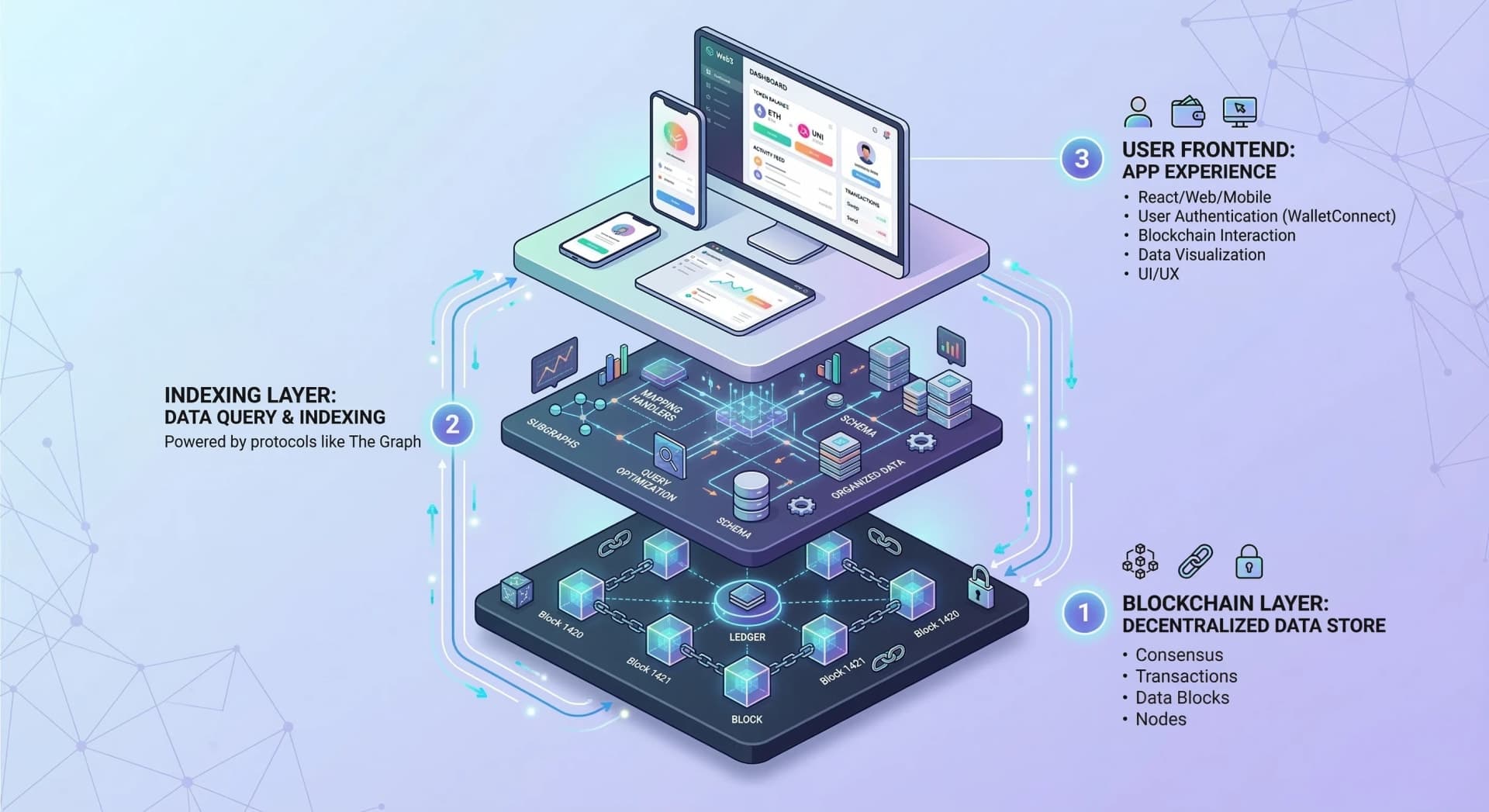
Blockchain app development is rarely just about writing contracts. A complete blockchain app typically includes a smart contract layer, an indexing layer (like The Graph), a backend API, and a frontend. Claude can assist across all of these, not just the contract code.
Frontend Integration
Claude can write React and Next.js components that connect to deployed contracts using wagmi hooks, handle transaction state, and surface meaningful error messages to users — rather than raw hex error codes from the EVM.
Backend and Indexing
For teams building custom indexers or using TheGraph, Claude can help write subgraph schemas, mapping handlers, and query optimization. It can also assist with building REST or GraphQL APIs that sit between chain data and your frontend.
Cross-Chain Logic
If your blockchain application development spans multiple chains, Claude can help design cross-chain messaging logic using protocols like LayerZero or Chainlink CCIP, explaining the trust assumptions of each approach before you commit.
For teams working with blockchain development services providers, Claude is also useful for reviewing technical proposals, making sure the architecture makes sense before kickoff rather than discovering issues mid-build.
AI in Blockchain: How Claude Enhances On-Chain Intelligence
The intersection of AI and blockchain technology is one of the most genuinely exciting frontiers in software right now. While most of the hype focuses on token-based AI projects, the more practical story is about how AI with blockchain can make the development process smarter, faster, and more secure.
AI in blockchain doesn't mean training a model on-chain. It means using AI to reason about chain data, generate better code, and identify patterns that human reviewers miss. Here is how Claude specifically fits into that picture:
- Transaction pattern analysis: Paste raw transaction logs and Claude can help you interpret what happened, useful for debugging failed transactions or understanding MEV activity.
- Economic attack modeling: Describe your tokenomics and Claude can help you think through potential manipulation vectors - flash loan attacks, governance exploits, liquidity drains.
- Protocol documentation generation: Claude can read your contracts and generate human-readable documentation, making your protocol more accessible to auditors, integrators, and the broader community.
The relationship between artificial intelligence and blockchain is still maturing, but Claude represents a practical, available-today version of that collaboration, not a research project, but a working tool that blockchain developers can use right now.
Claude as a Research Partner for Blockchain Technology Applications
Before a single line of code is written, most serious blockchain development projects go through an extended research and planning phase. Which chain fits this use case? What are the gas cost implications of this data structure? Has this mechanism been exploited before?
Claude excels at this discovery phase. Because it has absorbed a vast amount of information about blockchain technology applications: DeFi, NFTs, DAOs, identity, supply chain, gaming, it can quickly synthesize what is known and where the open questions lie.
Concretely, Claude can help teams:
- Research how similar protocols have handled a specific mechanism and what their post-mortems revealed.
- Compare the tradeoffs of different consensus mechanisms for a given use case (e.g., BFT variants vs Nakamoto consensus for a permissioned enterprise chain).
- Draft a technical whitepaper or specification document from rough notes, saving days of writing time.
- Summarize lengthy EIPs (Ethereum Improvement Proposals) or protocol upgrade changelogs into actionable summaries.
For teams evaluating top blockchain development companies or assembling an internal blockchain app development company practice, Claude can help create evaluation frameworks, RFP documents, and technical due diligence checklists.
Blockchain Game Development: Claude as Your Creative-Technical Bridge
Blockchain game development sits at a uniquely demanding intersection: it requires game design sensibility, Solidity engineering, tokenomics understanding, and frontend performance optimization, often from the same small team. Claude can stretch that team further.
In the context of on-chain games and GameFi projects, Claude can:
- Design token economies: Describe your game loop and Claude will suggest token sink and source mechanics, inflation controls, and reward structures grounded in behavioral economics.
- Write on-chain game logic: For fully on-chain games (like those built on MUD or Dojo), Claude can help write the ECS (Entity Component System) schemas and system contracts.
- Optimize NFT metadata pipelines: Claude can help design efficient off-chain metadata generation and IPFS pinning workflows for large generative NFT collections.
- Prototype fast: Scaffold a working game contract, a basic frontend interaction layer, and a test suite in a fraction of the time it would take starting from scratch.
The speed advantage is real. Teams working on blockchain applications in gaming have reported that using Claude for initial prototyping cut their first playable demo timelines significantly, leaving more time for the things AI cannot do: playtesting, community building and creative iteration.
Helping Blockchain Development Companies Scale Their Teams
Whether you run one of the blockchain development companies serving enterprise clients or you are building an internal Web3 practice at a larger firm, scaling quality blockchain talent is genuinely hard. Claude does not replace senior engineers, but it does make mid-level engineers more productive and helps juniors ramp faster.
Here is how EthElite uses Claude to scale effectively:
- Onboarding acceleration: New developers can use Claude to understand an existing codebase quickly, asking questions about specific functions, tracing data flows, and understanding architectural decisions.
- Code review support: Claude can perform a first-pass review before human reviewers see the code, catching obvious issues and freeing senior developers to focus on higher-level concerns.
- Documentation maintenance: As contracts evolve, Claude can update NatSpec comments, README files, and integration guides to match the current implementation.
- Client communication: Claude can translate technical architecture decisions into clear, accessible language for non-technical stakeholders or clients.
For any blockchain app development company that bills by the project or maintains retainer relationships, the productivity gains from integrating Claude into the workflow translate directly to margin improvement or the ability to take on more projects without proportional headcount growth.
AI for Blockchain Security: Going Beyond Automated Scanners
Traditional automated security tools for blockchain coding - Slither, Mythril, Echidna are excellent but pattern-based. They catch known vulnerability classes but struggle with novel attack vectors or business logic flaws. Claude adds a complementary layer of reasoning-based analysis.
When it comes to AI for blockchain security specifically, Claude can:
- Read through an entire protocol's contract suite and map out trust assumptions, which contracts can call which, what privileged roles exist, and what happens if an admin key is compromised.
- Simulate attacker thinking: "If I wanted to manipulate this oracle, what sequence of transactions would I need, and at what cost?"
- Review upgrade mechanisms (proxy patterns, timelocks, multisig governance) for logic gaps that automated tools typically miss.
- Generate invariant specifications that can then be fed into formal verification tools like Certora or Halmos.
This is particularly valuable for blockchain development services firms that include security review as part of their offering, Claude can make that review more thorough without necessarily increasing billable hours proportionally.
⚠️ Note: Claude is a powerful reasoning tool, but it is not a certified security auditor. Always supplement Claude-assisted reviews with professional and credentialed smart contract audit firms like EthElite before deploying contracts managing significant value.

Getting the Most Out of Claude for Your Blockchain Projects
Like any tool, the value you get from Claude scales with how well you use it. A few practical patterns that web3 development services teams and independent blockchain developers have found effective:
Be Specific About Context
The more context you give Claude - the chain, the framework, the version of Solidity, the specific invariant you are trying to enforce, the more precise and useful its output will be. Treat it like briefing a senior contractor on day one.
Iterate Rather Than Accept
Claude's first output is a starting point. Ask it to critique its own answer, suggest alternatives, or stress-test its reasoning. It will often surface better solutions in the second or third round.
Use It for the Thinking, Not Just the Typing
The highest-leverage use of Anthropic's Claude is in the reasoning phases - architecture decisions, security threat modeling, tokenomics design where thinking carefully early saves enormous rework later. Code generation is useful, but it is not where the biggest ROI lives.
Combine with Specialized Tools
Claude works best as part of a broader workflow. Use it alongside your static analysis tools, your testing framework, and your documentation system not as a replacement for any of them. The combination of AI on blockchain development workflows and purpose-built tools is more powerful than either alone.
Frequently Asked Questions
Q: Can Claude AI write Solidity smart contracts from scratch?
A: Yes. Claude AI can generate Solidity contracts based on natural language descriptions, following current standards like OpenZeppelin. These should always be reviewed and tested before deployment.
Q: Is Claude useful for Web3 developers who are not Solidity experts?
A: Absolutely. One of Claude's strongest use cases for web3 development is helping developers who are strong in traditional software engineering but newer to blockchain-specific patterns ramp up quickly without making expensive mistakes.
Q: How does AI and blockchain technology work together in practice?
A: In practical terms, AI and blockchain technology work together when developers use AI tools like Claude to write, audit, document, and reason about blockchain code, not by running AI models on-chain. The synergy is in the development workflow, not in the execution environment.
Q: Can Claude replace a professional smart contract audit?
A: No. Claude can complement an audit by surfacing issues early and helping developers think through edge cases, but it is not a substitute for a professional security review by credentialed auditors, especially for contracts managing significant user funds.
Q: Which blockchain development companies are using AI tools like Claude?
A: Many leading blockchain development companies have quietly integrated AI tools into their workflows for code generation, documentation, and initial security review. The trend toward AI-assisted blockchain application development is well established and accelerating.
Conclusion
Claude AI, built by Anthropic, is not a blockchain developer. It does not deploy contracts, it does not sign transactions, and it will not make decisions for your protocol. What it does do remarkably well is help the humans doing those things think more clearly, work faster, and catch problems earlier.
Across smart contract development, blockchain app development, smart contract security review, blockchain game development, team scaling, and research, Claude has demonstrated genuine utility for development teams of all sizes. The intersection of artificial intelligence and blockchain is no longer a future promise; it is a present-day workflow advantage that forward-thinking teams are already using.
At the same time, staying aligned with the fast-moving Web3 ecosystem requires reliable insight and ongoing learning. Platforms like EthElite help developers and teams keep up with emerging tools, architectural patterns, and best practices shaping modern Web3 development.
If you are building on Web3 and not yet experimenting with how AI with blockchain development can compress your timelines and improve your output quality, the gap between you and teams that are is widening every month.
Share with your community!