Loading blog post...


DePIN: Decentralizing Physical Infrastructure Through Blockchain
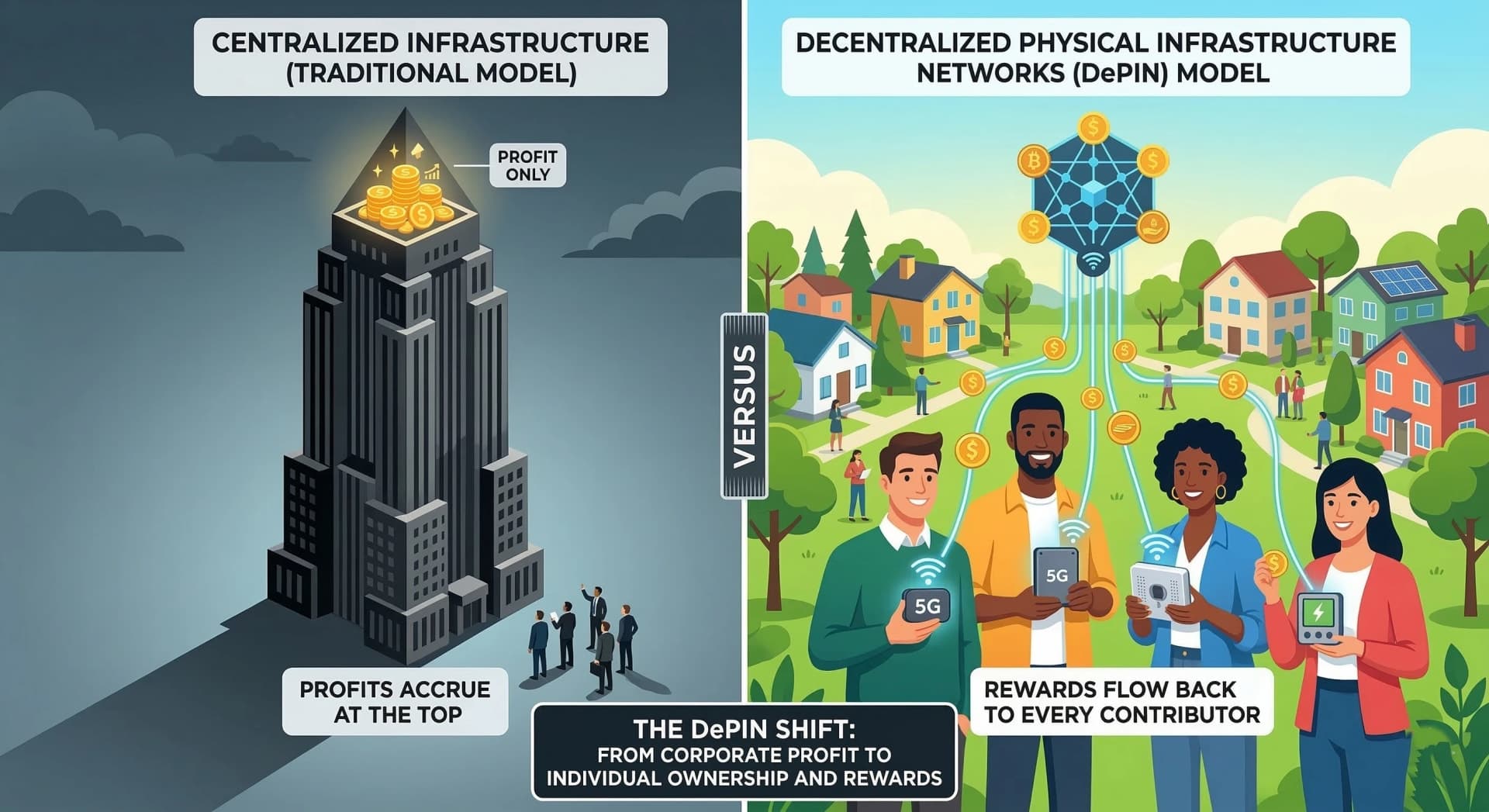
DePIN (Decentralized Physical Infrastructure Networks) is flipping the traditional corporate model on its head. By combining blockchain technology with real-world hardware like 5G antennas and energy grids, DePIN allows individuals to own, operate, and earn from the infrastructure that powers modern life. Discover how this "people-powered" movement is solving the connectivity gap and why it’s the most grounded application of Web3 today.
Most of what powers modern life, wireless networks, energy grids, storage systems, GPS infrastructure is owned and operated by a small number of large corporations. You use it, you pay for it, but you have no stake in it and no say over how it runs.
Decentralized Physical Infrastructure Networks, or DePIN, are a direct challenge to that model. The idea is straightforward: use blockchain technology to coordinate the building and operation of real-world infrastructure by the people who actually use it and reward them for contributing.
It sounds ambitious. In several sectors, it is already working.

What DePIN Actually Is Beyond the Acronym
Decentralized Physical Infrastructure Networks refer to systems where physical hardware such as antennas, storage drives, sensors, energy meters are deployed and maintained by individuals rather than corporations, with coordination and payment handled by a blockchain system.
The model works like this: someone contributes hardware to the network, the network tracks their contribution on-chain, and smart contracts automatically reward them with tokens based on what they provide. There is no central operator deciding who gets paid or whether a contributor is legitimate. The blockchain handles it.
What makes this different from a cooperative or a franchise is the trustless nature of the coordination. Participants do not need to know or trust each other. They do not need a central company managing payouts. The rules are encoded in smart contracts, the contribution data lives on-chain, and the rewards flow automatically.
This is what the decentralisation meaning stands for, not just a philosophical preference for distributed systems, but a working operational model for physical infrastructure at scale.
The Problem DePIN Is Actually Solving
To understand why DePIN matters, it helps to understand what it's pushing back against.
Traditional infrastructure deployment follows a familiar pattern: a company raises capital, builds infrastructure across high-density profitable areas, charges what the market will bear, and leaves underserved regions without coverage because the unit economics don't work. The incentives are entirely corporate.
DePIN flips this by turning infrastructure contributors into stakeholders. A person in a rural area with line-of-sight to a highway can deploy a sensor node or a wireless antenna and earn from the coverage they provide, coverage a corporation would never bother building because the population density doesn't justify it.
The decentralisation of power here is not just rhetorical. Ownership of the infrastructure is genuinely distributed across the contributors who built it, tracked transparently through blockchain cryptocurrency token allocations and on-chain records.
If you're exploring how decentralised infrastructure ownership could apply to an enterprise context, our Blockchain Development Services covers integration models for organisations building on distributed infrastructure rails.
How Blockchain Technology Makes the Model Work
DePIN is not possible without blockchain technology. The trust problem is simply too large to solve any other way at scale.
Consider what needs to happen for a DePIN network to function honestly:
- Contribution verification — the network needs to know that a device is actually online, actually in the location claimed, and actually providing the service it's supposed to provide
- Tamper-proof records — contribution history needs to be immutable so that payouts can't be manipulated retroactively
- Automated settlement — rewards need to flow without a human approving each transaction
- Transparent governance — rules about how rewards are calculated need to be visible and changeable only through agreed processes
Blockchain technology handles all of this. Contribution data gets written to a blockchain system that no single party controls. Smart contracts calculate and distribute rewards automatically. Participants can track blockchain transactions to verify their own payouts independently. And protocol governance happens on-chain, visible to everyone.
The result is a system where strangers can cooperate to build shared infrastructure without needing to trust each other, only needing to trust the code.
Decentralised Governance: Who Actually Runs a DePIN Network?
This is the question most people don't ask until they're already building and it matters enormously.
In a traditional infrastructure company, governance is clear: executives make decisions, shareholders have voting rights proportional to ownership. In a DePIN network, decentralised governance replaces that structure with onchain mechanisms, typically token-weighted voting where contributors and token holders propose and vote on protocol changes.
In practice, decentralised planning for DePIN networks involves decisions like:
- How rewards are weighted between different types of contribution (coverage area vs. data volume vs. uptime)
- Whether to expand to new geographic regions or hardware categories
- How to handle disputes when a contributor claims their device is functioning but the network disagrees
- Parameter changes to the smart contracts that govern payouts
The tension in decentralised governance is that the people best positioned to make good decisions - active contributors with deep network knowledge are not always the largest token holders. Well-designed DePIN governance systems try to weight participation alongside ownership, though this remains an open design problem across the space.
Decentralization of power in governance is also not binary. Most functioning DePIN networks operate with some degree of core team stewardship early on, progressively handing control to token holders as the protocol matures. The path toward genuine community governance is incremental, not instantaneous.
Real Sectors Where DePIN Is Already Operating
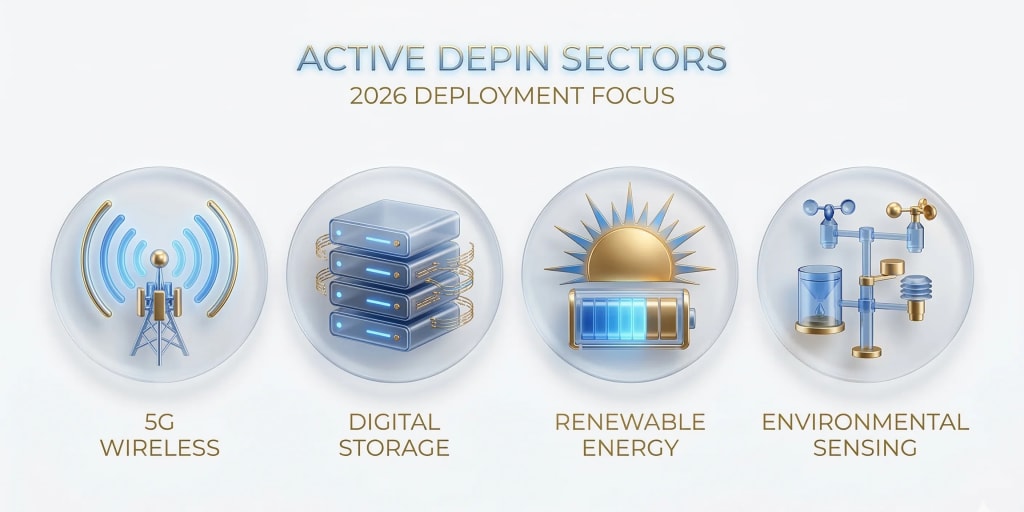
DePIN is not a whitepaper concept. Several networks are live, growing, and generating real economic activity across distinct infrastructure categories.
- Wireless connectivity — Helium is the most prominent example: a network of individually owned hotspots providing LoRaWAN and increasingly 5G coverage, with contributors earning tokens for the coverage they provide. The network has deployed more hotspots in more locations than many traditional carriers would consider economically viable.
- Decentralised storage — Filecoin and Arweave allow individuals to contribute unused hard drive space to a distributed storage network, earning tokens for storing data reliably. The blockchain system verifies storage proofs cryptographically, the network can confirm data is being stored without having to trust the storage provider's word.
- Energy infrastructure — Emerging DePIN networks are coordinating distributed energy resources: solar panels, home batteries, EV chargers. Participants contribute excess energy or grid stabilization capacity and receive blockchain cryptocurrency token rewards, with smart contracts handling settlement automatically.
- Environmental sensing — Networks like WeatherXM deploy individually owned weather stations, aggregating hyperlocal data that traditional meteorological infrastructure doesn't capture, rewarding station owners for accurate, consistent readings verified on-chain.
Each of these sectors shares the same underlying logic: individual hardware contributors, blockchain-verified contribution data, and smart contract-automated rewards. The physical layer differs. The coordination model is the same.
Decentralization in Government and Public Infrastructure: An Emerging Frontier
Most DePIN discussion focuses on private networks - wireless, storage, energy. But the model has meaningful implications for public infrastructure too and some governments are beginning to notice.
Decentralization in government infrastructure could look like municipalities deploying sensor networks for air quality, traffic, or utility monitoring but instead of procuring and operating all the hardware centrally, incentivizing residents to deploy and maintain nodes in exchange for on-chain rewards.
The appeal is practical as much as ideological. Government infrastructure projects are notoriously expensive and slow to deploy. A DePIN model could dramatically reduce upfront capital requirements and distribute maintenance responsibility across a wider base.
The challenge is regulatory. Decentralisation meaning is really just genuine distribution of operational control with public accountability frameworks that assume a identifiable responsible party. When a government sensor network is managed by smart contracts and token holders, the question of who is legally responsible for its accuracy and uptime becomes genuinely complex.
This is frontier territory. But it is territory that forward-thinking municipalities and infrastructure planners are beginning to map seriously.
If your organisation is evaluating blockchain-enabled infrastructure for public sector applications, avail a free session with our blockchain consultants to get started.
The Honest Challenges DePIN Still Needs to Solve
DePIN is compelling. It is also early, and some of its hardest problems are not yet solved.
- Proof of physical work is hard. Verifying that a device is genuinely online, in the claimed location, and providing real service rather than simulating contribution is technically difficult. Networks have been gamed by contributors spoofing location data or inflating coverage claims. The cryptographic mechanisms for reliable proof of physical work are improving but not yet robust across all hardware categories.
- Token incentive sustainability is uncertain. Most DePIN networks bootstrap growth by issuing tokens to early contributors at rates that would not be sustainable at scale. The transition from "growth subsidized by token issuance" to "growth funded by genuine service revenue" is a path every DePIN network needs to navigate and not all will do it successfully.
- Regulatory uncertainty is real. Operating a distributed wireless network, a distributed energy resource, or a distributed storage system touches on regulatory frameworks that were not written with DePIN in mind. Navigating spectrum licensing, energy regulation, and data sovereignty laws in a system with no central operator is genuinely complex.
These are not reasons to dismiss DePIN. They are the actual engineering and policy problems that the best teams in the space are working on right now.
Frequently Asked Questions
Q: What does DePIN stand for?
A: DePIN stands for Decentralized Physical Infrastructure Networks - systems where real-world hardware infrastructure is deployed and operated by individuals rather than corporations, with coordination and rewards managed by a blockchain system.
Q: How does blockchain technology enable DePIN?
A: Blockchain technology provides the trust layer that makes DePIN possible. It records contribution data immutably, executes reward payments automatically through smart contracts, and allows participants to track blockchain transactions to verify their own payouts without needing a central operator to manage any of it.
Q: What is decentralisation meaning in the context of DePIN?
A: In DePIN, decentralisation means that infrastructure ownership, operation, and governance are distributed across many individual participants rather than concentrated in a single company. No single entity controls the network, and the rules governing it are encoded in publicly visible smart contracts.
Q: What sectors are DePIN networks operating in today?
A: Active DePIN networks are operating in wireless connectivity, decentralised storage, distributed energy, and environmental sensing with emerging applications in transportation, mapping, and public infrastructure monitoring.
Q: What are the biggest challenges facing DePIN networks?
A: The main challenges are reliable proof of physical contribution (preventing gaming of reward systems), sustainable token economics beyond the initial growth phase, and regulatory frameworks that weren't designed with decentralised infrastructure operators in mind.
Q: How is decentralised governance used in DePIN?
A: Decentralised governance in DePIN typically uses token-weighted voting for protocol decisions, reward structure changes, geographic expansion, smart contract parameter updates. Most networks operate with some core team stewardship early on, progressively transitioning to community governance as the protocol matures.
Conclusion
Decentralized Physical Infrastructure Networks represent one of the more grounded applications of blockchain technology, not financial speculation, but a coordination mechanism for building real things in the real world.
The decentralisation at the heart of DePIN is structural: ownership distributed across contributors, rules encoded in smart contracts, records kept in a blockchain system that no single party controls. Decentralised governance handles protocol evolution, while blockchain cryptocurrency tokens align incentives between contributors and users, the same smart contract logic that specialist teams such as EthElite increasingly help businesses design for production environments.
What makes DePIN worth paying attention to is that it works in sectors where the traditional model has obvious failures. It does not work perfectly yet, but the direction is clear, and the infrastructure being built is real.
Share with your community!