Loading blog post...


Decentralised Governance in Web3: Design Patterns That Actually Work
Governance in Web3 sounds elegant in theory, but in practice, it’s one of the hardest design problems in the space. From 'whale' dominance to voter apathy, the stakes are high when smart contracts execute decisions automatically. This guide breaks down the design patterns that actually work from tiered decision-making to the honest path of progressive decentralization to help you build a protocol that is both durable and legitimate.
Every organisation needs a way to make decisions. In traditional companies, that means executives, boards, and shareholders. In governments, it means elected representatives and bureaucracies. In Web3, it means something that does not have a clean analogue anywhere else - communities of strangers, holding tokens, voting on protocol changes that affect real money, with no central authority to override bad decisions or fix mistakes.
Decentralised governance sounds elegant in theory. In practice, it is one of the hardest design problems in the space. Protocols have been drained because governance was captured. Communities have fractured over votes that went poorly. Upgrades have stalled for months because quorum was never reached.
But some systems are working - producing legitimate, durable decisions at scale. The difference between the ones that work and the ones that do not is almost always design, not intent.
What Decentralised Governance Actually Means in Web3
Before getting into design patterns, it helps to be precise about what decentralised governance is and is not.
Governance in any context is the system by which a group makes collective decisions like what changes, who decides and how disputes get resolved. In traditional organisations, project governance and governance frameworks are well-studied fields with centuries of accumulated practice. In Web3, that practice is being rebuilt from scratch, on public infrastructure, with financial stakes attached to every decision.
Decentralised governance specifically means that decision-making authority is distributed across participants rather than concentrated in a small group. The decentralization of power here is not just philosophical, it is structural. No single entity should be able to unilaterally change the protocol, move treasury funds, or override community decisions.
What makes Web3 technology distinct is that governance rules are enforced by smart contracts rather than legal agreements or institutional trust. A vote that passes on-chain triggers an action automatically - the protocol upgrades, the funds move, the parameter changes. There is no board that can override the result, and no legal system that will unwind it.
That enforceability is the promise. The challenge is designing systems where the right decisions get made in the first place.
The Problem With Token-Weighted Voting And Why It's Still Used
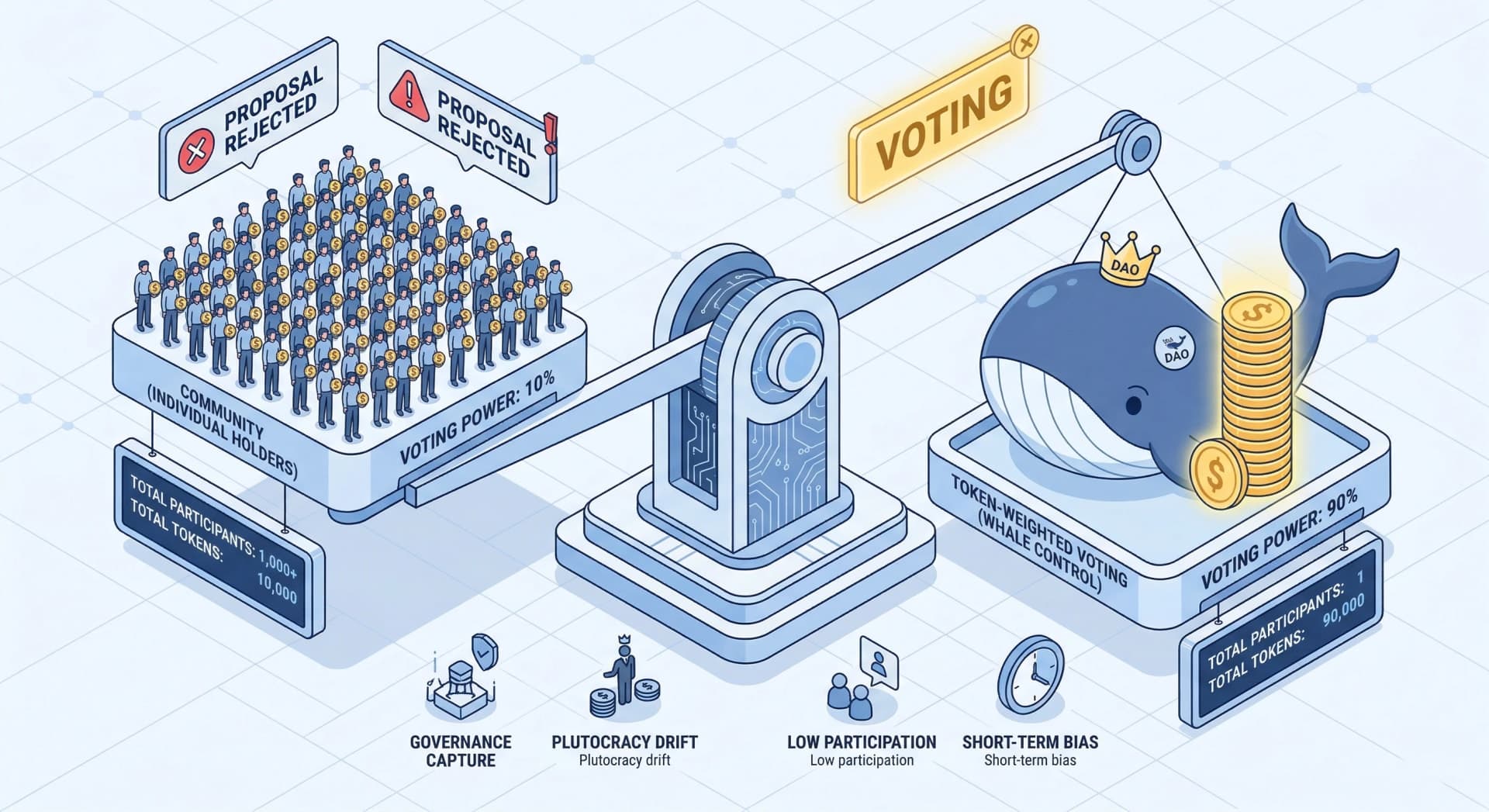
Most decentralized governance systems in Web3 use token-weighted voting: one token, one vote. It is simple, Sybil-resistant and easy to implement. It is also deeply imperfect, and being honest about those imperfections is where serious governance design starts.
The core problem is that token holdings correlate with financial interest, not necessarily with protocol knowledge or long-term commitment. A whale who acquired tokens last week has more voting power than a developer who has contributed to the protocol for two years. Governance becomes a proxy for capital, not a proxy for stakeholder representation.
More practically, token-weighted voting is vulnerable:
- Plutocracy drift — over time, governance power concentrates among large holders, reducing the practical influence of ordinary participants and creating a gap between governance outcomes and community preferences
- Low participation — most token holders do not vote. In many protocols, governance decisions pass with less than 5% of eligible tokens participating, raising legitimate questions about legitimacy
- Short-term orientation — participants optimizing for near-term token price may vote against upgrades that sacrifice short-term yield for long-term protocol health
Despite all of this, token-weighted voting persists because the alternatives are harder. It is Sybil-resistant without requiring identity verification. It is proportional in a way that is defensible. And it is what the tooling supports.
The answer is not abandoning token-weighted voting but layering mechanisms on top of it that compensate for its weaknesses.
Governance Frameworks That Distribute Power Without Losing Coherence
The most durable governance frameworks in Web3 share a common insight: not every decision should go to a full community vote. Governance needs structure - different processes for different types of decisions, with appropriate authority delegated to appropriate bodies.
Think of it like types of governance in traditional organisations. A company does not put every operational decision to a shareholder vote. It reserves major strategic decisions for board-level approval, delegates operational authority to executives and handles routine matters through established processes. Decentralised governance needs equivalent structure.
The design patterns that have proven most effective:
- Tiered decision-making — separating decisions by their significance and risk. Parameter adjustments within pre-approved bounds (interest rates, fee levels) can be delegated to smaller committees or even automated. Protocol upgrades that change core logic require full community votes with higher quorum thresholds. Constitutional-level changes: ones that affect the governance system itself require supermajority approval and longer deliberation periods.
- Working groups and sub-DAOs — empowering specialist groups with budgets and mandates to handle specific domains. A security council handles emergency responses. A grants committee evaluates funding proposals. A technical committee advises on upgrade proposals. Each is accountable to the broader community but operates with appropriate autonomy for its domain.
- Time delays and vetoes — most serious decentralized governance systems implement a time delay between a vote passing and execution. This window allows the community to identify problems, allows large stakeholders to exit if they disagree strongly, and provides a circuit-breaker if something goes wrong. Some systems also maintain a security council with limited veto power over clearly malicious proposals not as a permanent authority, but as a safety valve during the protocol's early maturity.
If you're designing a governance framework for a Web3 protocol, our Blockchain Development Services includes governance architecture as part of protocol design engagements.

Delegation: How Governance Scales Without Losing Participation
One of the most practical solutions to low governance participation in Web3 technology systems is delegation - allowing token holders who do not want to vote directly to assign their voting power to a representative who will.
This is not a new idea. Representative democracy is built on exactly this principle. What is new is implementing it in a trustless, on-chain environment where delegation can be revoked instantly, delegate voting records are publicly visible, and no institutional infrastructure is required to make it work.
Well-designed delegation systems have a few properties that matter:
- Partial delegation — holders can delegate specific domains (technical votes, treasury votes) to different delegates rather than assigning all governance power to one representative
- Transparent track records — every vote a delegate casts is on-chain and auditable. Delegators can evaluate their representative's actual voting history, not just their stated principles
- Liquid re-delegation — voting power can be reassigned at any time, without lock periods. This keeps delegates accountable because their power base can evaporate if they make consistently unpopular decisions
The decentralisation and local governance parallel is instructive here. Effective local governance works because representatives are close enough to their constituents to understand specific needs, and accountable enough to those constituents that they cannot ignore them. Delegation in Web3 attempts to replicate this dynamic at the protocol level, creating an informed, accountable middle layer between passive token holders and the protocol's decision-making process.
Decentralization and Local Governance: What Web3 Can Learn from Real-World Models
Decentralization and local governance in the traditional sense, the distribution of government authority from central to regional and local bodies has produced decades of research on what works and what does not. Web3 governance designers are largely reinventing these wheels, sometimes discovering the same insights, sometimes making the same mistakes.
The lessons most directly applicable to decentralized governance design:
- Subsidiarity works. The principle that decisions should be made at the lowest level where they can be made effectively is as relevant to protocol governance as it is to municipal administration. Routine operational decisions made by working groups close to the relevant domain will almost always be better than the same decisions made by a large community vote.
- Accountability requires transparency and consequences. In decentralisation and local governance research, the factor most correlated with good outcomes is not the structure of decision-making but whether decision-makers face genuine accountability. In Web3, on-chain voting records provide transparency. The consequences part whether delegates who vote poorly lose their delegated power, whether committees that underperform lose their mandates is a design choice that many protocols have not thought through carefully enough.
- Legitimacy is separate from legal authority. Traditional governance derives legitimacy from democratic mandate or legal authority. Web3 governance derives it from community buy-in and procedural integrity. A technically valid vote that most of the community considers illegitimate because quorum was gamed, the proposal was poorly specified, the timeline was rushed will be contested even if it passes. Building legitimacy into the process is as important as building correctness into the outcome.
The Crypto Governance Attack Surface: What Goes Wrong and Why
No treatment of decentralised governance in Web3 is honest without spending real time on failure modes. The attack surface for governance systems is large, and several high-profile exploits have demonstrated exactly how expensive governance failures can be.
- Governance capture through token accumulation — an attacker who acquires sufficient tokens (through purchase, borrowing, or flash loans) can pass malicious proposals. The Beanstalk exploit is the canonical example: a flash loan provided temporary governance majority, a malicious proposal was passed and executed, and the protocol was drained before anyone could respond. The mitigation is time delays between proposal passage and execution, combined with emergency veto mechanisms.
- Voter apathy enabling minority control — when participation is consistently low, a well-coordinated minority can reliably control outcomes. This is not necessarily malicious — it is structural. The solution is not lecturing token holders about civic duty but designing systems where participation is easier and delegation provides a sensible default for the disengaged.
- Proposal spam and governance fatigue — high-volume governance activity burns out active participants and buries important proposals in noise. Protocols without proposal thresholds (minimum token holdings required to submit a proposal) or structured deliberation periods end up with governance processes that reward persistence over quality.
- Inadequate specification leading to disputed outcomes — proposals that pass despite being ambiguously worded create downstream disputes about what was actually approved. Forcing proposal templates that require explicit specification of what changes, why, and what success looks like reduces this substantially.
These are not theoretical risks. Each of them has played out in real protocols, with real financial consequences. A governance framework that does not explicitly address each failure mode is not a complete governance framework.
On-Chain vs. Off-Chain Governance: Finding the Right Balance
A practical question every Web3 protocol faces is how much governance should happen on-chain versus off-chain. The answer is almost never "all of one or all of the other."
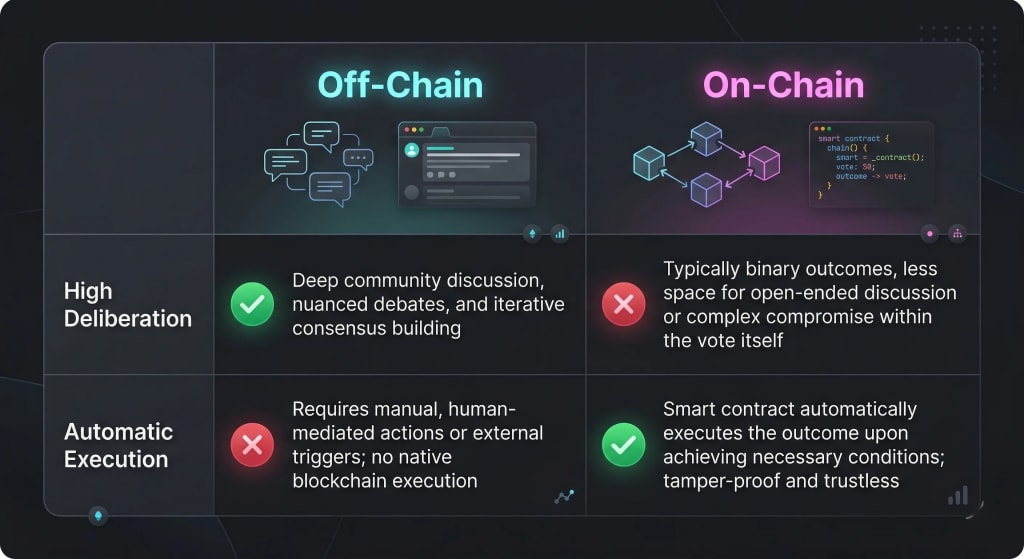
- On-chain governance — where votes are cast and recorded as blockchain transactions — provides transparency, auditability, and automatic execution. Every vote is verifiable. Passed proposals execute without human intermediaries. The record is permanent. The cost is participation friction (gas costs for voting) and the exposure that comes from executing decisions automatically without a human review step.
- Off-chain governance — forums, signaling votes on Snapshot, working group discussions — provides lower friction, richer deliberation, and a space for nuance that binary on-chain votes cannot accommodate. The cost is that off-chain decisions depend on social enforcement rather than automatic execution, creating potential gaps between what the community decided and what actually happens.
The most functional project governance systems use both deliberately:
- Off-chain for deliberation — proposals are discussed in forums, refined through community feedback, and signaled through non-binding votes before anything goes on-chain
- On-chain for ratification and execution — once a proposal is well-specified and has demonstrated community support, it moves to a binding on-chain vote with automatic execution
This separation respects the different strengths of each environment. It keeps gas costs down by avoiding on-chain votes that are clearly going to fail. And it ensures that final decisions have both community legitimacy (demonstrated through deliberation) and on-chain enforceability.
Our Blockchain experts covers the specific tooling and process design for protocols at different stages of maturity. Connect today to get a free consultation.
Progressive Decentralisation: The Honest Path Forward
One of the most practically important concepts in Web3 governance design is progressive decentralisation, the idea that full community governance on day one is not a realistic or desirable starting point for most protocols.
Early-stage protocols need to move quickly, fix mistakes, and iterate on design. Submitting every decision to a community vote during this phase creates a governance overhead that slows development without meaningfully improving decisions because the community does not yet have enough context to make most of those decisions well.
What progressive decentralisation looks like in practice:
- Phase one — core team retains operational authority with transparent communication about decisions and a commitment to community input on significant changes
- Phase two — governance is established for treasury allocation and major protocol decisions, with the team retaining emergency authority and veto power
- Phase three — full community governance with working groups, delegation systems, and the team operating as one stakeholder among many rather than as a privileged authority
The honest challenge is that teams rarely want to give up the phase one authority they find comfortable, and communities rarely give credit for the transparency and good faith that makes phase one legitimate. Clear, public commitments to a decentralisation timeline with specific milestones rather than vague intentions are what separate genuine progressive decentralisation from permanent benevolent dictatorship dressed up in governance language.
Decentralization of power is not an event. It is a process, and it requires both the willingness to give up control and the institutional design to make that transfer of control durable.
Frequently Asked Questions
Q: What is decentralised governance in Web3?
A: It is a governance system where protocol decisions are made by token holders and community participants instead of a central team. Smart contracts enforce approved proposals automatically, without intermediaries.
Q: What are the main types of governance used in Web3 protocols?
A: Common models include token-weighted voting, delegation systems, multisig control, and hybrid structures that combine off-chain discussion with on-chain approval. Most established protocols use a mix of these approaches.
Q: Why does voter participation stay so low in decentralised governance?
A: Voting takes time, attention, and often transaction costs, while many token holders remain passive investors. Delegation helps by allowing holders to assign voting power to active participants.
Q: What is progressive decentralisation?
A: It is the gradual transfer of governance power from the founding team to the community as the protocol matures and participants gain context.
Q: How do governance attacks happen, and how are they prevented?
A: They usually involve gaining temporary voting power to pass harmful proposals. Protection comes through execution delays, proposal thresholds, and limited emergency veto rights.
Q: What is the difference between on-chain and off-chain governance?
A: On-chain governance records votes on the blockchain and executes outcomes automatically. Off-chain governance supports discussion and signaling before formal approval. Most protocols use both together.
Conclusion
Decentralised governance in Web3 is genuinely hard. It is trying to solve coordination problems that traditional organisations address with authority, legal systems, and institutional trust using token voting, smart contracts, and pseudonymous internet strangers.
The design patterns that work share a few properties: they are honest about the limits of token-weighted voting and layer mechanisms on top of it, they match decision processes to decision types rather than applying one mechanism to everything, they build in time delays and circuit breakers rather than assuming good outcomes, and they treat progressive decentralisation as a legitimate path rather than a failure of commitment.
Web3 technology provides the infrastructure for governance that is transparent, auditable, and automatically enforced. Whether that infrastructure produces good decisions depends entirely on the quality of the governance framework built on top of it.
The protocols that figure this out will be the ones that last. The ones that treat governance as a token distribution event followed by a community forum will not.
Share with your community!