Loading blog post...


Choosing the Right Blockchain for Your Web3 Application in 2026
In 2026, picking a blockchain is no longer just a technical detail, it's a high-stakes business decision that’s nearly impossible to undo. From the liquidity of Ethereum’s L2 'vaults' to the consumer-ready speed of Solana, your choice of infrastructure defines your app’s transaction costs, security, and user growth. This guide breaks down the four essential questions every founder must ask before writing a single line of code.
The blockchain you build on is one of the earliest decisions in any web3 application project and one of the hardest to undo. Get it right and the rest of the build has a solid foundation. Get it wrong and you spend months working around constraints the chain was never designed to handle.
The options in 2026 are genuinely better than two years ago. More chains are production-ready. Performance gaps that once made certain use cases impossible have narrowed. But more options also mean more ways to pick the wrong one for the wrong reasons.
Why This Decision Comes First, Not Later
Most early web3 development conversations focus on features like what the dapp will do, what the token economy looks like. Chain selection gets deferred, treated as an infrastructure detail to sort out once the product is clearer.
This is backwards.
The chain determines transaction costs, throughput limits, security model, developer tooling, and the ecosystem of users and liquidity available to the application. Migrating a live decentralized application from one chain to another is one of the most painful things you can do to a product - user re-onboarding, liquidity migration, smart contract redeployment, ecosystem rebuilding. It is expensive in every dimension.
Make the decision deliberately, before you build.
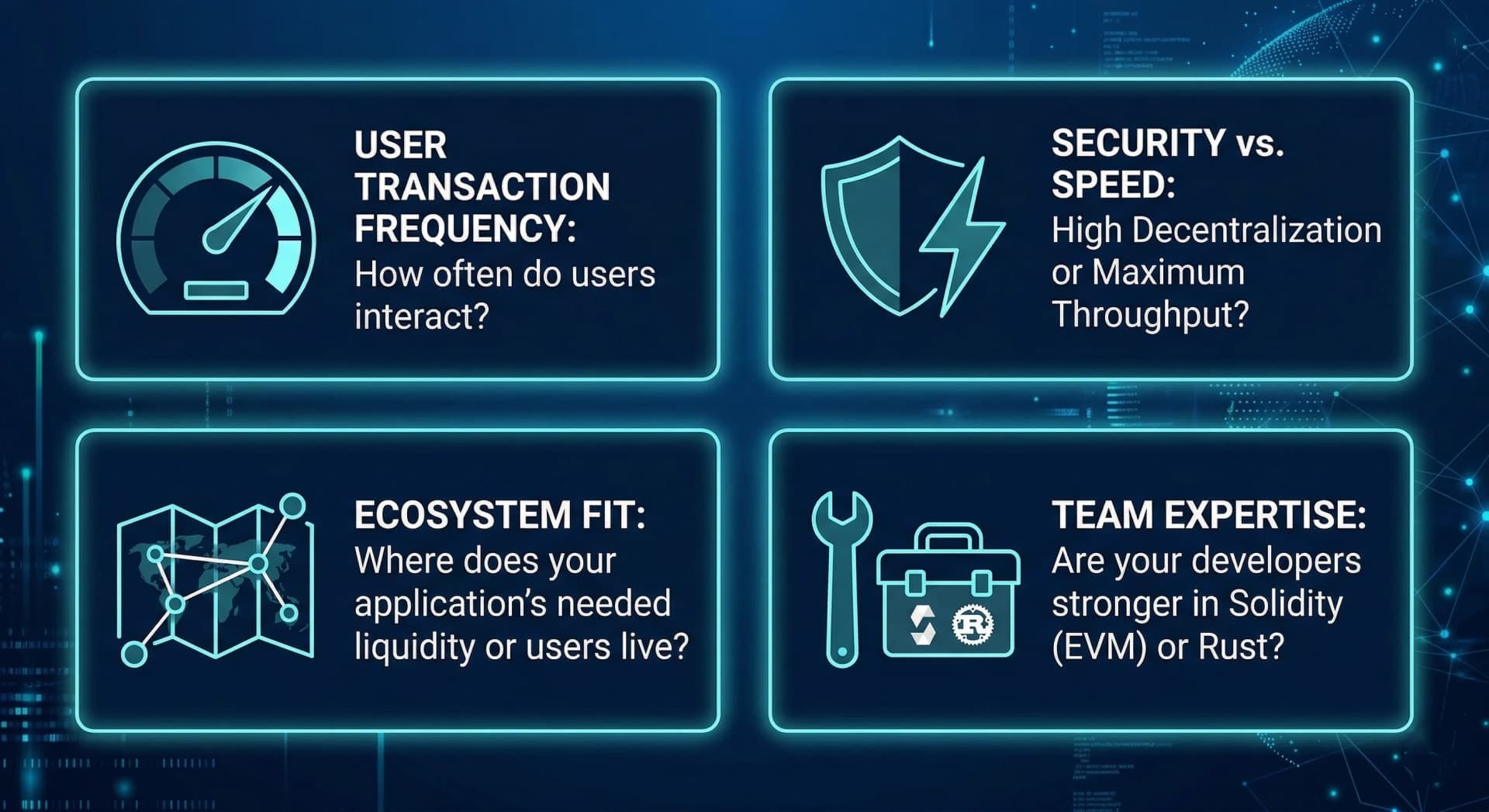
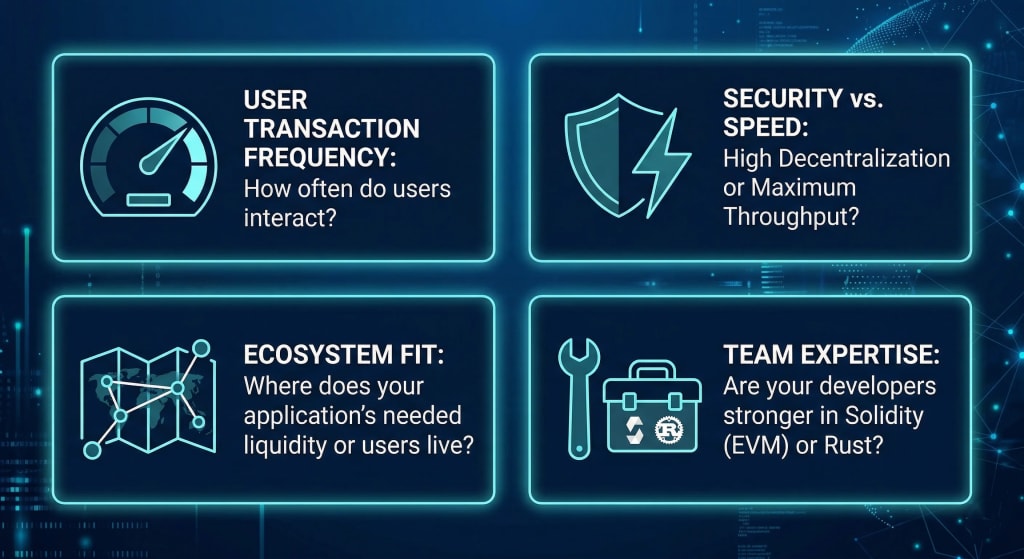
Four Questions That Actually Drive the Right Choice
Before looking at specific chains, get clear on requirements.
- How often will users transact? A web3 app where users interact multiple times per session - a game, a trading interface needs very low transaction costs. A decentralized app where users transact monthly can tolerate higher fees.
- How much does security matter relative to speed? More decentralised chains offer stronger security guarantees but lower throughput. Newer chains flip that. There is no free lunch.
- What ecosystem does your app need? A DeFi protocol needs to be where existing liquidity lives. A gaming dapp needs to be where gaming NFT infrastructure already exists. The best technical chain is worth much less if your users are not there.
- What does your team actually know? EVM-compatible chains, those supporting Solidity give access to the largest blockchain developer talent pool and the most mature tooling. Non-EVM chains may have technical advantages but require specialised expertise that is genuinely harder to hire for.
Ethereum and Its L2s: Where Most Serious Web3 Development Lives
Ethereum is not the fastest chain or the cheapest. It is the most battle-tested and the home of the deepest liquidity in the blockchain ecosystem.
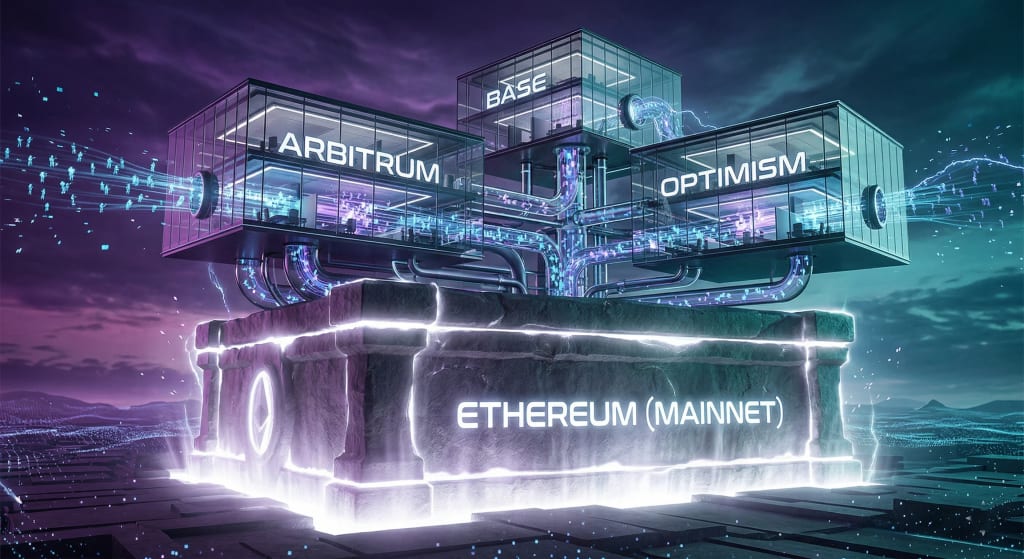
For web3 applications where security is paramount and composability with existing DeFi protocols matters, Ethereum remains the default. But in 2026, most dapp development teams building on Ethereum are not building on mainnet directly. They are building on Layer 2 networks - rollups that inherit Ethereum's security at a fraction of the cost.
Think of it like this: Ethereum mainnet is the vault. L2s are the efficient offices built on top of it that still have access to everything inside.
- Arbitrum — largest TVL of any L2, mature DeFi ecosystem, excellent tooling. The pragmatic default for most blockchain application development teams.
- Base — built by Coinbase on the OP Stack, very low fees, strong consumer web3 app traction. Good choice if your users are newer to crypto.
- Optimism — strong governance design and ecosystem grants. Worth considering for projects with community-first orientations.
- Starknet — ZK-native, attracts fully onchain game developers through the Dojo framework. Technically compelling but smaller ecosystem.
For most EVM-familiar teams building DeFi or consumer web3 apps, the shortlist is Arbitrum, Base, or Optimism with the final call coming down to where target users and ecosystem partners are most active.
Solana: Fast, Cheap and Consumer-Friendly
Solana is the most significant non-EVM alternative for most web3 application teams. It processes thousands of transactions per second at fractions of a cent, numbers that matter when transaction frequency is high and individual transaction margins are thin.
The consumer web3 apps and NFT ecosystem on Solana is genuinely strong. If your decentralized application is consumer-facing and your users are likely newer to crypto, Solana's wallet experience, particularly Phantom is widely considered the most accessible in the space.
The trade-off is the development environment. Blockchain coding in Rust requires different expertise than Solidity, and experienced Solana blockchain developers are harder to hire than EVM developers. Factor that into team planning from the start.
Application-Specific Chains: For When No General Chain Fits
For some web3 applications, no general-purpose chain is the right answer. The application is large enough, specialised enough, or performance-sensitive enough that it needs its own infrastructure, its own validators, fee structure, and governance.
This is custom blockchain development territory, using frameworks like the Cosmos SDK or Avalanche Subnets. dYdX migrated from Ethereum to its own Cosmos chain specifically to achieve the throughput its trading application required.
The threshold for this decision is high. Application-specific chains require running validators, managing network security, and building ecosystem relationships from scratch. They make sense for large, well-funded projects with specific requirements no general-purpose chain can meet. For most dapp development projects, they are premature.
If your team is genuinely evaluating this path, our Blockchain Development Services covers the full architecture assessment process.
What to Watch For When Working With Web3 Development Companies
A pattern worth knowing when working with external web3 development companies: some will recommend the chain they know best rather than the chain that fits the application best. This is not always cynical as familiarity is a legitimate factor in development speed. But it can lead to expensive mismatches.
Ask any blockchain development company you are evaluating:
- Which chains have you shipped production applications on?
- What were the chain-specific challenges, and how did you handle them?
Web3 development companies with genuine multi-chain experience will have specific, concrete answers. Those without it will tend toward generalities.
Our custom web3 development covers what to look for before engaging any development partner. Connect today to get started.
A Quick Blockchain Decision Map
No single chain is right for every web3 application. But mapping requirements against options usually narrows the field fast:
- High-value DeFi, maximum security → Ethereum mainnet or Arbitrum
- Consumer apps, low fees, Coinbase ecosystem → Base
- High-frequency transactions, consumer UX → Solana
- Fully onchain games, ZK-native → Starknet
- Custom throughput, sovereign infrastructure → Cosmos SDK or Avalanche Subnet
If your application sits across multiple categories, that warrants a deeper architecture conversation before committing.
Frequently Asked Questions
Q: What is a decentralized application?
A: Software that runs on a blockchain rather than a company's server. Its logic lives in smart contracts that execute automatically, no central operator can shut it down or change the rules unilaterally.
Q: What is the difference between Ethereum mainnet and Layer 2?
A: Mainnet is the most secure and decentralised base layer but the most expensive. L2s like Arbitrum and Base run on top of it, inheriting its security while processing transactions far more cheaply. Most new dapp development is happening on L2s.
Q: Do I need a web3 development company to build a dapp?
A: Not necessarily. Teams with existing blockchain developer expertise can build internally. Web3 development companies definitely add value when chain-specific experience is missing or when speed matters. The key is finding partners with genuine multi-chain experience.
Q: What is custom blockchain development?
A: Building an application-specific chain with its own validators and governance using frameworks like Cosmos SDK or Avalanche Subnets. Appropriate for large applications with requirements no general-purpose chain can meet.
Q: Can I switch chains after launching?
A: Yes, but it is expensive. Smart contract redeployment, liquidity migration, user re-onboarding. Treat it as a last resort, not a fallback plan.
Conclusion
The blockchain you choose shapes everything downstream - costs, users, security, integrations, and your path to scale. The teams that make this decision well begin with product requirements, user behavior, and long-term infrastructure goals, then let those factors point to the right chain. The teams that struggle usually start with a chain preference and force the product to fit backwards.
At EthElite, chain selection is treated as a strategic architecture decision, not a trend decision. The focus is on matching execution speed, fee tolerance, liquidity environment, security assumptions, and ecosystem fit to what the product actually needs before development begins.
Good web3 development starts with disciplined technical choices. This one happens before you write a single line of blockchain coding, because the wrong foundation becomes expensive to fix later.
Share with your community!