Loading blog post...


Blockchain Cryptocurrency Tokenomics: Designing Sustainable Incentive Systems
Most crypto projects fail not because the technology breaks, but because the economics do. While smart contracts hold, the underlying incentive systems often collapse. Tokenomics is the discipline of designing the rules—the supply mechanics, demand drivers, and vesting schedules that determine whether a project creates long-term value or becomes another "up then down forever" chart. This deep dive explores how to build a self-reinforcing economy that survives market stress and builds genuine adoption
Most crypto projects fail not because the technology breaks but because the economics do. The smart contracts work. The blockchain technology holds. What collapses is the incentive system underneath, the rules that determine who gets tokens, when, and why.
Tokenomics is the discipline of designing those rules. Done well, it creates a self-reinforcing system where participation produces value and value attracts participation. Done poorly, it produces a token price chart that goes up dramatically, then down permanently.
What Tokenomics Actually Means
Here is the simplest way to think about it: tokenomics is the rulebook for a token's economy. It governs who gets tokens, how many, when they can use or sell them, and what those tokens are actually good for.
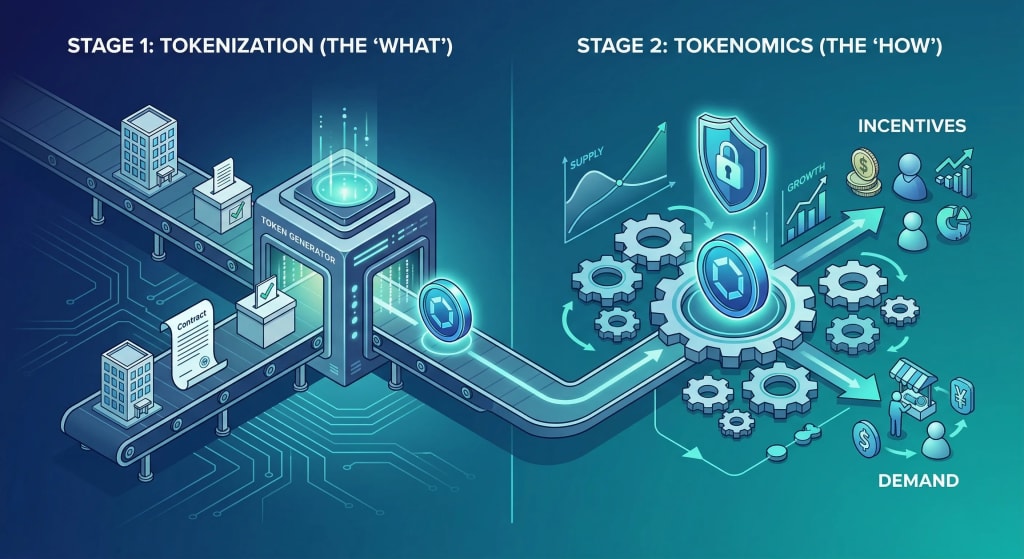
Tokenization is the step before that, the process of turning something real (ownership, access, voting rights) into an on-chain token that can be held, transferred, or traded. Tokenomics is the economic design layered on top: the incentives, the supply mechanics, the demand drivers.
Where most projects go wrong is treating tokenomics as a supply schedule, a graph showing how many tokens get released over time. Supply is one variable. The harder questions are on the demand side: why would anyone want to hold this token in the first place, and will that reason still exist in three years?
Projects that cannot answer those questions clearly are building on sand.
Token Supply Design: The Mechanics That Set the Tone Early
Supply design is the first thing most new crypto projects figure out, and the first place where subtle mistakes compound into serious problems.
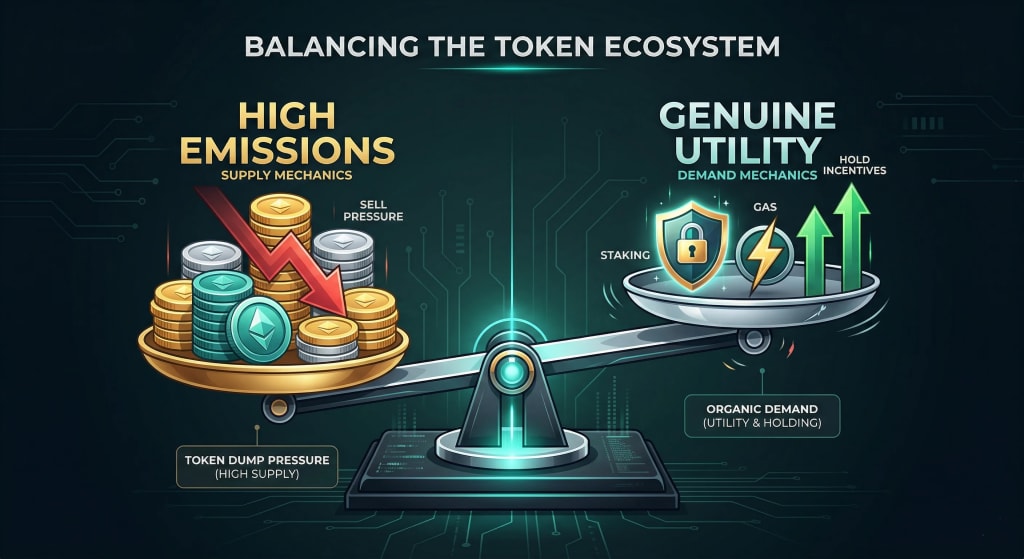
The fundamental tension is straightforward. High early emissions attract participants and bootstrap liquidity which a new network genuinely needs. But high emissions also mean a lot of people received tokens cheaply and have little reason to hold them long-term. That creates persistent sell pressure that can overwhelm even genuine demand.
The key decisions every project has to make:
- Fixed or inflationary supply? Bitcoin has a hard cap of 21 million so scarcity is structural. Ethereum issues new tokens continuously but burns transaction fees, aiming for a dynamic balance. Neither is universally better. The right answer depends on how much fee revenue the protocol can realistically generate.
- How do emissions decline over time? Front-loaded emissions (high early, tapering off) attract early participants but need strong demand to absorb the selling. Flatter curves are more conservative but can starve early growth.
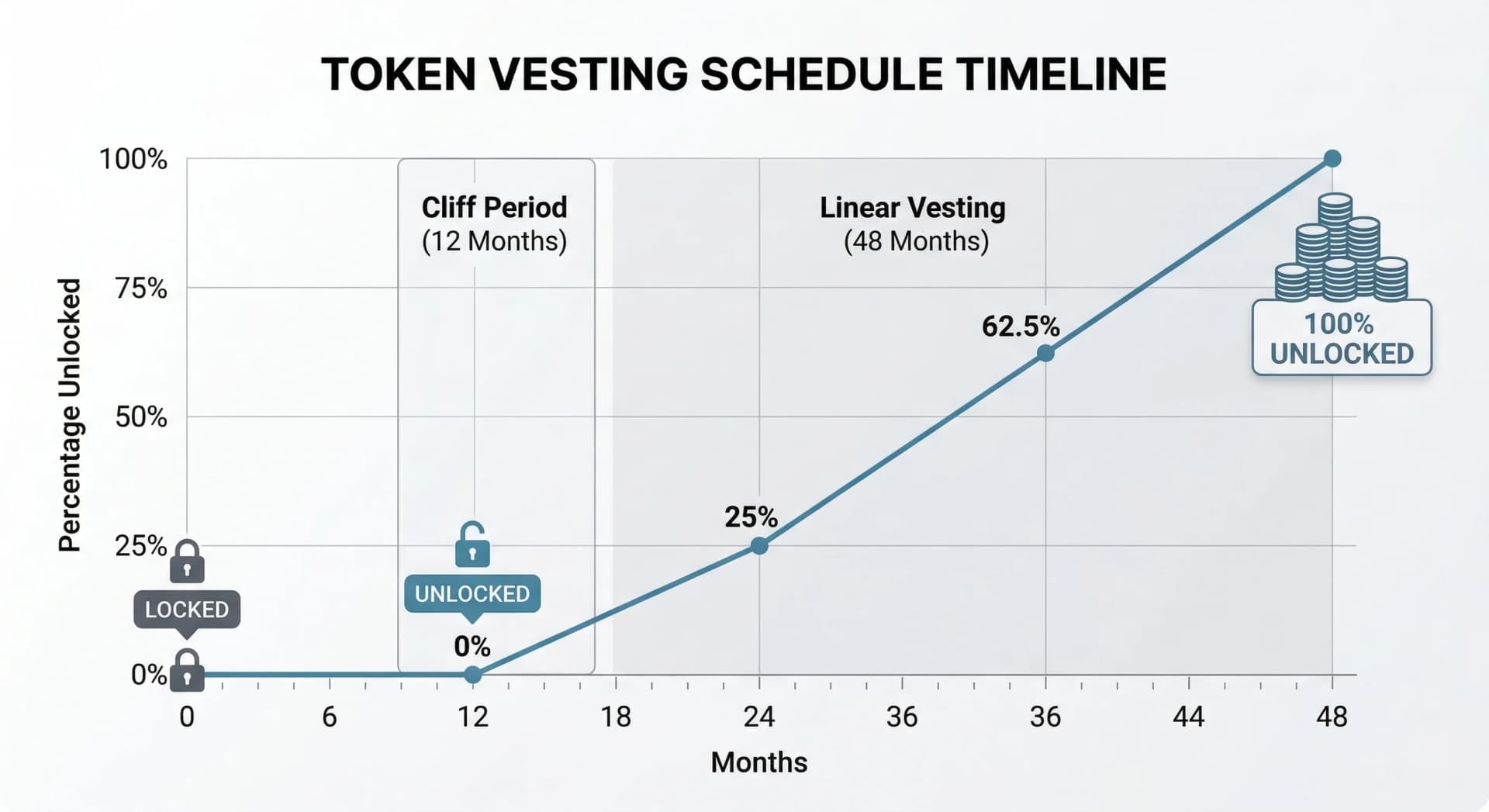
- Who gets tokens, and when can they sell? Team and investor allocations should vest over multiple years, 3 to 4 years is standard with a cliff period where nothing vests at all. Projects where insiders can sell within six months of launch are not building for the long term.
The good news: blockchain technology makes all of this enforceable. Vesting schedules, emission rates, burn mechanisms, these are smart contracts, not spreadsheets. Once deployed, they execute as written. The catch is that bad rules enforced reliably are still bad rules.
Why People Should Actually Hold the Token: Building Real Demand
This is the section most tokenomics documents skip, or address with vague language about "ecosystem utility." It is also the most important section.
Durable demand comes from specific, concrete reasons to hold not from the expectation that someone else will pay more tomorrow.
- The token is required to use the product. If interacting with a protocol requires holding or spending the token — for gas, for access, for staking — demand is tied directly to usage. This is structural demand. It scales as the protocol grows.
- The token captures a share of revenue. When a crypto trading platform or DeFi protocol generates fees and distributes them to token holders, the token has a yield. Suddenly it resembles something closer to an equity stake — there is a financial reason to hold it beyond speculation.
- Staking locks supply and creates yield. In proof-of-stake blockchain systems, validators stake the native token to participate in consensus. This removes supply from circulation, creates yield for long-term holders, and ties token economics to network security — a demand driver that scales with the network itself.
- Cross-chain collateral utility. Tokens accepted across multi chain environments as collateral in lending protocols have demand from the DeFi ecosystem's composability. This is independent of speculative interest and tends to be more stable.
The honest test: if your project stopped issuing new tokens tomorrow, would anyone still want to hold what exists? If the answer is no, you have an emissions-dependent system, not a tokenomics system.
If you're designing a token system from scratch and want to pressure-test the demand logic, our Blockchain Development Services includes economic design review as part of protocol architecture engagements.
Tokenization Security: How Economic Designs Get Exploited
Tokenization security is broader than most people realize. It is not just about whether the smart contract has a bug, it is about whether the economic design itself can be gamed, manipulated or attacked.
- Governance attacks are the clearest example. If voting power in a protocol is proportional to token holdings, and tokens can be borrowed or flash-loaned cheaply, then anyone can temporarily acquire governance majority and pass a malicious proposal. The Beanstalk exploit in 2022 did exactly this, the attacker borrowed enough tokens to control the vote, approved a proposal draining the treasury, and repaid the loan, all within a single transaction.
- Emissions gaming is subtler but more common. Liquidity mining programs attract what the industry calls "mercenary capital", participants who deposit funds purely to farm token rewards, with no intention of staying once yields decline. When they leave, liquidity collapses and price follows. The protocol mistook rented attention for genuine adoption.
- Oracle manipulation affects protocols where token prices feed back into their own economics. If the protocol borrows against token value, or distributes rewards based on token price, then manipulating the price manipulates the protocol itself. This feedback loop needs to be designed out, not discovered in a post-mortem.
A useful real-world tokenization example: Compound's COMP distribution in 2020 created massive TVL growth but much of it was circular lending to maximize farming rewards rather than genuine usage. Emissions-driven metrics looked healthy. Organic adoption was harder to see. The lesson is not that incentive programs are bad, but that they need sunset conditions and honest measurement criteria built in from the start.
Multi-Chain Tokenomics: The New Complexity Most Crypto Projects Underestimate
A few years ago, a token lived on one chain. Today, any protocol seeking meaningful reach needs to operate across multiple chains simultaneously and that creates economic complexity that most tokenomics designs have not caught up with.
The problems multi chain deployment introduces:
- Supply becomes invisible across chains. When tokens bridge from Ethereum to Arbitrum to Base, the circulating supply on any single chain explorer is misleading. Emission tracking, burn calculations, and staking ratios all depend on knowing total circulating supply and that number becomes genuinely hard to pin down.
- Liquidity gets thin everywhere. A token trading across five chains and twenty pools has fragmented liquidity at every venue. This makes price manipulation cheaper and creates arbitrage inefficiencies that sophisticated traders extract at the protocol's expense. Better to have deep liquidity in two or three strategic venues than shallow liquidity everywhere.
- Governance participation drops with distance from L1. Token holders on L2s often cannot vote in L1 governance without bridging back which costs time and gas. The result is that governance participation concentrates among the holders closest to the base layer, creating a gap between who holds tokens and who shapes the protocol.
Well-designed multi chain tokenomics addresses all three: canonical supply tracking aggregated across chains, concentrated liquidity programs on specific high-volume venues, and cross-chain governance mechanisms that reduce the friction of participation. Avail a free consultation from EthElite to get started.
How Real Trading Behavior Stresses Tokenomics Designs
You can design a beautiful incentive system on paper. Then crypto trading behavior hits it, and the gaps show up fast.
- Bots extract value from naive emissions programs. Crypto trading bots monitor mempools, front-run reward distributions, and exit positions faster than any human can react. A liquidity mining program without harvest delays or minimum lock periods is essentially a bot subsidy. The users it was designed to reward get a fraction of what the bots extract.
- Drawdowns create self-reinforcing spirals. When crypto prices fall, staking rewards denominated in that token are worth less in dollar terms. That makes staking less attractive. Tokens unlock and get sold. Price falls further. Protocols that express rewards as a percentage of staked value rather than a fixed token quantity handle this more gracefully, the yield adjusts rather than the behavior cascading.
- Early buyers and late buyers have different incentives. Someone who bought at $0.01 and someone who bought at $1.00 respond very differently to the same price signals. Projects where early participants hold a large, low-cost-basis position need vesting structures that spread out that selling pressure, otherwise every price rally becomes an exit opportunity for founders and early investors.
None of this requires predicting what any individual trader will do. It requires designing mechanisms that work reasonably well across a range of behaviors including adversarial ones.
Reading Tokenomics as a Crypto Investor
If you are evaluating a cryptocurrency investment whether you are a professional allocator or someone deciding whether to buy crypto for the first time, the tokenomics document is one of the most useful places to look. Most people skip it. The ones who read it carefully tend to have fewer unpleasant surprises.
The questions that actually matter:
- What is the token for, specifically? Not "ecosystem utility", what specific action requires holding or using this token? If there is no concrete answer, there is no structural demand.
- What happens when emissions end? Almost every project launches with high emissions to attract participants. The best crypto projects to hold long-term have a clear answer to what replaces that incentive. Fee revenue, collateral utility, protocol-required staking, something concrete.
- Who holds the most tokens, and when can they sell? This is on-chain and public. A project where the team and early investors control 40% of supply with 12-month vesting is a different risk profile than one with 4-year vesting and meaningful lock-ups.
- Has this token survived a bear market? Projects that have navigated a full crypto cycle reveal how their design actually behaves under stress, not just how it was intended to behave.
EthElite’s Crypto Investment Due Diligence Framework covers the full evaluation process for anyone conducting serious analysis of new crypto projects.
What Crypto Mining Economics Still Teach Modern Token Designers
Before liquidity mining and points programs, the original tokenomics mechanism was crypto mining and Bitcoin's design remains the most rigorously studied incentive system in the space.
The mechanics are simple: fixed maximum supply, a halving schedule that cuts new issuance every four years, and a difficulty adjustment that keeps block times consistent regardless of how much computing power joins the network. There is no governance vote that can change the emission schedule. No team allocation. No unlocks.
What modern tokenomics designers can learn from cryptocurrency mining economics:
Predictability builds long-term behavior. Miners make capital-intensive infrastructure investments based on expected returns over years. That only works if the rules are stable. Protocols where tokenomics can be changed frequently through governance create uncertainty that discourages the long-term investment that builds genuine ecosystems.
The transition from subsidies to fees is the hardest problem. Bitcoin's tokenomics depend on transaction fees eventually replacing block rewards as the primary miner incentive. Every protocol that uses emissions to bootstrap security or growth faces the same transition and few address it as explicitly as Bitcoin's design forces them to. This is worth thinking about before launch, not after emissions run out.
Frequently Asked Questions
Q: What is tokenomics in simple terms?
A: It is the economic rulebook for a crypto token covering how tokens are created, who gets them, what they are used for, and whether the incentives are designed to last. Think of it as the difference between a business model and a price chart.
Q: What is tokenization?
A: Tokenization is turning something real - ownership, access rights, voting power into an on-chain token. A tokenization example: a real estate property represented as a blockchain token that can be fractionally owned and traded without a broker.
Q: How does multi-chain deployment affect tokenomics?
A: It fragments supply visibility, thins out liquidity, and reduces governance participation. Good multi chain tokenomics tracks supply across all chains, concentrates liquidity strategically, and makes cross-chain governance low-friction.
Q: What should I look for when evaluating a crypto investment?
A: What the token is concretely used for, what drives demand after emissions end, who the large holders are and when they can sell, and whether the protocol generates real revenue. Vague answers to any of these are a signal worth taking seriously.
Q: Is crypto mining still relevant to tokenomics design?
A: Absolutely. Bitcoin's emission design contains lessons about predictability, long-term incentive alignment and the subsidy-to-fee transition that apply to any protocol using emissions to fund security or growth regardless of consensus mechanism.
Q: How do trading bots affect token incentive programs?
A: They extract value systematically from programs without lock periods or harvest delays, front-running distributions and exiting before price impact catches up. Designing around bot behavior is not optional for any emissions program that wants to reward genuine participants.
Conclusion
Good tokenomics is not a clever supply curve or a high early emission rate. It is an economic system where builders, users, investors, and validators all have genuine reasons to contribute and where those reasons hold up when the market gets difficult.
The blockchain technology to enforce any incentive design you can imagine exists today. Smart contracts will execute vesting schedules, emission rates, and fee distributions exactly as written. The constraint was never technical; it is the quality of the thinking that goes into the design before a single line of code is written, which is why many teams also involve experienced Web3 strategy and development and launch partners such as EthElite before implementation begins.
The cryptocurrency projects still operating and growing five years from now will be the ones that treated tokenomics as a serious discipline. The difference between them and the projects that do not make it is usually invisible at launch. It becomes visible when emissions slow down and the market asks a simple question: what is this token actually for?
Share with your community!