Loading blog post...


Agentic AI in Web3: The Rise of Autonomous Execution for Decentralized Protocols
The Web3 landscape has shifted from simple workflows to Agentic AI, autonomous systems that don't just follow scripts but pursue complex goals on-chain. By leveraging the permissionless and composable nature of blockchain, these agents are evolving into "Autonomous Software Companies," capable of executing transactions and managing liquidity without human intervention. While the efficiency gains are massive, the risks from oracle manipulation to irreversible code bugs require a new discipline of decentralized engineering.
Something shifted quietly over the last two years. The Web3 conversation stopped being purely about tokens and started being about agents, software that doesn't just respond to commands but pursues goals, makes decisions, and executes onchain transactions without a human in the loop.
This is already happening on live blockchain networks. The infrastructure is early, the risks are real, and the implications are worth understanding carefully.
What Web3 Actually Means and Why AI Agents Fit Naturally Into It
Web3 meaning gets stretched in too many directions, so it's worth being precise. Web 3.0 refers to internet infrastructure built on decentralized foundations, applications running on blockchain networks, rules enforced by smart contracts, and users controlling their own assets rather than surrendering them to a platform.
The properties of Web3 technology that matter most for autonomous systems are:
- Permissionless execution — any actor, including an AI agent, can submit transactions without asking anyone's permission
- Programmable settlement — smart contracts execute automatically when conditions are met
- Composability — protocols built on the same blockchain can interact, letting agents chain operations across multiple systems in one transaction
These aren't incidental features. They're precisely what agentic AI needs to operate reliably without depending on any single gatekeeper.
Agentic AI: What Makes a System Genuinely Autonomous
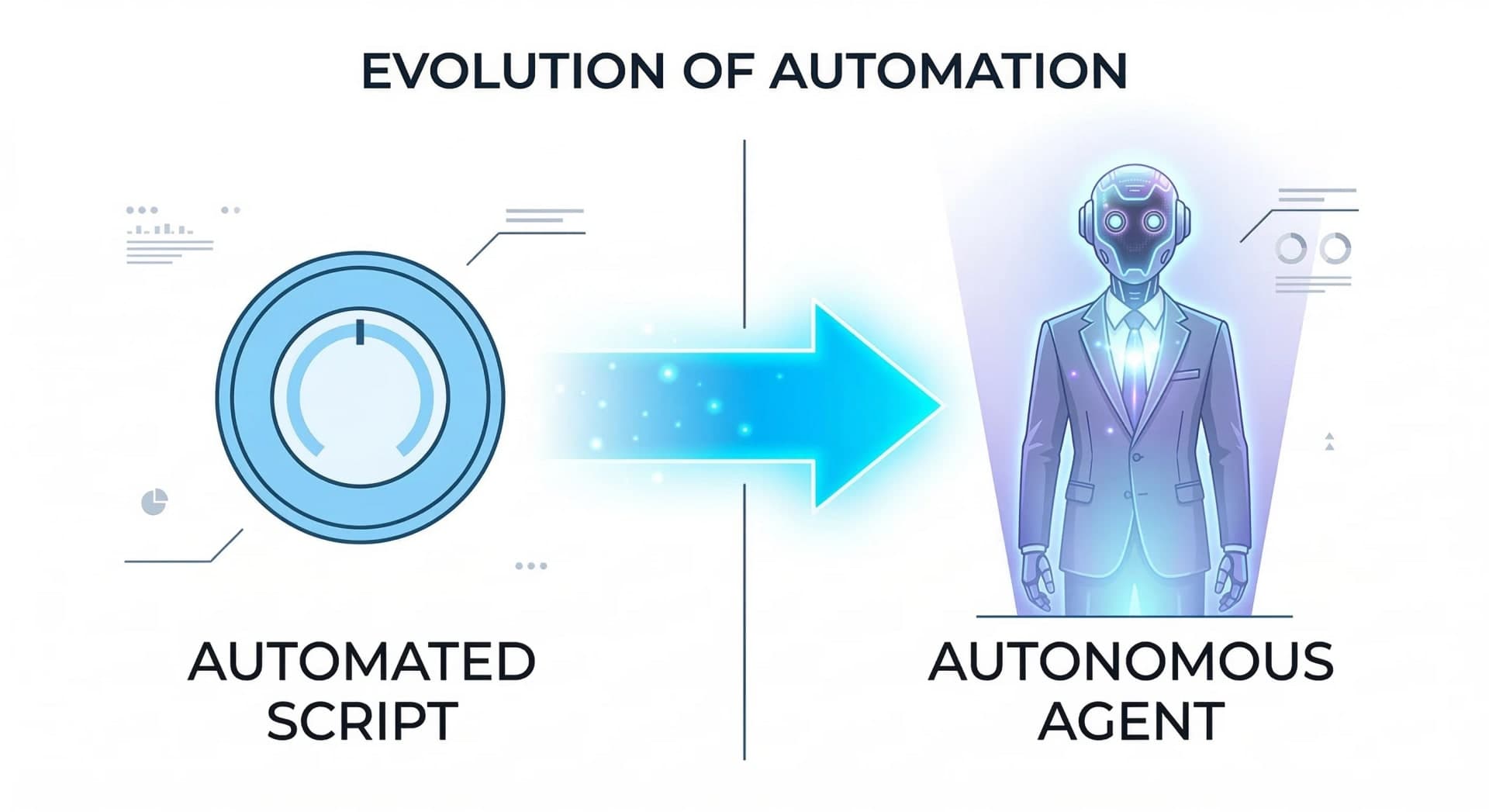
A trading bot running fixed rules is not agentic AI, it's a script. The distinction matters more than most people realize.
Genuine agentic AI systems share a few defining characteristics:
- They set and pursue sub-goals on the way to a broader objective, rather than following pre-written rules
- They observe and adapt by reading environment state and updating behavior based on what they find
- They plan across multiple steps where later actions depend on earlier outcomes
- They use tools - APIs, smart contracts, other agents, to act in the world beyond their own context window
What makes this newly viable is large language models with tool-use capabilities meeting the mature execution environment that Web3 provides. An agent can now read blockchain state, reason about it, decide on an action, and execute a transaction in a continuous loop, without stopping for human approval.
The gap between "automated" and "autonomous" is the gap between a thermostat and a building manager. Web 3.0 technology is what gives the building manager somewhere to act.
Why Decentralisation Is a Technical Requirement, Not Just a Philosophy
There's a reason serious agentic AI development is converging on Web3 infrastructure rather than traditional cloud. It comes down to what decentralisation meaning implies for autonomous systems: no single point that can block, censor, or override an agent's actions.
An agent running on traditional infrastructure is conditionally tolerated, not truly autonomous. It depends on:
- Cloud providers that can suspend accounts
- APIs that can revoke access without notice
- Payment processors that can freeze funds
- Platforms that can change terms of service overnight
Decentralised infrastructure removes these dependencies. When an agent's assets sit in a wallet it controls and its interactions are governed by smart contracts executing published code, its ability to act depends on network consensus, not anyone's goodwill.
Understanding types of decentralization matters here too. Architectural decentralisation (no single server) is different from political decentralisation (no controlling entity) and logical decentralisation (no single shared state). Robust agent infrastructure ideally achieves all three — which is why blockchain technology is the natural substrate.
If you're building autonomous systems for enterprise environments, our Blockchain Development Services outlines how decentralised infrastructure integrates with existing organisational frameworks at scale.
Smart Contracts as the Hands of Agentic AI
Smart contracts are the mechanism through which agents actually do things in the world. From an agent's perspective, they are callable functions in a trustless execution environment and this relationship is central to how autonomous execution works in practice.
Here is what that looks like concretely: an agent monitoring a DeFi lending protocol detects a position nearing liquidation. It calculates whether executing is profitable after gas costs, constructs the transaction, signs it, and calls the liquidation function. The blockchain confirms. Assets move, fees are collected with no human decision at any step.
More sophisticated cases involve agents chaining multiple smart contract interactions in a single atomic transaction:
- Flash-borrow assets from one protocol
- Execute arbitrage across two decentralized exchanges
- Repay the loan within the same block
- Capture the spread, with the entire sequence reverting if any step fails
This is blockchain technology explained through what it actually enables: a composable execution environment where agents act with confidence that the rules won't change mid-transaction. For teams building these kinds of systems, it’s worth exploring professional smart contract development support offered by EthElite.

The Emergence of Autonomous Software Companies on Web3
Individual agents executing smart contracts is interesting. Entire organizations whose core operations run on agents rather than humans, what might be called autonomous software companies is something more significant.
Several Web3 protocols are already structured this way. The organizational model looks roughly like this:
- Governance layer — token holders or a DAO set high-level objectives and constraints
- Agent layer — agentic AI systems execute operations in real time within those constraints
- Execution layer — smart contracts on a blockchain network carry out transactions, immutably and transparently
- Treasury layer — assets held in decentralised multi-sig or programmatic treasuries, accessible to agents within defined limits
What this eliminates is entire categories of organizational overhead, approval chains for routine decisions, reconciliation delays, middle management of repetitive processes. The Web3 meaning here is organizational as much as technical. Web 3.0 isn't just a different way to build applications. It's a different way to build institutions.
Real Use Cases Already Running
Theory is useful. Grounding it in what's actually live is better.
- Automated liquidity management — Uniswap v3 requires active position management to perform competitively. Agentic systems now adjust liquidity ranges, collect fees, and redeploy capital continuously without manual input.
- Cross-protocol yield optimization — Modern yield aggregators use agents that factor in gas costs, slippage, smart contract risk scores, and opportunity duration, not just raw APY when moving capital across decentralised protocols.
- Governance agents — Some large token holders have deployed agents that monitor proposals across multiple Web3 protocols, analyze likely impact, and vote according to documented principles without human review of each proposal.
- On-chain security monitoring — Several protocols run agents that detect anomalous transaction patterns and trigger defensive actions like pausing contracts before a human has even been notified.
If your team is evaluating where agentic automation fits in a Web3 product, get a free consultation from our Blockchain experts to understand practical starting points for teams at different stages.
The Risks That Come with Autonomous Execution
It would be dishonest to write about agentic AI in Web3 without spending real time on what can go wrong. The same properties that make blockchain networks attractive for agents: immutability, permissionless execution, composability can also make mistakes expensive and hard to contain.
- Smart contract bugs become agent vulnerabilities — An agent designed to interact with any protocol meeting certain criteria may encounter one with a vulnerability, either as a victim or as an inadvertent trigger. The agent has no way to know the difference without explicit risk scoring built into its decision logic.
- Feedback loops between agents — Multiple agentic AI systems watching the same signals on the same blockchain network can amplify price movements, drain liquidity, or produce cascading effects that no individual agent was designed to cause.
- Irreversibility at execution speed — A bug in traditional software can usually be caught before serious damage occurs. An autonomous agent on-chain can execute thousands of transactions before anyone notices and blockchain transactions cannot be rolled back.
- Oracle manipulation — Many agents rely on external data feeds to perceive market reality. Manipulating the oracle manipulates the agent's decisions. This is a known attack vector that responsible agentic AI design must account for explicitly, not as an afterthought.
These risks don't make autonomous execution a bad idea. They make it a serious engineering discipline, one that deserves the same rigor that the best teams bring to smart contract security audits.
Frequently Asked Questions
Q: What is agentic AI in simple terms?
A: Agentic AI refers to systems that can set goals, plan across multiple steps, and take actions in the world including executing transactions and calling smart contracts without requiring human approval at each step.
Q: Why does Web3 suit autonomous agents better than traditional infrastructure?
A: Web3 technology is permissionless, programmable, and composable. An agent operating on a public blockchain network doesn't need approval from a cloud provider, API vendor, or payment processor. If it has assets and gas, it can act and the rules governing its interactions are fixed in code, not subject to a platform's discretion.
Q: What are decentralised protocols and why do they matter for AI agents? A: Decentralised protocols run on blockchain infrastructure without a central operator. Their rules are enforced by smart contracts and network consensus. For agents, this means consistent, uncensorable interfaces they can depend on, no third party can change the terms mid-operation.
Q: What is decentralisation meaning in the context of autonomous software?
A: Decentralisation means no single entity controls the infrastructure an agent depends on. For autonomous software companies, this allows organizational structures where rules are encoded in smart contracts, executed by agents, and transparent to every stakeholder with no central authority that can unilaterally override the system.
Q: What are the biggest risks of agentic AI on blockchain networks?
A: The main risks are smart contract vulnerabilities, feedback loops between competing agents, the irreversibility of on-chain mistakes at execution speed, and oracle manipulation that corrupts an agent's perception of market reality. All are manageable with rigorous design, none are trivial.
Conclusion
Agentic AI and Web3 are converging into something genuinely new: software that pursues goals and executes on decentralised infrastructure without human intermediaries at each step.
The blockchain technology properties enabling this weren't designed for AI agents, but they turn out to be exactly what autonomous systems need. Decentralisation, properly understood, is a technical requirement for systems that need to be trustworthy independent of any single party's goodwill.
Web 3.0 technology gave us programmable money. Agentic AI is turning it into programmable organizations. The question isn't whether this will happen, it already is. The question is whether it's being built carefully enough.
As this intersection evolves, platforms like EthElite are increasingly contributing through research, ecosystem insights, and consulting support that help teams understand how AI with blockchain can be implemented responsibly and effectively in real-world Web3 systems.
Share with your community!