Loading blog post...



7 Proven Ways DeFi Lending Transforms Digital Finance
Traditional banks are being replaced by transparent code. Explore how DeFi lending is breaking down borders, reducing costs, and creating a programmable future for global digital finance through automated smart contracts.
Financial systems have traditionally relied on intermediaries such as banks, brokers and centralized institutions that control access to credit. Over the last few years, however, decentralized finance has started reshaping this model by replacing intermediaries with transparent code.
Among all innovations inside DeFi, lending has emerged as one of the strongest real-world use cases. Through automated smart contracts, users can borrow or lend assets without traditional gatekeepers, creating a new layer of Digital Finance that operates globally and continuously.
Understanding how DeFi lending works reveals why it has become central to modern defi platforms and why many believe it represents the next evolution of finance.
1. DeFi Lending Redefines What DeFi Meaning Represents
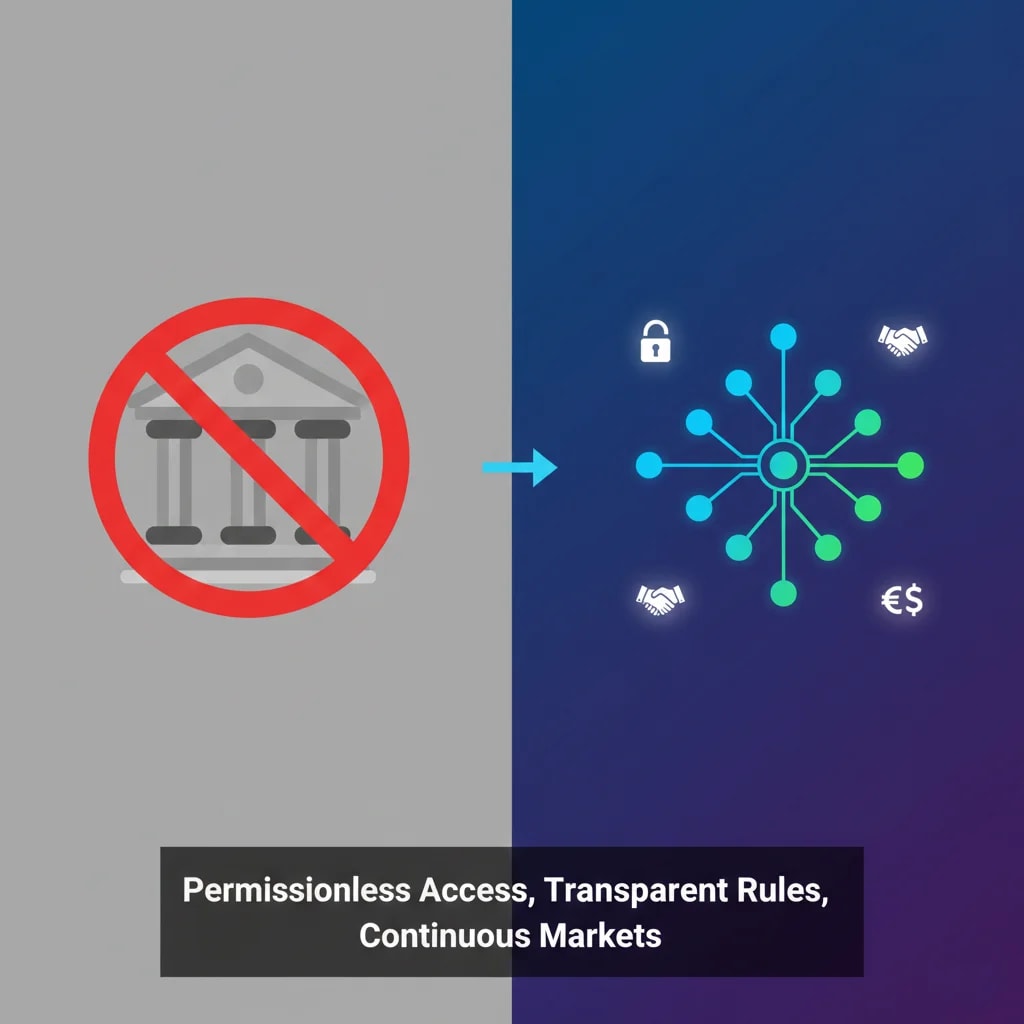
To understand the impact of lending, it’s important to revisit defi meaning itself. At its core, DeFi aims to recreate financial services using open protocols rather than centralized entities.
Lending captures this shift clearly. Instead of applying for loans through institutions, users interact with smart contracts that enforce rules automatically.
This changes the fundamentals of decentralised finance:
- access becomes permissionless
- rules remain transparent
- markets operate continuously without manual approval
In many ways, lending is the purest expression of decentralized finance in action.
2. DeFi Platforms Create Global Access to Credit
Traditional lending depends on geography, identity checks, and institutional approval. Large parts of the world remain excluded from these systems.
DeFi platforms remove those barriers by allowing anyone with a wallet to participate. Collateral replaces credit scores, and smart contracts manage enforcement automatically.
This enables:
- borderless borrowing
- instant liquidity access
- transparent collateral requirements
For teams building inclusive lending systems, our blockchain consulting services help design scalable financial architectures.

3. Automated DeFi Protocols Reduce Intermediary Costs
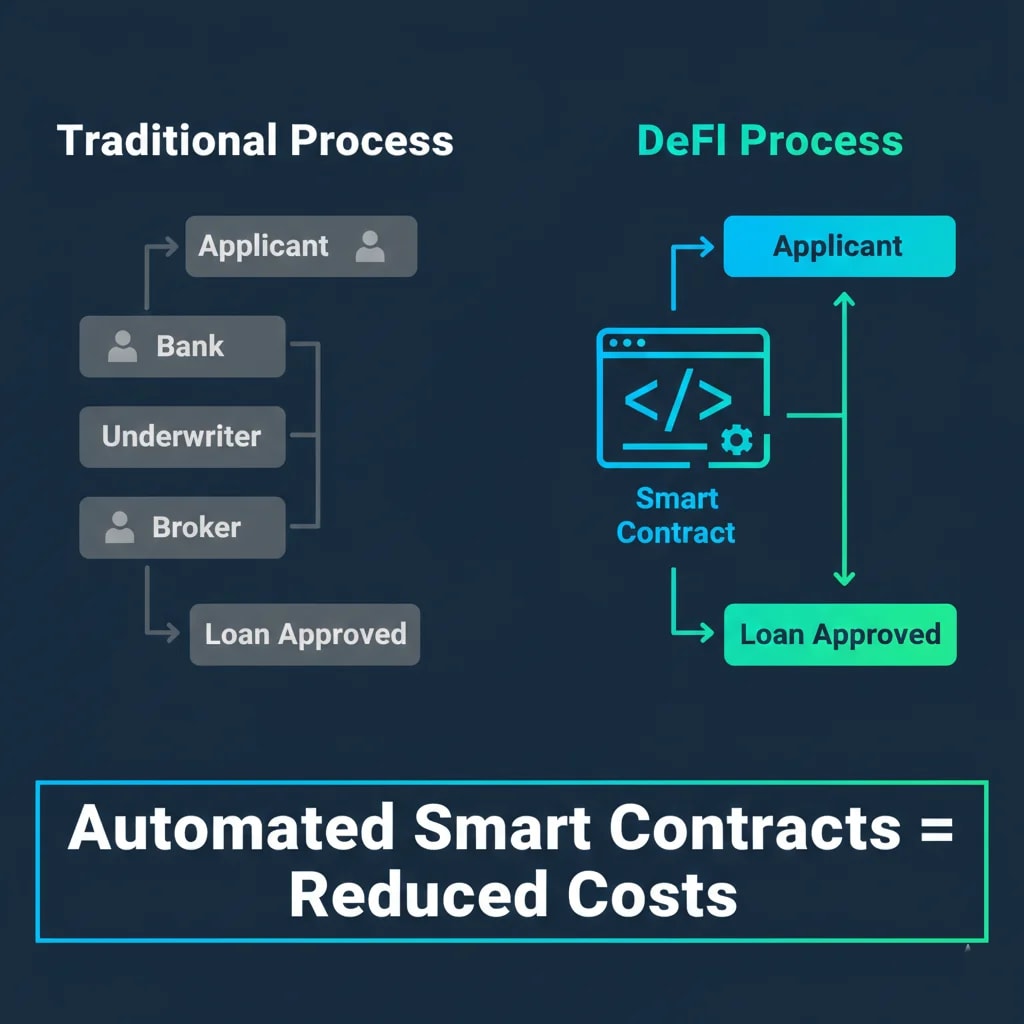
Traditional finance involves multiple intermediaries, each charging fees. DeFi protocols automate these roles through code.
Smart contracts handle:
- loan creation
- interest calculations
- collateral management and liquidation
This automation lowers operational costs and creates more efficient lending markets. For many defi projects, this efficiency is a major advantage over legacy systems.
4. Transparent Risk Models Improve Trust in DeFi Applications
Risk management in traditional finance is often opaque. Users rarely understand how interest rates or liquidation rules are determined.
In decentralized finance, risk models are visible on-chain. Users can audit collateral ratios, reserve pools, and lending rules themselves.
This transparency builds trust across defi applications and allows participants to make informed decisions rather than relying on institutions.
For teams building trust-centric products, our smart contract development services focus on transparent financial logic.
5. DeFi Coins Align Incentives Across Lending Ecosystems
Most lending systems rely on a defi coin to align participants and sustain growth.
These tokens often serve multiple roles:
- governance voting
- liquidity incentives
- fee-sharing mechanisms
When designed well, token incentives encourage long-term participation and strengthen ecosystem stability rather than short-term speculation.
EthElite’s token design services help align incentives with platform goals. Get a free consultation now.
6. DeFi Apps Enable Programmable Lending Strategies
Unlike traditional finance, where products are fixed, a defi app allows users to build flexible strategies by combining multiple protocols.
Users can:
- borrow against collateral and redeploy liquidity
- automate yield strategies
- move funds between protocols instantly
This programmability transforms Digital Finance into a modular system where users actively shape their own financial workflows.
For teams building composable DeFi ecosystems, our custom Web3 development services support interoperable protocol design.
7. DeFi Lending Accelerates the Evolution of Digital Finance
Perhaps the biggest transformation lies in expectations. Users increasingly expect financial systems to be open, transparent, and always available.
DeFi lending introduces:
- continuous market operation
- permissionless participation
- transparent governance
As these expectations grow, traditional systems may adopt features first pioneered by defi crypto ecosystems, blurring the line between traditional and decentralized finance.
FAQ: DeFi Lending and Digital Finance
Q: What is DeFi lending?
A: Borrowing and lending assets through smart contracts instead of centralized institutions.
Q: How do DeFi platforms distribute loans?
A: Through automated smart contracts using collateralized assets.
Q: What role do DeFi coins play?
A: They align incentives and often govern protocol decisions.
Q: Is DeFi lending accessible globally?
A: Yes, anyone with a compatible wallet can participate.
Q: How does DeFi transform digital finance?
A: By making financial services transparent, programmable, and open.
Conclusion
DeFi lending is more than a trend, it’s a foundational shift in how digital finance operates. By removing intermediaries, automating trust, and enabling programmable strategies, decentralized finance creates systems that are faster, more transparent, and globally accessible.
As DeFi platforms, DeFi applications, and DeFi protocols continue to mature, lending remains one of the clearest demonstrations of how blockchain reshapes financial infrastructure. Behind the scenes, this evolution relies on teams that understand both finance and protocol design - an approach that reflects how EthElite views DeFi development: less about experimentation, more about building systems meant to persist.
In the long run, the success of DeFi lending won’t depend on hype cycles. It will depend on how naturally these systems integrate into everyday financial life.
Share with your community!