Loading blog post...


7 Core Components of a High-Performing Web3 Website
Most crypto websites waste their first eight seconds on vague taglines and impressive but empty animations. A high-performing Web3 website has only one job: to convert a skeptical stranger into an informed user. From building "Trust Architecture" that satisfies developers to designing a mobile-first experience for on-the-go traders, this guide breaks down the seven structural pillars that turn a digital brochure into a powerful conversion engine.
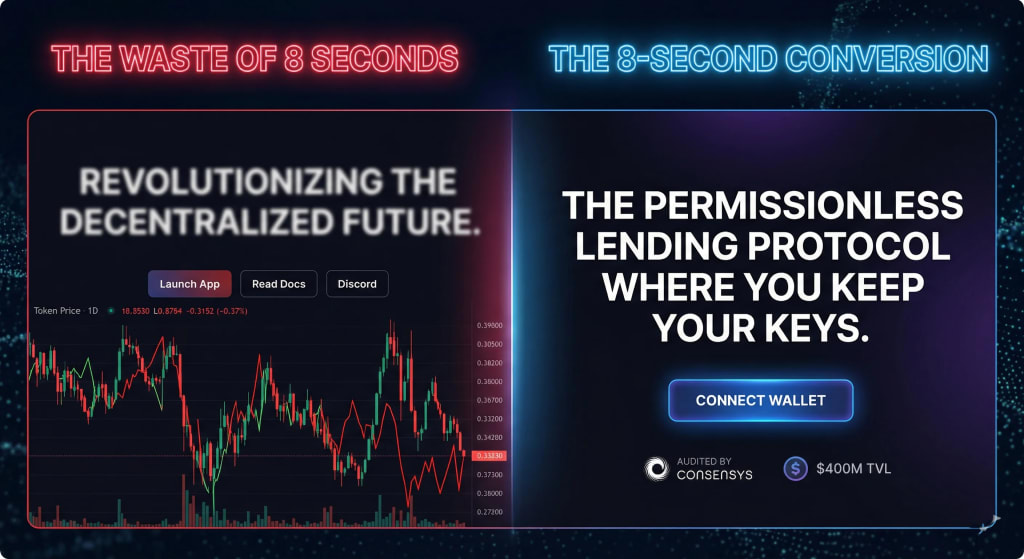
The landing page is the first thing most people see before they ever touch your Web3 product. Before they connect a wallet, before they read the docs, before they decide whether to join the community, they land on a page and make a judgment in about eight seconds.
Most crypto websites waste those eight seconds. They lead with a token price ticker, a vague tagline about "decentralising the future," and a hero section that looks impressive and explains nothing. The visitor leaves having no idea what the product actually does.
A high-performing web3 website landing page does one job: convert a sceptical stranger into someone who understands the product well enough to take the next step. Here is what goes into building one.
1. A Hero Section That Answers the Only Question That Matters
The hero section - the first thing visible without scrolling has one job: answer "what is this and why should I care?" in under ten seconds.
Most crypto sites fail this immediately. For example - "The future of decentralised finance" answers neither question. "The permissionless lending protocol where you keep your keys" answers both.
What a high-converting hero section for a cryptocurrency website actually needs:
- A headline that describes the product, not the vision. The vision lives in the about page. The headline is for the visitor who has never heard of you and needs to understand immediately whether they are in the right place.
- A subheadline that handles the "so what." One or two sentences that explain the primary benefit to the specific person this product is for. Not for everyone, for the person most likely to use it.
- A single primary call to action. One button. Not "Launch App" and "Read Docs" and "Join Community" competing for attention. The most important next step, made obvious. Everything else goes below the fold.
- Social proof that is specific, not generic. "$400M TVL" or "Audited by XXX" or "Used by 80,000 wallets" means something. "Trusted by thousands of users worldwide" means nothing and everyone knows it.
The hero section of a web3 website is not the place for animation-heavy showcase work. It is the place for clarity. The best crypto platforms lead with clarity and use design to support it, not to substitute for it.
2. The Problem-Solution Narrative That Makes Visitors Stay
After the hero section convinces someone to keep reading, the next section needs to earn continued attention. The mechanism that works often in crypto sites and everywhere else is making the visitor feel understood before asking them to understand the product.
That means naming the problem the product solves in terms the target user would use themselves. Not "inefficient legacy financial infrastructure" - that is how the team talks internally. "Waiting three days to settle a trade" or "paying 30% in fees to an intermediary who adds nothing" - that is how the user experiences the problem.
For a blockchain dev building for enterprise clients, the problem framing principle should be: describe the frustration before presenting the solution.
What follows problem framing:
- The solution, described in terms of outcomes not features. Not "our protocol uses optimistic rollups" - that is a feature. "Trades that settle in minutes instead of days, at 90% lower cost" - that is an outcome. Features live in the docs. Outcomes live on the landing page.
- A brief mechanism explanation. One paragraph that gives enough technical credibility to satisfy a curious visitor without overwhelming someone who just wants to know if this solves their problem. Blockchain projects that go too deep too early on the landing page lose the non-technical visitor. Those that skip technical explanation entirely lose the technical one.
The best cryptocurrency websites calibrate this balance by being honest about who their primary visitor is and writing for that person rather than for everyone simultaneously.
3. Trust Architecture: What Crypto-Native Audiences Look For Before They Click Anything
A mainstream Web2 SaaS landing page builds trust with customer logos and testimonials. A web3 website visitor is often checking different things and they know what they are looking for.
The trust signals that actually matter to a crypto-native audience visiting a cryptocurrency website for the first time:
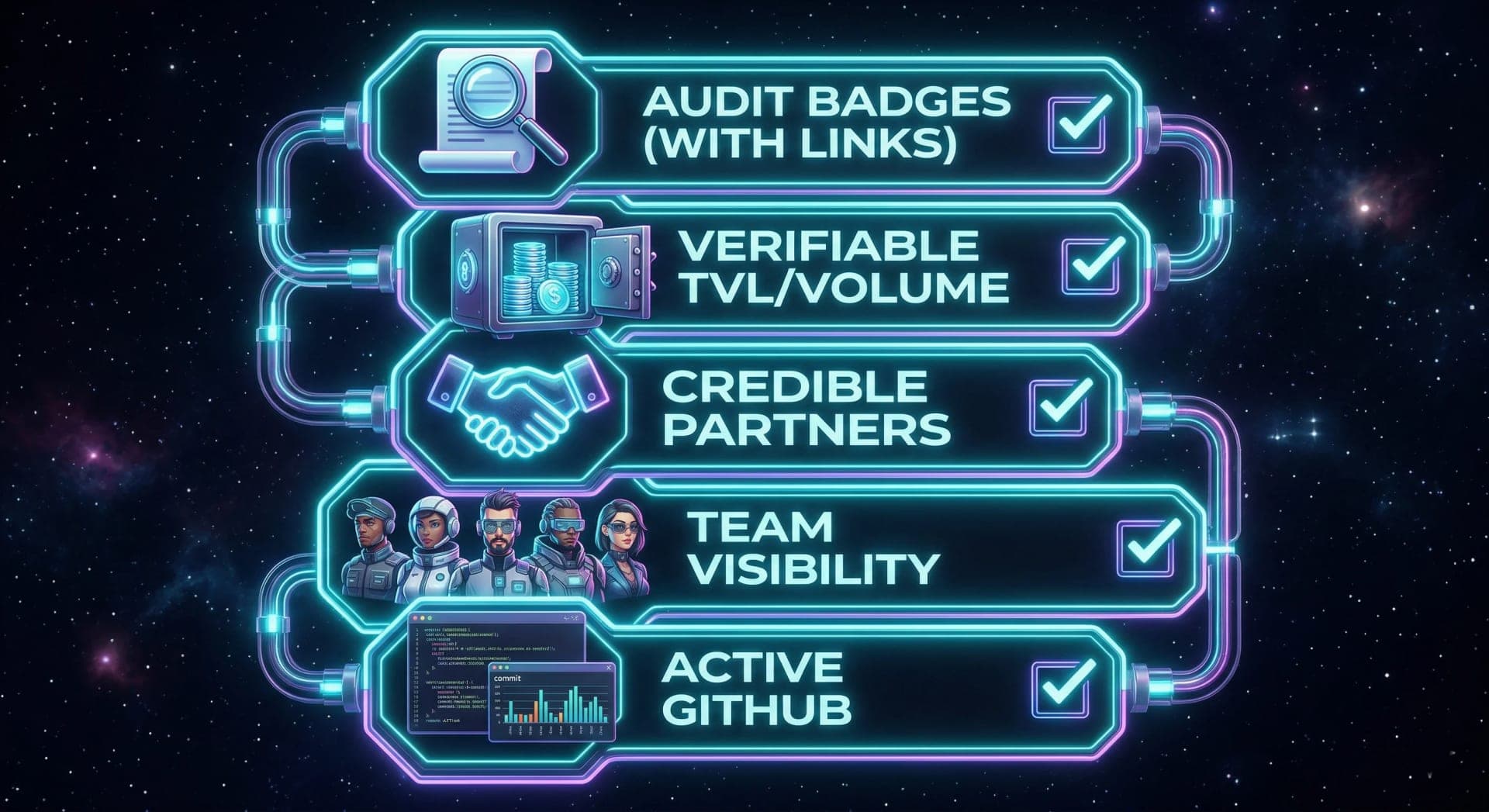
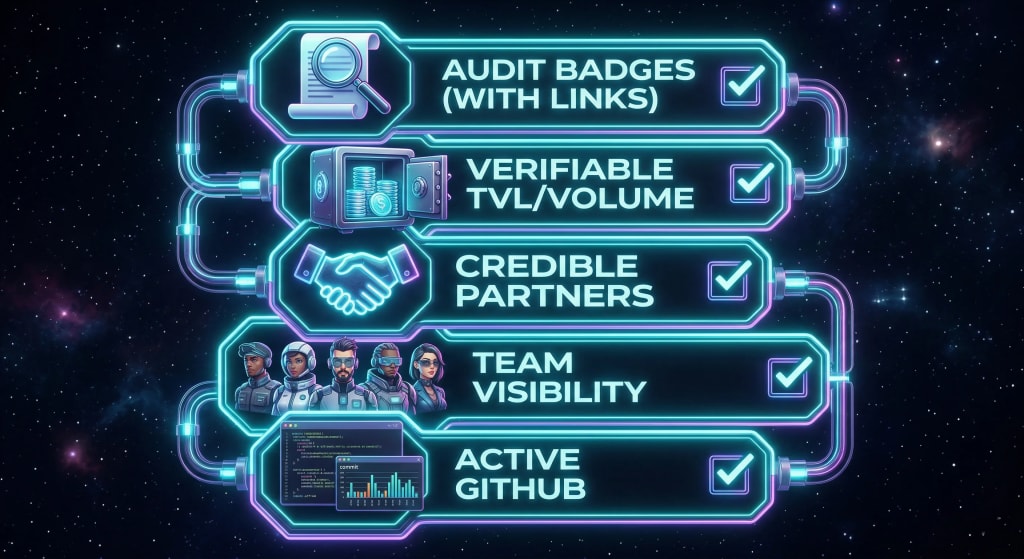
- Audit badges with links to the full report. Not just "audited by [firm]" as a logo - a clickable link to the actual report. Users who check will click through. Users who do not check are reassured by the presence. Both groups are served.
- Total value locked or transaction volume. Real usage metrics with on-chain sources that can be verified independently. Made-up or unverifiable numbers are worse than no numbers, a sophisticated visitor who cannot verify a metric assumes it is inflated.
- Named investors or partners with credible reputations. For early-stage new crypto projects, reputable investors signal that the project has passed some level of due diligence. This is not sufficient on its own but it is a meaningful signal.
- Team visibility. Anonymous teams are not automatically disqualifying, but founders with verifiable backgrounds and track records reduce the friction of trust significantly.
- GitHub activity. A link to an active repository with recent commits signals ongoing development. Many visitors will not click it. The ones who do are often the most valuable - developers, researchers, and sophisticated users who are evaluating whether to build on or integrate with the protocol.
Best blockchain development companies building web3 websites for clients understand that trust architecture is not decoration, it is a structural element that determines whether technically sophisticated visitors convert or leave.
4. Feature Presentation That Speaks to Both Technical and Non-Technical Visitors
Most crypto website landing pages make a binary choice: either they go deep on technical specifications (losing non-technical visitors immediately) or they stay entirely at the surface (losing developers and researchers who want to understand how it actually works).
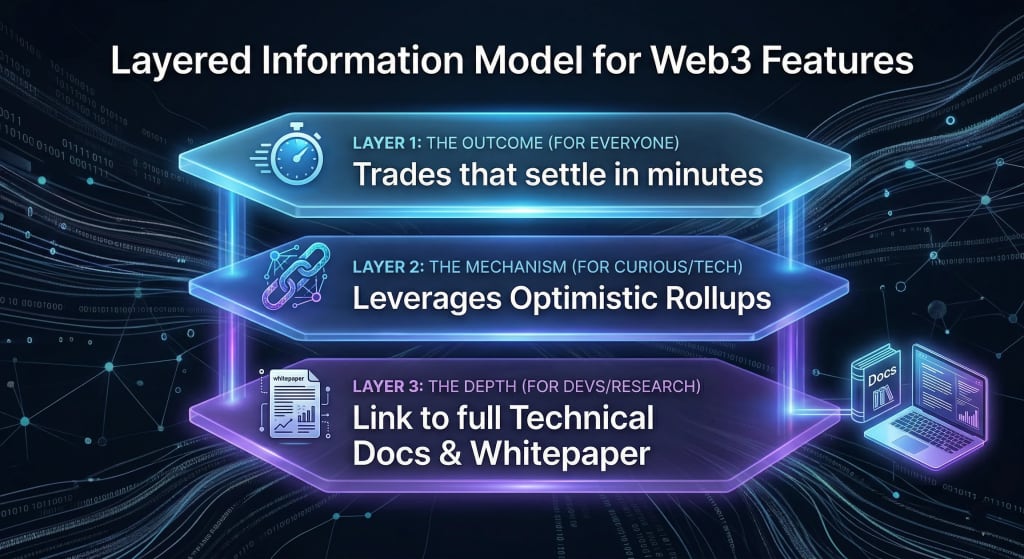
The solution is layered presentation - information available at multiple depths from the same section:
- The top layer is outcome-focused and jargon-free. What does this feature allow the user to do that they could not do before, or do faster, cheaper, or more safely?
- The middle layer is mechanism-focused and moderately technical. How does it work at a high level? What makes it different from existing approaches? This is where a web3 dev evaluating the protocol starts to form a technical opinion.
- The bottom layer lives in a linked resource - documentation, a technical blog post, a whitepaper section for visitors who want the full picture. The landing page links to this depth without trying to contain it.
This structure works because it respects different visitors' different needs without forcing everyone through the same level of detail. The blockchain app development company evaluating a potential integration reads further than the retail user deciding whether to try the product. Both should find what they need from the same page.
5. Clear User Journey Design: Where Do Different Visitors Go Next?
A landing page for a web3 website is typically visited by people with very different intentions. A retail user who wants to try the product, a developer who wants to build on the protocol, an investor conducting due diligence, a researcher evaluating the technology, a journalist writing about the space. All of them may land on the same page from different sources.
A single call to action serves the most important segment. But a well-designed crypto website landing page also provides clear paths for other visitor types without cluttering the primary conversion flow.
The way this typically works in practice:
- Primary CTA in the hero for the most important action — usually "Launch App," "Start Building," or "Connect Wallet" depending on the product stage
- Secondary navigation for other visitor types — "Read the Docs," "View on GitHub," "See the Audit" — positioned clearly but subordinate to the primary action
- Segment-specific sections further down the page — a developer-focused section with integration highlights and an API link, an investor-focused section with protocol metrics and team credentials, a user-focused section with a product walkthrough or demo
The goal is that any visitor, regardless of their intent can find their appropriate next step within thirty seconds of arriving. Blockchain projects that design only for the primary conversion path lose significant value from every other visitor type.
If your team needs landing page architecture that works across multiple visitor segments, our Web3 Website Development Services covers the full design and development process for crypto website landing pages built for conversion. Connect today to get started.
6. Mobile Experience That Does Not Treat Mobile as an Afterthought
Crypto trading websites, DeFi protocols, and most blockchain projects often have visitor bases where mobile represents 40-60% of traffic. The landing page experience on mobile frequently does not reflect that.
The mobile-specific failures common to cryptocurrency websites:
- Hero sections that break on small screens — headlines that looked elegant on desktop wrap awkwardly on mobile, CTAs that were positioned relative to desktop layouts appear in unexpected places, and background images that conveyed quality on desktop become illegible on mobile
- Navigation that is not touch-optimised — hamburger menus that do not open reliably, tap targets that are too small for finger navigation, and hover states that have no mobile equivalent
- Slow mobile load times — the performance issues that are annoying on desktop become dealbreakers on mobile, where network conditions are variable and user patience is lower
A web3 developer or blockchain developer building a crypto website landing page should be testing on actual mobile devices, not just responsive browser previews throughout development. Browser responsive mode does not replicate the actual performance, rendering, or interaction behaviour of real devices.
The practical standard: every element of the landing page should work as well on a mid-range Android device on a 4G connection as it does on a desktop with a fast connection. If it does not, it is not ready.
7. Copy That Sounds Like a Team, Not a Press Release
This is the component that most crypto sites get most consistently wrong and it is the one that requires the least technical expertise to fix.
Cryptocurrency websites frequently read like they were written by a committee optimising for comprehensiveness rather than by a team with a genuine point of view. The result is landing page copy that is grammatically correct, technically accurate, and completely inert.
The copy on a high-performing web3 website landing page has a voice, an identifiable perspective on the problem the project is solving and why the existing solutions are inadequate. That voice can be technical and precise, or accessible and warm, or provocative and direct. What it cannot be is generic.
A few practical tests for whether landing page copy is working:
- Could this paragraph appear on a competitor's website with minor word substitutions? If yes, it is not differentiating.
- Does it name the specific people it is for? "For DeFi traders managing active positions across multiple chains" is more compelling than "for anyone interested in decentralised finance."
- Does it make a claim that someone could disagree with? Safe, consensus statements produce safe, consensus reactions. Copy that takes a genuine position, "current lending protocols are broken for this specific reason" creates the kind of response that drives conversion.
- Does it use the project's own vocabulary, or generic crypto vocabulary? Projects with genuine communities develop their own language for the things they care about. That language, used naturally on the landing page, signals authenticity to people already familiar with the project and creates curiosity in those who are not.
Hiring blockchain developer talent is often the right call for only the technical components. For copy, the right approach is finding someone who genuinely uses and understands the product, then giving them the latitude to write with a real voice rather than editing it into corporate neutrality.
EthElite combines experienced blockchain developers with a dedicated Web3 marketing team, so technical execution and landing page copy are built with the same product understanding, not handed off in isolation.
Frequently Asked Questions
Q: What is the most important element of a crypto website landing page?
A: The hero section specifically the headline and primary CTA. If a visitor cannot understand what the product does and what to do next within eight seconds of arrival, everything else on the page does not get seen.
Q: How do web3 landing pages build trust differently from regular websites?
A: Cryptocurrency websites need to address a different set of trust signals. Generic social proof that works for SaaS does not satisfy a crypto-native audience conducting genuine due diligence.
Q: Should a crypto landing page target technical or non-technical visitors?
A: Both. Through layered content presentation. Outcome-focused surface copy serves non-technical visitors; mechanism explanations and linked technical resources serve developers and researchers. The best web3 websites make both groups feel the page was written for them.
Q: How important is mobile for crypto website landing pages?
A: Very. Mobile often represents 40-60% of traffic for blockchain projects. Mobile-specific failures in layout, navigation, and load time cost a significant portion of potential visitors.
Q: What makes crypto website copy feel authentic rather than generic?
A: Specificity, a genuine point of view, and language that reflects how the team actually talks about the problem they are solving. Copy that could appear on any crypto website with minor word changes is not doing its job.
Conclusion
A web3 website landing page is not a brochure. It is a conversion mechanism, a structured argument for why the right visitor should take the next step.
The seven components here work together: a clear hero sets expectations, problem-solution narrative earns continued attention, trust signals handle credibility, layered feature presentation serves different visitor depths, journey design handles different visitor intents, mobile execution reaches the full audience, and genuine copy makes it all feel human rather than assembled.
Blockchain software development companies and crypto projects that treat the landing page as a design exercise rather than a product decision tend to produce beautiful pages that do not convert. The ones that treat it as the first step in the user journey, designed backward from the conversion action rather than forward from the design aesthetic tend to produce pages that actually work.
That is also why EthElite approaches Web3 website development as part of product positioning by combining technical build, structure, and messaging in one execution layer.
The first impression is the whole game before anyone touches the product. It deserves the same rigour as the product itself.
Share with your community!