Loading blog post...


6 Ways Tokenomics Design Shapes Long-Term Incentives
Every token launch tells a story, but eighteen months later, the math takes over. While most projects focus on the 'hype' of day one, the most successful ecosystems are built on invisible mechanics. From the 'ticking clock' of supply schedules to the strategic alignment of 4-year vesting cliffs, discover the six critical dimensions of tokenomics design that separate long-term industry leaders from short-term exits.
Every token launch tells a story about what the team believes will motivate people over time. Some of those stories are honest. Some are optimistic. And some are quietly designed to benefit insiders at the expense of everyone who comes later.
Tokenomics is the system underneath that story, the mechanics that determine who gets rewarded, when, and for doing what. It shapes behaviour in ways that are often invisible at launch and very visible eighteen months later when the incentives start paying out.
This blog covers six specific ways tokenomics design shapes long-term incentives and what good design actually looks like in each case.
1. Supply Schedule Design: The Clock That Runs Whether You Watch It or Not
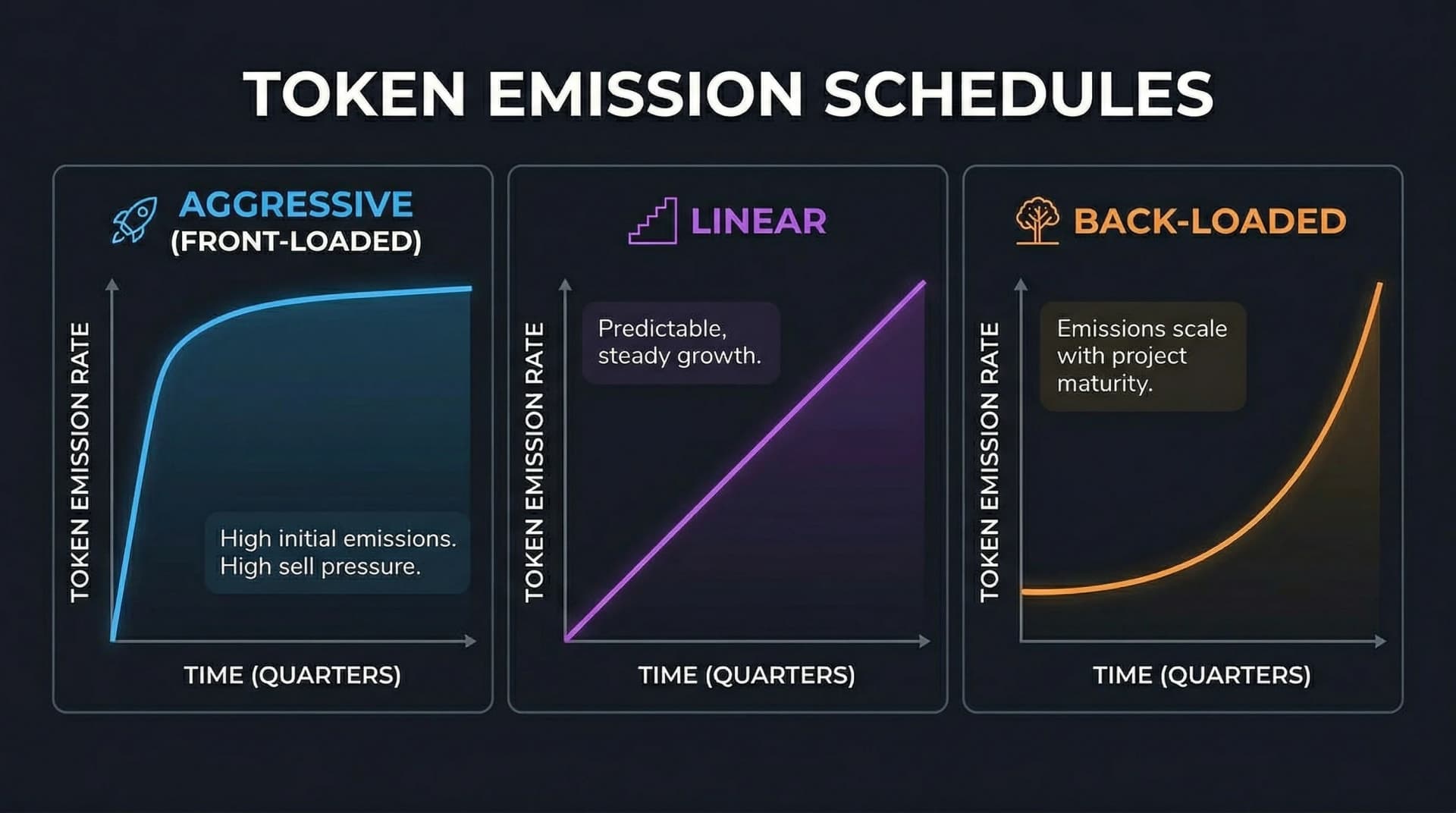
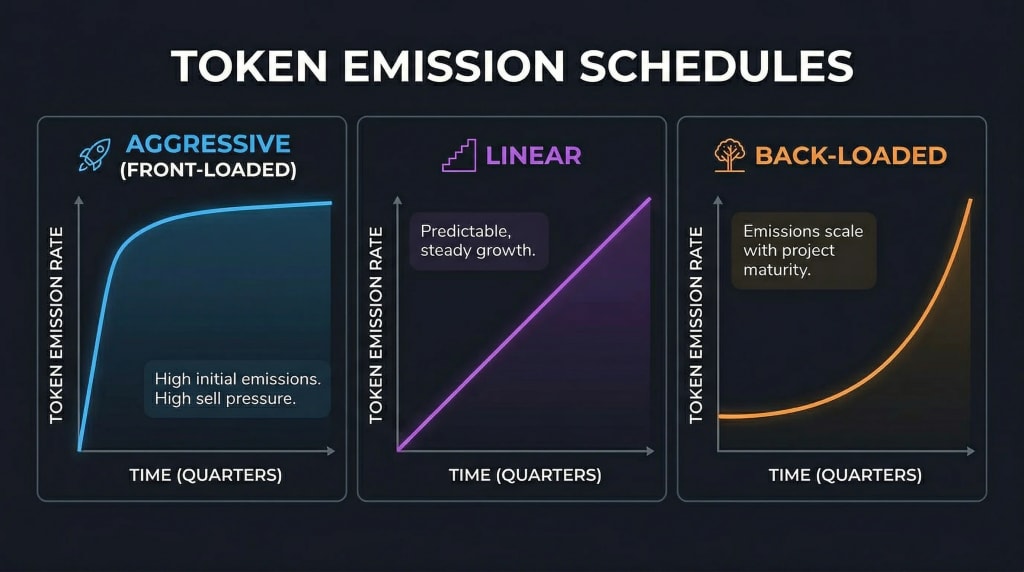
The supply schedule is the foundation everything else sits on. It determines how many tokens exist today, how many will exist in a year, and who is holding the newly issued ones.
Tokenization meaning in practice starts here: when you hold a token, you hold a fraction of the total supply. If that supply is expanding rapidly, your fraction is shrinking even if the nominal amount you hold does not change.
The design decisions that matter most:
- Emission rate — how quickly are new tokens entering circulation? Front-loaded emissions bootstrap early participation but create sustained sell pressure as recipients realise gains. Back-loaded or declining emissions are more conservative but may not generate the early energy needed to reach critical mass.
- Who receives new emissions — if new supply flows primarily to liquidity providers, validators, or active protocol users, the incentive structure rewards genuine participation. If it flows primarily to treasury addresses or team wallets, it is a different conversation.
- Hard cap vs. inflation — fixed supply digital currencies like Bitcoin derive scarcity value from an unchangeable maximum. Inflationary models can work if fee burns create equilibrium, but the path to that equilibrium needs to be credible before investing in cryptocurrency at scale.
The supply schedule is the one part of tokenomics that is hardest to change after launch and the one that has the most durable effect on long-term incentive alignment.
2. Vesting and Lock-Up Structures: Aligning Who Stays and Who Exits
Vesting schedules are the mechanism by which a token launch either aligns long-term interests or creates a structured exit for insiders at the expense of later participants.
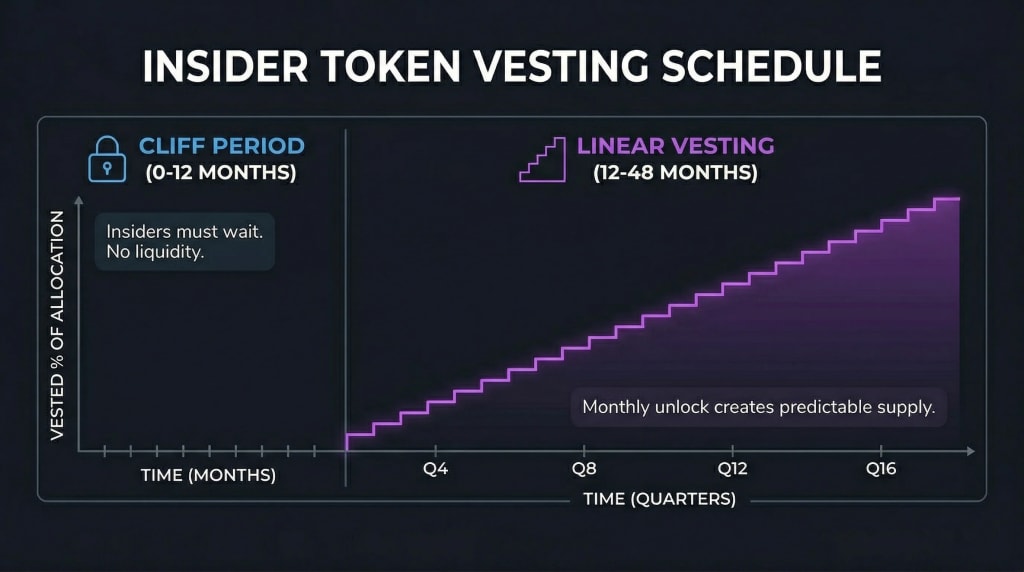
When a project launches a new coin launch, the team, investors, and advisors hold significant allocations. The vesting schedule determines when those allocations become liquid. Short vesting with no cliffs means insiders can sell within months of launch. Four-year vesting with a twelve-month cliff means their financial outcome is tied to the project's health over a meaningful time horizon.
The numbers that matter when evaluating any token launch services engagement or project:
- Total insider allocation as a percentage of supply — above 40% concentrated among founders and early investors is a meaningful concentration risk
- Cliff duration — twelve months minimum is standard for anything credible; shorter than that is a signal worth scrutinising
- Vesting period after cliff — two to four years is the range that produces genuine long-term alignment
- Whether governance rights vest with tokens — teams whose governance power activates at cliff can influence protocol decisions in ways that favour their selling window
Good vesting design also considers what happens after vesting ends. A team that fully vests and immediately loses all financial stake in the protocol is a team with diminishing incentive to continue building. Ongoing grants, long-dated options, or equity-like structures tied to protocol milestones extend alignment beyond the initial vesting schedule.
3. Utility Design: The Reason People Hold When Speculation Fades
This is the section that separates tokenomics documents from tokenomics systems. Any project can write that the token will have "ecosystem utility." The question is whether that utility creates genuine structural demand - reasons to hold that exist independently of price expectations.
Security token structures, where holding the token provides a claim on protocol revenue or fee distributions, are the most straightforward form of durable utility. The token resembles equity in economic terms, its value is anchored to the protocol's cash flows rather than entirely to speculation.
Other utility structures that create real holding incentives:
- Protocol access requirements — interactions with the protocol require holding or staking the token. Demand scales directly with protocol usage.
- Governance over meaningful decisions — voting rights over real treasury allocations, parameter changes that affect returns, or upgrade decisions that affect functionality. Governance over a protocol with no revenue and no meaningful decisions is not utility.
- Staking for network security — tokens locked to validate the network earn yield and contribute to security. The economic incentive to stake reduces circulating supply and creates holding demand that scales with the network's security requirements.
Data tokenization applications and security token offerings have pushed this further by attaching tokens to real-world cash flows like rental income, royalties, receivables. When a token represents a legal claim on an underlying asset, the utility is defined by law rather than protocol design. That is a different risk profile entirely and one worth understanding clearly before investing in cryptocurrency in this category.
If you're designing token utility for a new protocol, our Blockchain Development Services covers utility architecture and the technical implementation of token-gated mechanisms.
4. Governance Rights Distribution: Who Actually Controls the Protocol
Tokenomics design and governance are inseparable. The distribution of tokens is the distribution of governance power and governance power determines who can change every other parameter in the system.
A token launch that concentrates governance rights among a small number of early holders creates a protocol that is formally decentralised and practically controlled by insiders. This matters for long-term incentive alignment because it means the rules can be changed in ways that favour whoever holds governance power including rules about token emissions, treasury allocation, and protocol fees.
The design considerations that determine whether governance is genuinely distributed:
- Quorum requirements — how much of the total supply needs to participate for a vote to be valid? Low quorum thresholds allow small, coordinated groups to pass significant decisions without broader community involvement.
- Delegation infrastructure — passive token holders who do not actively vote effectively surrender their governance stake. Well-designed tokenomics includes delegation mechanisms that allow passive holders to assign their voting power to active representatives.
- Proposal thresholds — minimum token holdings required to submit a governance proposal prevent spam and ensure that governance bandwidth is used on substantive decisions rather than noise.
- Time delays on execution — a mandatory delay between a vote passing and its execution allows the community to identify and respond to malicious or mistaken proposals before they take effect.
The tokenization of governance rights is one of the most consequential design decisions in any protocol. Getting it wrong produces a system where the most economically aligned participants, long-term holders of digital currencies who use the protocol have less influence than insiders whose primary interest is near-term financial returns.
5. Token Launch Mechanics: How the First Day Sets Long-Term Expectations
The mechanics of a new coin launch set precedents that are difficult to walk back. How tokens are distributed at launch — who gets them, at what price, under what conditions — establishes the community's understanding of what the project stands for.
The launch mechanisms in common use, and what they signal:
- Fair launches — no pre-mine, no private sale, tokens distributed through mining or protocol participation from day one. They signal a commitment to equitable distribution but often sacrifice the early funding that enables serious development. Bitcoin is the canonical example.
- VC-backed launches with public sales — the dominant model for serious token launch services engagements. Early investors and the team receive allocations at lower prices than public participants. Transparent vesting schedules and credible investors with reputational skin in the game make this model legitimate. Opacity about allocation sizes and investor identity makes it extractive.
- Liquidity bootstrapping pools and Dutch auctions — price-discovery mechanisms that allow the market to set the initial price rather than insiders. These reduce the advantage of early insiders and produce a more representative initial price, but they are less common and less understood by retail participants.
- Airdrop distributions — tokens distributed to existing community members, users of related protocols, or participants in specific on-chain activities. When well-designed, airdrops build genuine community ownership. When poorly designed, they attract wallet farmers with no interest in the protocol and create immediate sell pressure.
The long-term incentive implication is that a token launch perceived as unfair where insiders clearly profited at retail's expense creates a community dynamic that is difficult to recover from. Trust, once broken at launch, tends not to return.
6. Token Burns and Deflationary Mechanisms: Making Scarcity Mean Something
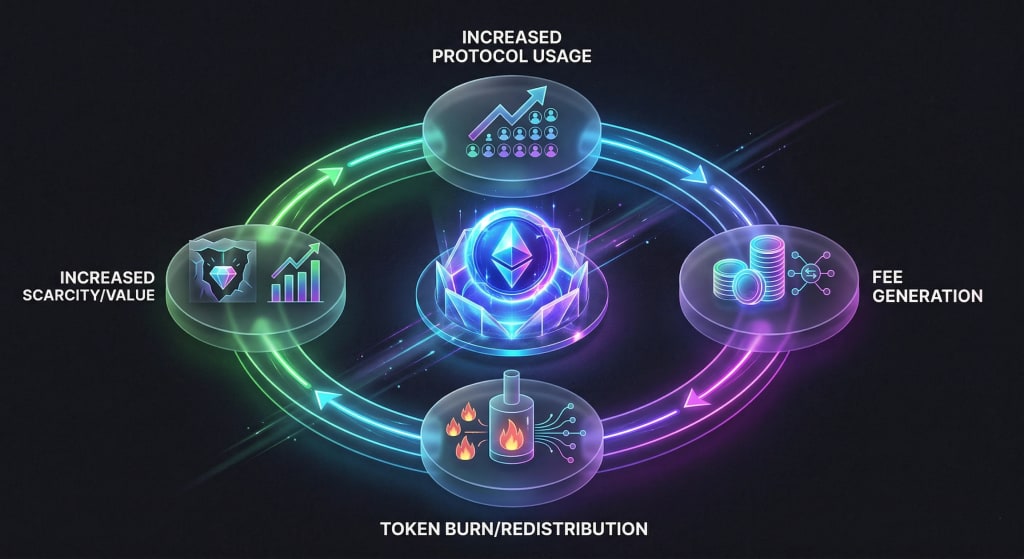
Tokenomics systems that only add supply create inflationary pressure that works against long-term holders. Burn mechanisms where tokens are permanently removed from circulation create deflationary pressure that can offset emissions and, in some cases, reduce total supply below the initial amount.
The most effective burn mechanisms are tied to genuine economic activity rather than arbitrary destruction. Ethereum's EIP-1559 burns a portion of every transaction fee, the more the network is used, the more ETH is destroyed. During periods of high network activity, ETH has been net deflationary despite ongoing validator emissions. The burn is load-bearing: it directly connects token value to network usage.
Other burn structures worth understanding when evaluating cryptocurrency projects:
- Buyback and burn programs — protocols use a portion of fee revenue to buy tokens on the open market and burn them. This ties token value to protocol cash flows in a way that is transparent and verifiable on-chain.
- Penalty burns — tokens staked for governance or network security that are slashed for misbehaviour are sometimes burned rather than redistributed. This removes supply while strengthening the incentive to behave honestly.
- Fee burns with dynamic rates — burn rates that adjust based on network activity create an automatic stabiliser. High usage burns more, reducing supply during periods when demand is also high.
The design question for any burn mechanism is whether the burn rate can credibly offset emissions at realistic levels of protocol activity. A burn mechanism that only becomes meaningful at 10x the current usage is not a meaningful deflationary mechanism today, it is a promise about a future that may not arrive.
For projects evaluating which burn mechanics to implement, our Token Launch Services covers the full economic design and implementation process. Connect today to get the first consultation for free.
Frequently Asked Questions
Q: What is tokenomics and why does it matter for investing in cryptocurrency?
A: Tokenomics is the economic design of a token system: supply schedules, distribution, utility, and governance. It matters for investing in cryptocurrency because it determines whether a token has structural demand that outlasts initial speculation, or whether its value depends entirely on new buyers paying more than old ones.
Q: What is tokenization meaning in the context of digital assets?
A: Tokenization refers to representing something of value - ownership, access rights, revenue claims as an on-chain token. Data tokenization and security token structures extend this to real-world assets, creating tokens with legal and economic properties that go beyond protocol-native utility.
Q: What should I look for in a token launch?
A: Transparent vesting schedules for team and investor allocations, clear utility that creates structural holding demand, credible governance distribution, and launch mechanics that do not disproportionately advantage insiders at the expense of public participants.
Q: How do token burns create long-term value?
A: By reducing circulating supply, increasing the scarcity of remaining tokens, and when tied to protocol activity connecting token value to genuine economic usage rather than pure speculation.
Q: What is the difference between a security token and a utility token?
A: A security token represents a legal claim on an underlying asset or revenue stream, it is regulated like a traditional security in most jurisdictions. A utility token provides access to protocol functions or governance rights without a direct legal claim on assets. The distinction has significant regulatory implications depending on jurisdiction.
Conclusion
Tokenomics design is not an abstraction. It is a set of concrete decisions about supply schedules, vesting structures, utility mechanics, governance distribution, launch mechanics, and burn rates that determine who is rewarded for doing what, over what time horizon.
The six dimensions covered here interact with each other. A well-designed supply schedule with extractive vesting produces the same long-term outcome as a poorly designed one. Genuine token utility means nothing if governance rights are so concentrated that the utility can be removed by insiders at will.
What makes tokenomics work is coherence, each element reinforcing the others in service of a system where the people doing the most valuable work are the ones rewarded most, over time horizons long enough to build something worth holding.
That level of coherence usually requires deliberate modelling before launch, which is why teams often work with blockchain expert firms like EthElite when structuring token systems intended to survive beyond the initial market cycle.
Share with your community!