Loading blog post...


6 Ways To Track Blockchain Transactions: A Practical Guide
Ever sent a crypto transaction only for it to vanish into "pending" limbo? In this practical guide, we demystify the blockchain ledger. Discover 6 proven ways to track your funds in real-time from using block explorers and multi-chain trackers to setting up automated alerts so you never have to guess where your money is again.
You sent crypto transaction twenty minutes ago and it has not arrived. Or you are trying to verify that a payment actually went through. Or you just want to understand what is happening with your funds without calling anyone or opening a support ticket.
The good news: every blockchain transaction is public. Every one. Unlike a bank transfer that disappears into a black box until it arrives, crypto transactions are recorded on a distributed ledger that anyone can read, in real time, for free.
The slightly less good news: knowing where to look and what you are looking at takes a few minutes to learn. This guide covers six practical ways to track blockchain transactions from the simplest to the most sophisticated so you always know exactly where your funds are.
What You Are Actually Looking At When You Track a Crypto Transaction
Before getting into the tools, it helps to understand what a blockchain transaction actually is.
When you send crypto from your digital wallet crypto address to another, that transaction does not travel invisibly from A to B. It gets broadcast to the entire network, picked up by validators or miners, bundled into a block, and written permanently to the crypto ledger. Every step of that process is visible.
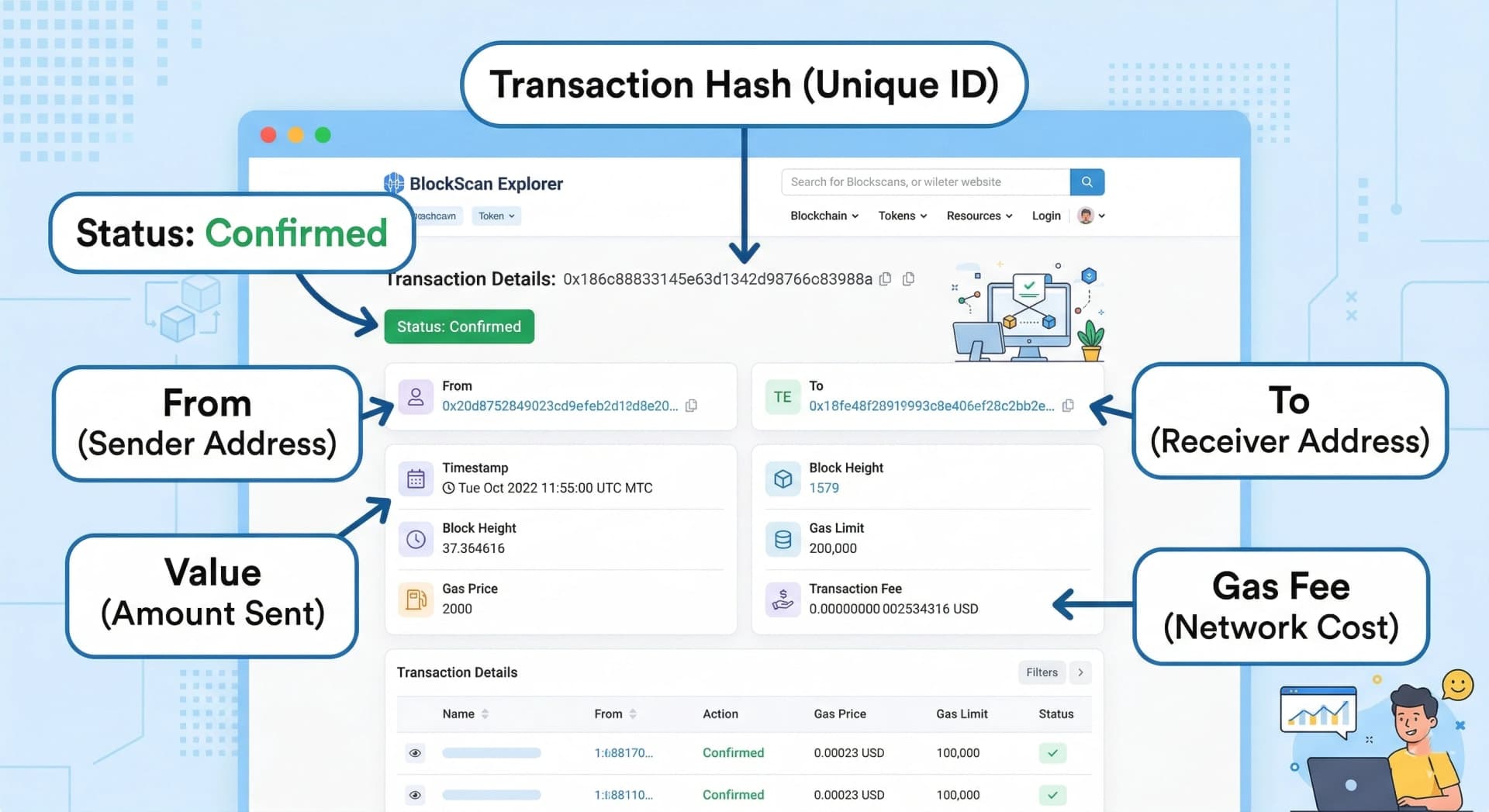
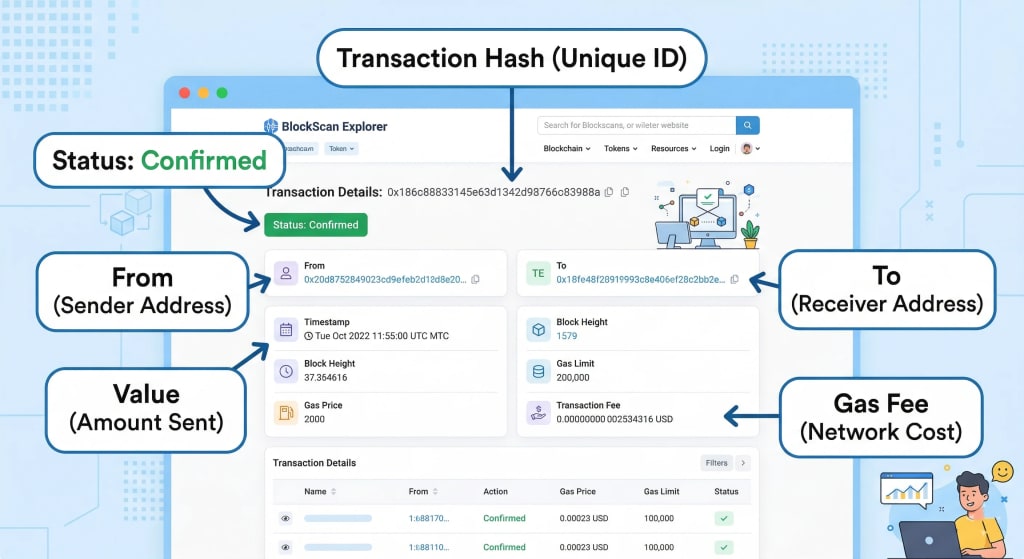
What a typical transaction record contains:
- Transaction hash (TxHash) — the unique ID for your transaction, like a tracking number for a parcel
- Status — pending, confirmed, or failed
- From and To addresses — the sender and receiver wallet addresses
- Amount — how much was sent
- Gas fee — what was paid to process the transaction
- Block number — which block it was included in
- Timestamp — exactly when it was confirmed
Armed with a transaction hash, you can find this information instantly. Most digital wallet crypto applications give you the hash automatically when you send, it is usually clickable and takes you straight to the transaction record.
1. Block Explorers: The Most Direct Way to Track Any Transaction
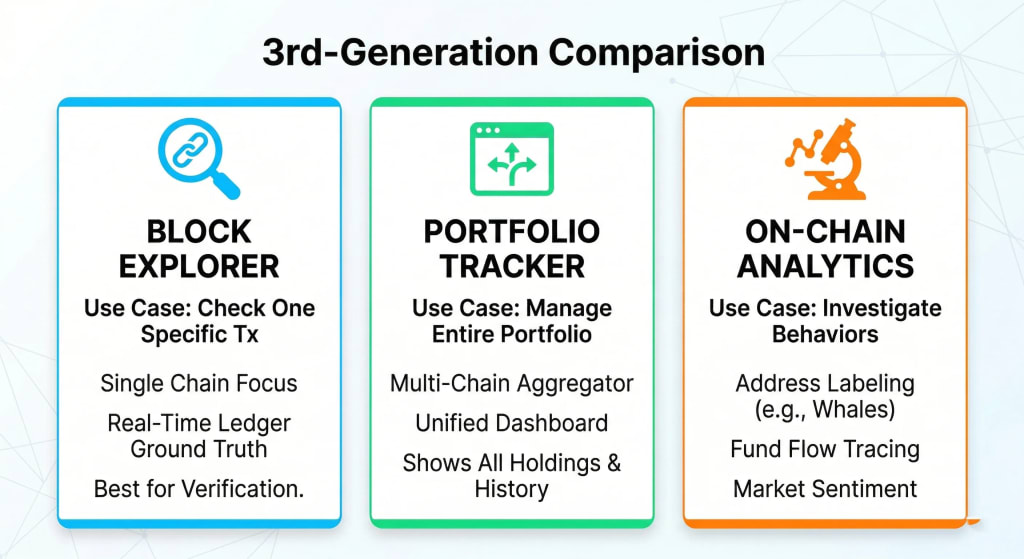
A blockchain explorer is essentially a search engine for a blockchain. You paste in a transaction hash, wallet address, or block number, and it shows you everything recorded on-chain about that query.
Every major chain has its own explorer:
- Ethereum — Etherscan (etherscan.io) is the standard
- Bitcoin — Blockchain.com or Blockstream.info
- BNB Chain — BscScan
- Solana — Solscan or Solana Explorer
- Polygon — Polygonscan
Using a blockchain explorer takes about thirty seconds. Paste your transaction hash into the search bar and you immediately see whether the transaction is confirmed, how many confirmations it has, and every detail about what moved where.
Block explorers also work for wallet addresses - paste your address and see your entire transaction history. This is particularly useful when someone claims they sent you funds and you want to verify independently, without trusting their screenshot.
The limitation: each blockchain explorer only covers its own chain. A transaction on Ethereum will not appear on BscScan. If you are not sure which chain a transaction is on, start with the chain your digital wallet crypto application was set to when you sent.
2. Crypto Transaction Trackers: When You Need Multiple Chains at Once
Block explorers are excellent for single-chain lookups. But if you regularly use multiple chains — which most active web3 projects participants do — switching between explorers gets tedious fast.
Crypto transaction tracker platforms aggregate data across chains, letting you monitor activity across multiple networks from a single dashboard. Some worth knowing:
Zerion connects to your wallet and shows all your crypto transactions across chains in one unified view — balances, history, DeFi positions, NFTs. It reads your public address, so there is no custody risk.
Zapper does similar work, with particular strength in tracking DeFi activity across protocols. Useful if you have funds deployed across lending protocols, liquidity pools, and yield strategies simultaneously.
DeBank is favoured by more active DeFi users for its detailed protocol-level breakdown — showing not just what you hold but where it is deployed and what it is earning.
None of these require connecting a wallet to read data. Paste any public address and you can see its full activity across chains. This is worth knowing if you want to verify someone else's transaction history as part of due diligence on a web3 projects partnership.
If you're building a product that needs transaction monitoring built in, our Blockchain Development Services covers on-chain data integration for teams that need custom tracking infrastructure.
3. Your Wallet's Built-In History: The Easiest Starting Point
Before reaching for an external tool, check the obvious place first. Most top crypto wallets - MetaMask, Phantom, Coinbase Wallet, Trust Wallet have built-in transaction history that covers everything you have sent and received from that wallet.
This is the fastest option for routine checks. Open your wallet, find the transaction, and tap through to see its status. Most wallets link directly to the relevant blockchain explorer from each transaction entry, so you can go deeper with one click if you need to.
The limitation is that wallet history is self-referential — it only shows what happened from your address. It does not show you the full picture of a transaction that involved multiple contracts or multiple hops across protocols. For that, you need an explorer or a tracker.
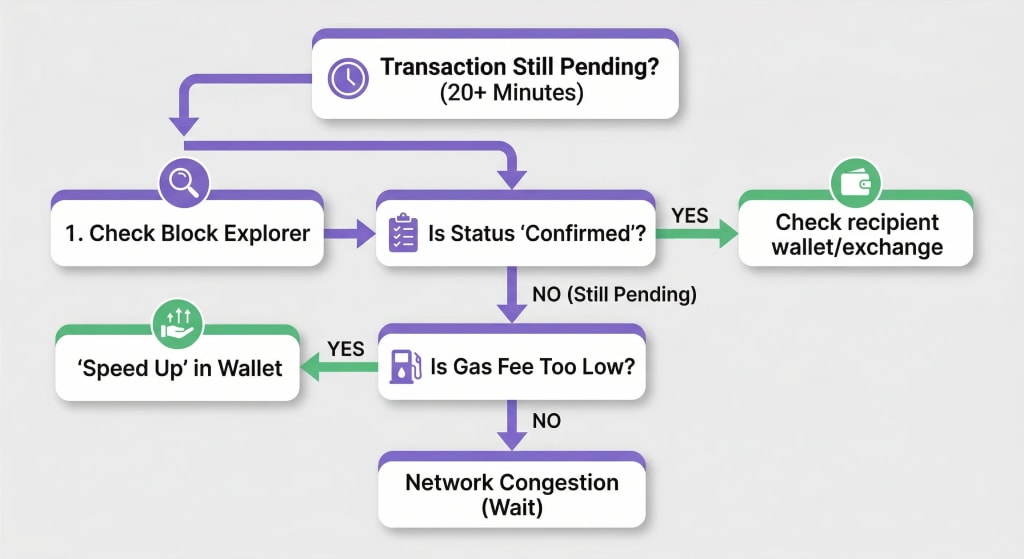
A practical tip: if a transaction shows as "pending" in your wallet for an unusually long time, open the blockchain explorer directly. Sometimes wallet interfaces lag behind the actual crypto ledger state, the explorer will show you the ground truth.
4. Exchange Transaction Records: For Crypto That Moves Through a Platform
If you sent or received crypto through a centralised exchange, the tracking process is slightly different. The exchange acts as an intermediary — your funds may sit in the exchange's pooled wallets for a period before the on-chain transaction is broadcast.
Most exchanges provide:
- An internal transaction ID for the withdrawal or deposit
- The on-chain transaction hash once the transfer is actually broadcast
- An estimated confirmation time based on the chain and network conditions
To track the on-chain leg of an exchange transaction, find the withdrawal record in your account history, locate the transaction hash (sometimes called TXID), and paste it into the relevant blockchain explorer. From that point, tracking works exactly the same as any other blockchain transaction.
One thing worth knowing: exchanges batch withdrawals on many chains to reduce gas costs. This means your withdrawal may not be broadcast immediately after you request it — a delay of several minutes to an hour is normal on busy networks.
5. On-Chain Analytics Platforms: For Deeper Investigation
Sometimes you need more than transaction confirmation, you need to understand what is happening at a protocol level, trace fund flows across multiple wallets, or investigate suspicious activity.
This is where on-chain analytics platforms become useful.
Nansen labels wallet addresses based on their behaviour patterns — identifying exchange wallets, whale addresses, protocol treasuries, and known entities. If you want to understand who sent you funds or where funds from a particular address have historically flowed, Nansen provides context that a raw blockchain explorer does not.
Chainalysis and Elliptic are used primarily by institutions and compliance teams for transaction monitoring and risk scoring, assessing whether funds have passed through sanctioned addresses or known mixing services.
Dune Analytics allows anyone to write SQL queries against blockchain data and visualise the results. If you want to track aggregate transaction patterns for a protocol, monitor specific wallet clusters, or build a custom dashboard for a web3 projects you are running, Dune gives you the raw access to do it.
These tools go well beyond "did my transaction confirm", they are research and compliance infrastructure for teams that need to understand crypto transactions at depth.
6. Setting Up Alerts: Tracking Without Constantly Checking
All the tools above require you to actively look. For ongoing monitoring, watching a treasury wallet, tracking when funds arrive at a specific address, getting notified when a large transaction moves through a protocol — alerts are more practical than manual checking.
A few ways to set this up:
Etherscan and most chain explorers offer email alerts for wallet address activity. Go to the address page, look for the notification option, and set up alerts for incoming or outgoing transactions. Free, no account required beyond an email.
Tenderly provides more sophisticated monitoring for developers, watching specific contracts or addresses and triggering webhooks or notifications when defined conditions are met. Useful for teams that need automated responses to on-chain events.
OpenZeppelin Defender offers similar monitoring at a higher level of sophistication, designed for teams managing deployed protocols who need to know instantly if something unusual happens.
For individuals who just want to know when funds arrive, exchange notifications combined with a blockchain explorer email alert cover most use cases without any technical setup.
EthElite covers more advanced alerting infrastructure for teams running production protocols.
Frequently Asked Questions
Q: What is a blockchain explorer?
A: A blockchain explorer is a search tool for viewing transactions, wallet addresses, and blocks on a specific chain. Common examples include Etherscan for Ethereum, Solscan for Solana, and BscScan for BNB Chain.
Q: What do I need to track a blockchain transaction?
A: You only need the transaction hash, paste it into the relevant blockchain explorer to view the full transaction record.
Q: Why is my transaction still pending?
A: Usually because of congestion. Validators often prioritise transactions with higher fees, so confirmation can be delayed during peak activity.
Q: Can I track transactions across multiple chains in one place?
A: Yes. Platforms such as Zerion, Zapper, and DeBank let you view crypto transactions across supported networks.
Q: Is tracking someone else's wallet address legal?
A: In most cases, yes. Public blockchain data is openly accessible by design, though use of that data can still raise legal issues depending on context.
Q: What is the difference between a transaction hash and a wallet address?
A: A wallet address identifies where assets are held. A transaction hash identifies one specific transfer
Conclusion
Every crypto transaction leaves a permanent, public record on the distributed ledger. The question is never whether the information exists, it is whether you know where to look.
For most users, a blockchain explorer and wallet history are enough to verify activity. Multi-chain trackers add convenience when transactions span networks, while analytics tools help when deeper tracing is needed.
That transparency sometimes uncomfortable, often powerful is what makes blockchain systems credible. You do not need to rely on claims when the record is visible and verifiable.
For teams building products around that transparency, EthElite increasingly treats transaction visibility as part of product design itself: making on-chain activity easier to audit, understand and trust from the start.
Share with your community!