Loading blog post...


5 Ways In Which Institutional Crypto Staking Works on Proof-of-Stake Networks
Institutional crypto staking is no longer a niche experiment; in 2026, it has become a core operational pillar for digital asset management. While retail staking focuses on simple clicks and variable APY, institutional participation demands a sophisticated intersection of MPC custody, multi-layer slashing insurance, and fiduciary governance. This guide breaks down the five mechanical dimensions, from segregated validator keys to complex yield accounting that define how the world’s largest funds securely navigate proof-of-stake networks.
Retail investors discovered crypto staking years ago. Institutions are only now catching up and when they do, they do not do it the same way. The scale is different, the risk tolerance is different, and the operational requirements are completely different.
Institutional crypto staking is not just "staking, but with more money." It is a structured financial operation that sits at the intersection of yield generation, regulatory compliance, custody infrastructure, and network governance. Understanding how it actually works, not just conceptually, but mechanically, matters both for institutions evaluating the space and for developers and service providers building the rails underneath it.
This blog breaks down five distinct ways in which institutional crypto staking operates on proof-of-stake networks, with each section covering a genuinely separate dimension of the picture.
1. How Institutions Actually Enter Proof-of-Stake Networks Without Exposing Custody Risk
The first and most fundamental challenge for any institution looking to stake crypto is custody. Staking requires locking assets on-chain, which means those assets need to move and for institutions, any movement of assets triggers compliance checkpoints, multi-party approval workflows, and custody liability questions.
Retail stakers solve this by connecting a wallet and clicking a button. Institutions cannot do that.
What institutional players actually do:
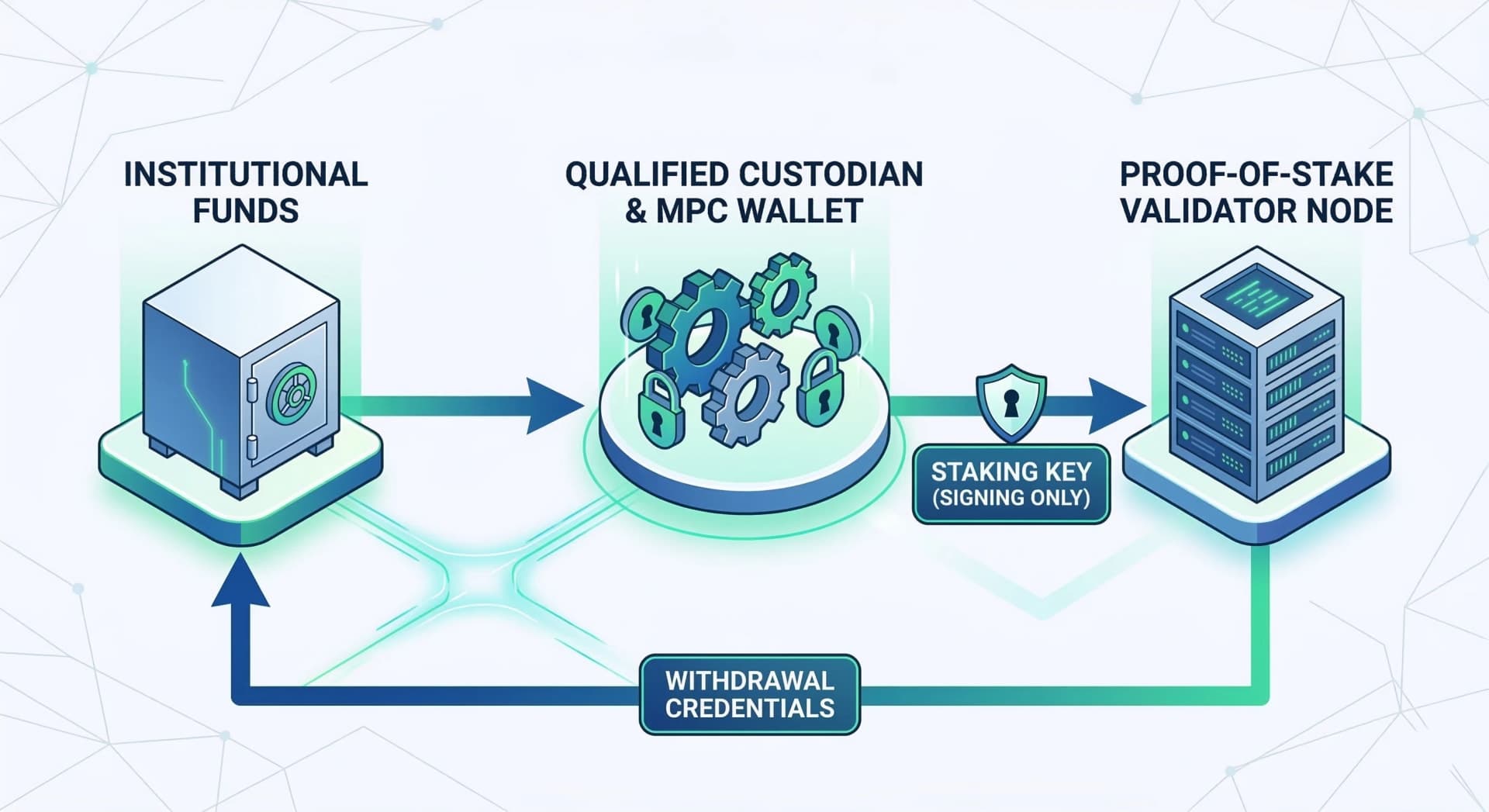
- Qualified custodian integration: Institutions typically work with custodians - Coinbase Custody, Anchorage Digital, BitGo, that have built native staking functionality directly into the custody layer. The assets never leave the custodial environment; the staking operation is executed by the custodian on behalf of the institution.
- MPC wallet infrastructure: Multi-party computation wallets allow staking transactions to be signed without any single party holding the complete private key. This preserves the security model while still enabling on-chain staking participation.
- Segregated validator keys: On networks like Ethereum, withdrawal credentials can be separated from validator signing keys. Institutions use this to ensure that even if a validator node is compromised, the underlying staked assets cannot be moved without triggering the full custody approval chain.
The reason this matters is that proof-of-stake security assumptions were designed with individual validators in mind. Institutions have had to engineer around those assumptions to make participation viable at scale without compromising the network's security model in the process.
2. Delegated Staking vs. Running Proprietary Validators: The Institutional Tradeoff
Once custody is handled, institutions face a structural decision: do they stake crypto by delegating to an existing validator, or do they build and operate their own validator infrastructure?
This is not a simple question, and most institutions land somewhere in between depending on the network, their internal capabilities, and their yield targets.
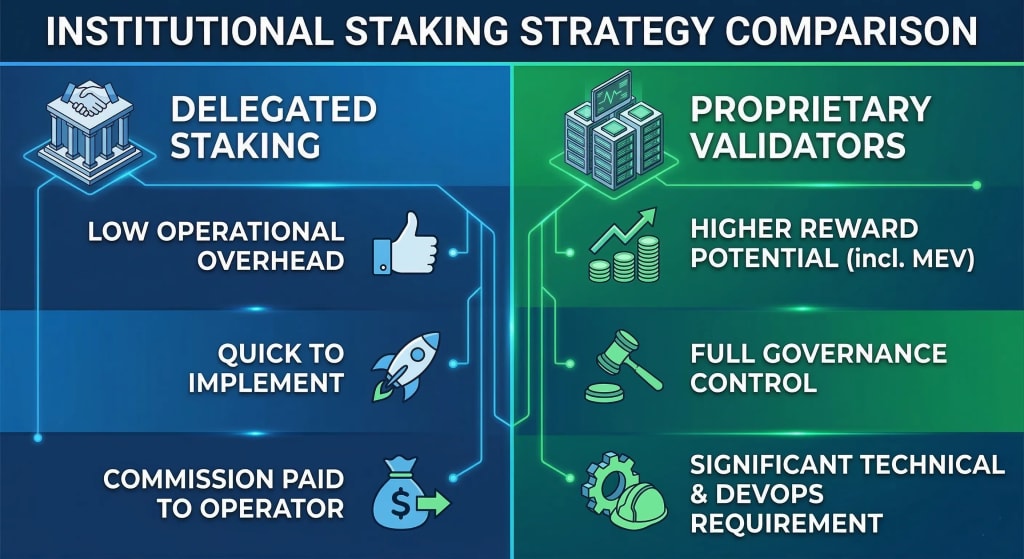
Delegated staking is the simpler path. The institution deposits assets with a professional validator operator - a staking-as-a-service provider like Figment, Kiln, or Allnodes and receives yield minus a commission. The validator operator handles node operations, uptime monitoring, and slashing risk management. For institutions that want staking crypto exposure without operational overhead, this is the entry point.
Proprietary validator operation is more complex but offers meaningful advantages:
- Full control over the validator's behavior, including MEV (maximal extractable value) strategy
- No commission paid to a third-party operator
- Direct participation in network governance decisions
- The ability to offer staking services to clients, effectively becoming a staking provider
The tradeoff is significant. Running validators on major proof-of-stake networks requires 24/7 infrastructure monitoring, slashing insurance or reserves, and engineering teams familiar with each chain's specific consensus mechanics. A missed attestation window or client bug that causes downtime has direct yield consequences.
Most institutions above a certain AUM threshold eventually move toward hybrid models, delegating on newer or smaller networks while running proprietary validators on Ethereum, Solana, and other high-priority chains where the yield volume justifies the operational investment.
Enterprises exploring how to structure this transition can also get a free consultation from EthElite to better understand validator strategy, staking infrastructure, and operational considerations before committing capital.
3. Slashing Risk Management: The Risk Framework That Makes or Breaks Institutional Staking
Any serious treatment of institutional crypto staking has to spend real time on slashing. This is the mechanism by which proof-of-stake networks penalize validators for misbehavior, specifically for double-signing blocks or extended downtime by destroying a portion of their staked assets.
For retail stakers, a small slashing event is painful but survivable. For an institution with hundreds of millions staked, the same percentage loss is a headline event and potentially a compliance breach.
Institutional slashing risk management operates on several levels:
- Client diversity: Running multiple consensus clients (Lighthouse, Prysm, Teku on Ethereum) means that a bug in one client does not take down the entire validator fleet. This is both a network health contribution and a self-protection mechanism.
- Geographic and infrastructure distribution: Validators spread across multiple cloud providers, regions, and data centers reduce the probability of correlated failures that could trigger simultaneous slashing across multiple validators.
- Remote signer architecture: Tools like Web3Signer separate the signing key from the validator client, adding a layer of protection against double-signing events caused by failover misconfiguration.
- Slashing insurance: A small but growing market of on-chain and off-chain insurance products specifically covers slashing events. Institutions with large staked positions often carry this as part of their risk management stack.
- Slashing reserves: Some institutions simply hold a reserve of unstaked assets proportional to their staked position to absorb any slashing event without triggering a reportable loss threshold.
The sophistication of this risk framework is one of the clearest differentiators between institutional and retail staking crypto operations. Retail stakers accept slashing risk implicitly. Institutions price it, hedge it, and build operational procedures around minimizing it, often with the support of specialized blockchain consulting services, such as those offered by EthElite, which help organizations design secure validator operations, monitoring systems, and governance strategies for institutional-scale staking.
4. Yield Accounting, Tax Treatment and Reporting Across Proof-of-Stake Networks
Yield is the reason institutions stake crypto in the first place. But the accounting and reporting of that yield is far more complex than it appears and it varies significantly across proof-of-stake networks, jurisdictions, and the specific legal structure of the staking arrangement.
This is a dimension that rarely gets discussed in staking content, but it is often the deciding factor in whether an institution can participate at all.
The core accounting questions institutions must resolve:
- Is staking yield recognized as income at the moment of receipt, or at the point of disposal? This question is not settled in most jurisdictions and has significant tax implications.
- For funds with NAV reporting obligations, how are pending staking rewards - rewards earned but not yet claimable treated on the balance sheet?
- How are unbonding periods handled? On networks like Cosmos or Polkadot, unstaking can take 21 to 28 days. That illiquidity needs to be reflected in portfolio liquidity calculations.
- How are rewards denominated in a volatile asset marked-to-market for reporting purposes?
Across different proof-of-stake networks, the mechanics also differ:
- Ethereum issues rewards continuously at the consensus layer, with separate execution layer rewards (tips and MEV) arriving per block
- Cosmos-based chains distribute rewards that must be manually claimed, creating a different accrual pattern
- Solana distributes rewards automatically at the end of each epoch, approximately every 2-3 days
Each of these patterns has different implications for revenue recognition timing, and institutions with daily NAV requirements need accounting systems that can handle all of them simultaneously.
The institutions doing this well have built or licensed custom staking accounting modules that integrate directly with their portfolio management systems, pulling onchain reward data and applying the appropriate recognition logic automatically.
5. Governance Participation: The Understated Institutional Responsibility in Staking
The final dimension of institutional crypto staking is also the one most frequently skipped in institutional due diligence: governance.
On most proof-of-stake networks, validators and large stakers are not passive yield recipients. They are active participants in network governance - voting on protocol upgrades, parameter changes, treasury allocations, and sometimes on decisions that directly affect the economics of staking itself.
For institutions, this creates an obligation that most have not yet fully grappled with.
Why governance matters for institutional stakers:
- Fiduciary implications: If an institution is voting with client assets on protocol governance decisions, those votes need to be defensible. Some institutional frameworks require documented governance policies before participation is permitted.
- Conflicts of interest: A validator operator that also holds a large token position has an inherent conflict of interest in governance votes that affect validator economics. Institutions need policies for managing this.
- Network health stakes: Poorly voted governance decisions such as parameter changes that make the network less secure or less attractive to developers, directly affect the value of staked assets. Governance participation is a form of risk management, not just civic duty.
How leading institutions are handling this:
- Some delegate their governance votes to specialized governance advisory services that research proposals and vote according to documented principles
- Others have built internal research functions that evaluate governance proposals across their entire proof of stake portfolio
- A few of the largest players vote actively and publish their rationale, treating governance transparency as a reputational asset
The institutions that treat governance as an afterthought are essentially accepting that their large staked positions will be directed by whoever shows up which is a risk management failure dressed up as a passive investment strategy.
This dimension of institutional crypto staking will only become more significant as the protocols mature, treasuries grow, and governance decisions carry higher economic stakes.
Frequently Asked Questions
Q: What is the minimum threshold for institutional crypto staking?
A: There is no universal minimum, but most institutional-grade staking arrangements become operationally viable, relative to the overhead they require at staked positions above $5–10 million. Below that, the cost of custody infrastructure, legal review and accounting setup often outweighs the yield advantage over delegation.
Q: Do institutions need to run their own validators to participate in proof-of-stake staking?
A: No. Delegated staking through qualified custodians or staking-as-a-service providers allows institutions to participate without operating validators directly. Proprietary validator operation becomes attractive at higher scale and when institutions want direct MEV exposure or governance control.
Q: How is slashing risk typically handled in institutional staking arrangements? A: Through a combination of client diversity, infrastructure redundancy, remote signing architecture, and for larger positions, dedicated slashing insurance products. Most institutional staking service agreements also include representations about the operator's slashing history and risk controls.
Q: Is staking yield treated as income for tax purposes?
A: This varies by jurisdiction and remains unsettled in many. Institutions typically work with specialized digital asset tax counsel to establish a defensible recognition policy before beginning staking operations at scale.
Q: How do proof-of-stake networks handle governance for large institutional validators?
A: Each network has different governance mechanisms. Most allow validators and delegators to vote proportionally to their staked weight. Institutions are increasingly expected by the community and in some cases by their own fiduciary obligations to vote actively rather than abstain.
Conclusion
Institutional crypto staking is not a product, it is an operational capability that takes months to build properly and years to refine. The five dimensions covered here - custody integration, validator strategy, slashing risk management, yield accounting, and governance, each represent a distinct layer of institutional infrastructure that retail staking simply does not require.
Proof-of-stake networks were designed for broad participation, but the assumptions baked into their design reflect individual validators, not entities managing billions in client assets under fiduciary obligations. The institutions doing this well have had to build meaningful infrastructure and expertise to bridge that gap.
For institutions still evaluating whether to stake crypto, the honest answer is that the technical barriers are lower than they were two years ago - custodians, staking service providers, and accounting software have all matured significantly. The remaining barriers are primarily operational and organizational: building the internal expertise, policies, and reporting infrastructure to do it responsibly.
For the networks themselves, institutional participation in staking crypto brings deeper liquidity, more stable validator sets, and increasingly thoughtful governance participation. The maturation of institutional proof of stake engagement is, on balance, good for the networks they stake on.
Teams that are navigating this transition, guidance from experienced ecosystem participants can accelerate the learning curve. Platforms such as EthElite increasingly play a role in helping organizations understand staking infrastructure, governance dynamics, and the broader operational realities of participating in modern proof-of-stake networks.
Share with your community!