Loading blog post...



Key Benefits and Risks of Decentralized Finance (DeFi)
Decentralized Finance (DeFi) has officially moved beyond the 'experiment' phase, evolving into a $100B+ financial layer that operates entirely on code. By removing traditional banks and replacing them with autonomous smart contracts, DeFi offers unprecedented transparency and global access. However, this 'permissionless' world isn't without its shadows. From smart contract bugs to the wild swings of market volatility, the shift to a decentralized system requires a disciplined understanding of both its transformative potential and its inherent risks.
Decentralized finance has moved far beyond being a niche experiment in crypto. Today, decentralized finance is reshaping how people borrow, lend, trade, and manage digital assets without relying on traditional intermediaries. Yet, despite its rapid growth, many still misunderstand what DeFi truly represents.
To understand the real impact of DeFi, it’s not enough to look at hype or token prices. You need to examine how decentralised finance changes financial infrastructure and what trade-offs it introduces.
This guide breaks down the fundamental benefits and risks of DeFi in a practical, system-level way, helping you understand its opportunities and limitations.
Understanding DeFi Meaning Beyond the Buzzword
Before exploring benefits and risks, it’s important to clarify DeFi meaning. At its core, DeFi refers to financial applications built on blockchain networks using smart contracts instead of centralized institutions.
Unlike traditional finance, DeFi platforms operate without banks, brokers, or custodians. Instead, logic is enforced by code, and value flows directly between users.
A typical DeFi ecosystem includes:
- lending and borrowing protocols
- decentralized exchanges
- yield and staking mechanisms
- synthetic asset platforms
Each of these systems is powered by smart contracts, making DeFi applications fundamentally different from traditional financial software.
For teams exploring DeFi architecture, our blockchain consulting services help evaluate suitable models and use cases.
Benefit: Financial Accessibility Without Intermediaries
One of the most transformative aspects of decentralized finance is accessibility. Anyone with an internet connection and a wallet can interact with DeFi protocols.
This eliminates many barriers present in traditional finance:
- geographic restrictions
- minimum account requirements
- dependence on centralized institutions
For emerging markets, DeFi offers an alternative financial infrastructure that is open and permissionless. This is why many DeFi projects focus on expanding access rather than replicating traditional banking models.

Benefit: Programmable Financial Systems Through Smart Contracts
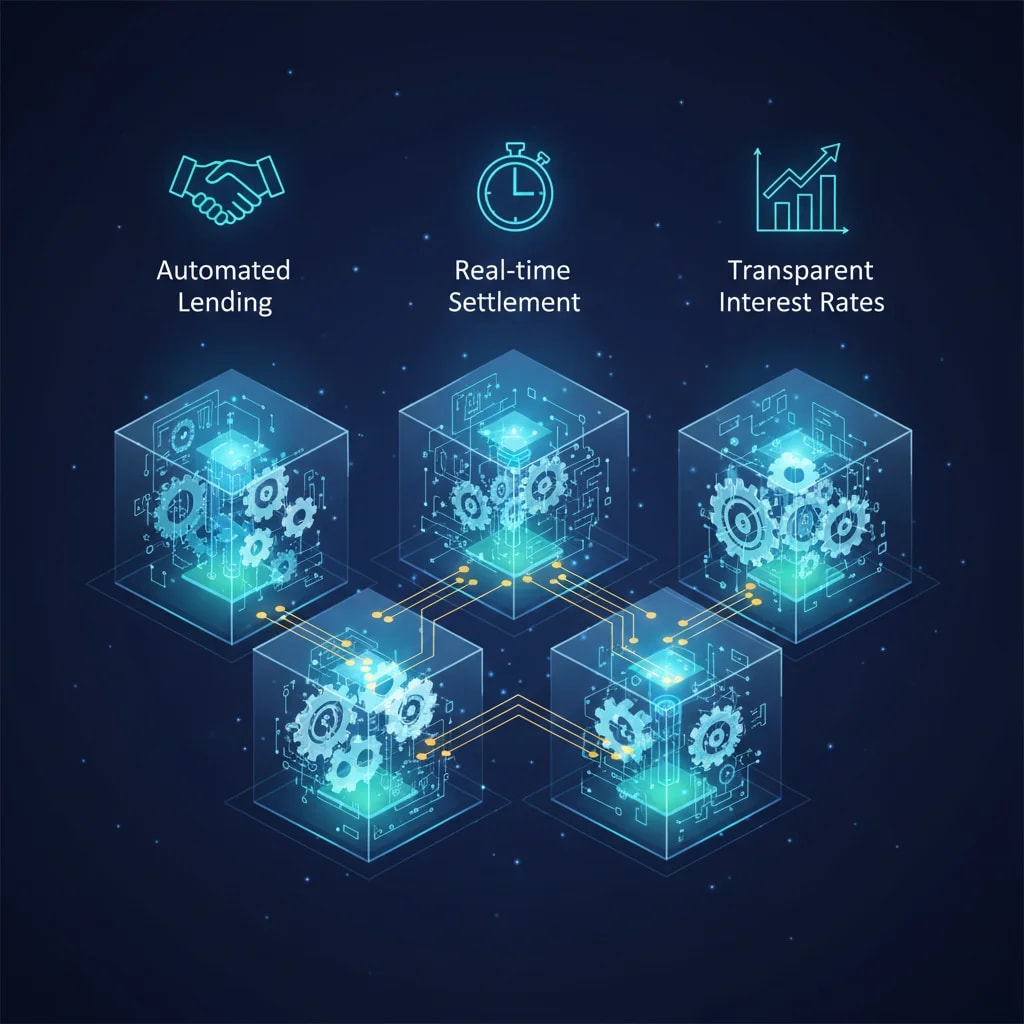
DeFi is not just about removing intermediaries, it’s about automation too. Through DeFi smart contract development, financial logic becomes programmable.
Smart contracts enable:
- automated lending and liquidation
- real-time settlement
- transparent interest rate mechanisms
This programmability allows DeFi platforms to evolve rapidly. Unlike traditional finance, where product innovation is slow and regulated, DeFi can iterate at software speed.
To build automated financial systems consult with us to avail our smart contract development services that focus on scalable DeFi logic.
Benefit: Open Innovation and Rapid Growth of DeFi Projects
The open-source nature of DeFi accelerates innovation. Developers can fork protocols, build integrations, and create entirely new financial products.
This openness has led to:
- rapid experimentation
- composable DeFi ecosystems
- continuous evolution of financial models
The rise of DeFi coins often reflects this innovation cycle, where tokens represent governance rights, utility, or economic incentives within protocols.
Risk: Smart Contract Vulnerabilities and Technical Failures
While DeFi offers automation, it also introduces technical risk. Smart contracts are immutable, meaning errors can have irreversible consequences.
Common risks include:
- coding vulnerabilities
- logic flaws
- economic attack vectors
Even mature DeFi platforms have suffered exploits due to subtle bugs. This is why rigorous testing and auditing are essential in DeFi development.
Risk: Market Volatility and Economic Instability
Unlike traditional finance, DeFi operates in highly volatile crypto markets. Token prices, liquidity, and user behavior can change rapidly.
This volatility affects:
- collateral values
- interest rates
- protocol stability
A sudden drop in the price of a DeFi coin can trigger cascading liquidations across protocols. This systemic risk is unique to decentralized financial systems.
Understanding these dynamics is critical for anyone evaluating DeFi investments or building protocols.
Risk: Regulatory Uncertainty in Decentralised Finance
Regulation remains one of the biggest unknowns in decentralised finance. Governments worldwide are still defining how DeFi should be classified and regulated.
Challenges include:
- compliance requirements
- legal accountability
- jurisdictional conflicts
For DeFi projects, navigating regulatory ambiguity can be as challenging as solving technical problems. This uncertainty influences how protocols design governance and token structures.
Risk: Usability and Adoption Barriers in DeFi Applications
Despite its potential, DeFi remains complex for mainstream users. Wallet management, gas fees, and transaction signing create friction.
Usability challenges include:
- complex interfaces
- irreversible transactions
- limited user education
These barriers slow adoption of DeFi applications, even when the underlying technology is robust. Improving UX is becoming a critical focus in modern DeFi design.
FAQ: Benefits and Risks of Decentralized Finance
Q: What is DeFi meaning in simple terms?
A: DeFi refers to financial services built on blockchain without traditional intermediaries.
Q: Are DeFi platforms safer than traditional banks?
A: They offer transparency but also carry technical and market risks.
Q: What role do DeFi coins play in protocols?
A: They often represent governance rights, incentives, or utility.
Q: Is DeFi suitable for mainstream users?
A: Not yet fully, but usability is improving.
Q: Do DeFi projects require specialized development expertise?
A: Yes. DeFi development involves blockchain engineering, smart contract design, and economic modeling.
Conclusion
Decentralized finance is not a passing trend, it is an evolving financial paradigm with profound benefits and real risks. By combining automation, accessibility, and open innovation, DeFi challenges traditional financial systems. At the same time, technical vulnerabilities, volatility, and regulatory uncertainty highlight its limitations.
Understanding both sides is essential for anyone exploring DeFi platforms, investing in DeFi coins, or building DeFi applications. For teams designing real DeFi systems, the challenge is not just innovation, but discipline involving architecting protocols that can survive scale, adversarial conditions, and long-term usage. That is the design mindset EthElite brings to decentralized finance.
In the long run, the future of decentralized finance will not be defined by hype, but by how well its benefits outweigh its risks.
Share with your community!