Loading blog post...


Blockchain Game Development: A Technical Overview of On-Chain Game Architecture
The "Ownership Layer" of gaming is being rewritten. For decades, players "rented" their progress from developers. Today, blockchain game architecture from Hybrid to Fully Onchain models is shifting that power back to the player's wallet. Dive into the technical blueprints of ECS (Entity Component System), the evolution of dynamic NFTs, and why the next generation of Web3 games must prioritize sustainable "token sinks" over short-lived hype to survive in 2026.
Games have always been about ownership of territory, of items, of progress. But until blockchain, that ownership always belonged to the developer, not the player. Your rare sword lived in a database the company controlled. Your account could be banned. The server could go down. Items you spent years earning could disappear overnight.
Blockchain game development changes the ownership layer fundamentally. When a game asset lives onchain, it belongs to the player's wallet and not a company's server. It can be traded, sold or held. The developer cannot take it back.
That shift sounds simple. The technical architecture required to make it work is anything but.
What Actually Makes a Blockchain Game Different
Think of a regular game like a restaurant where the chef owns the recipes and controls every ingredient. A blockchain game is more like a co-op because the rules are written down publicly, the assets belong to the people who hold them, and no single person can change the terms unilaterally.
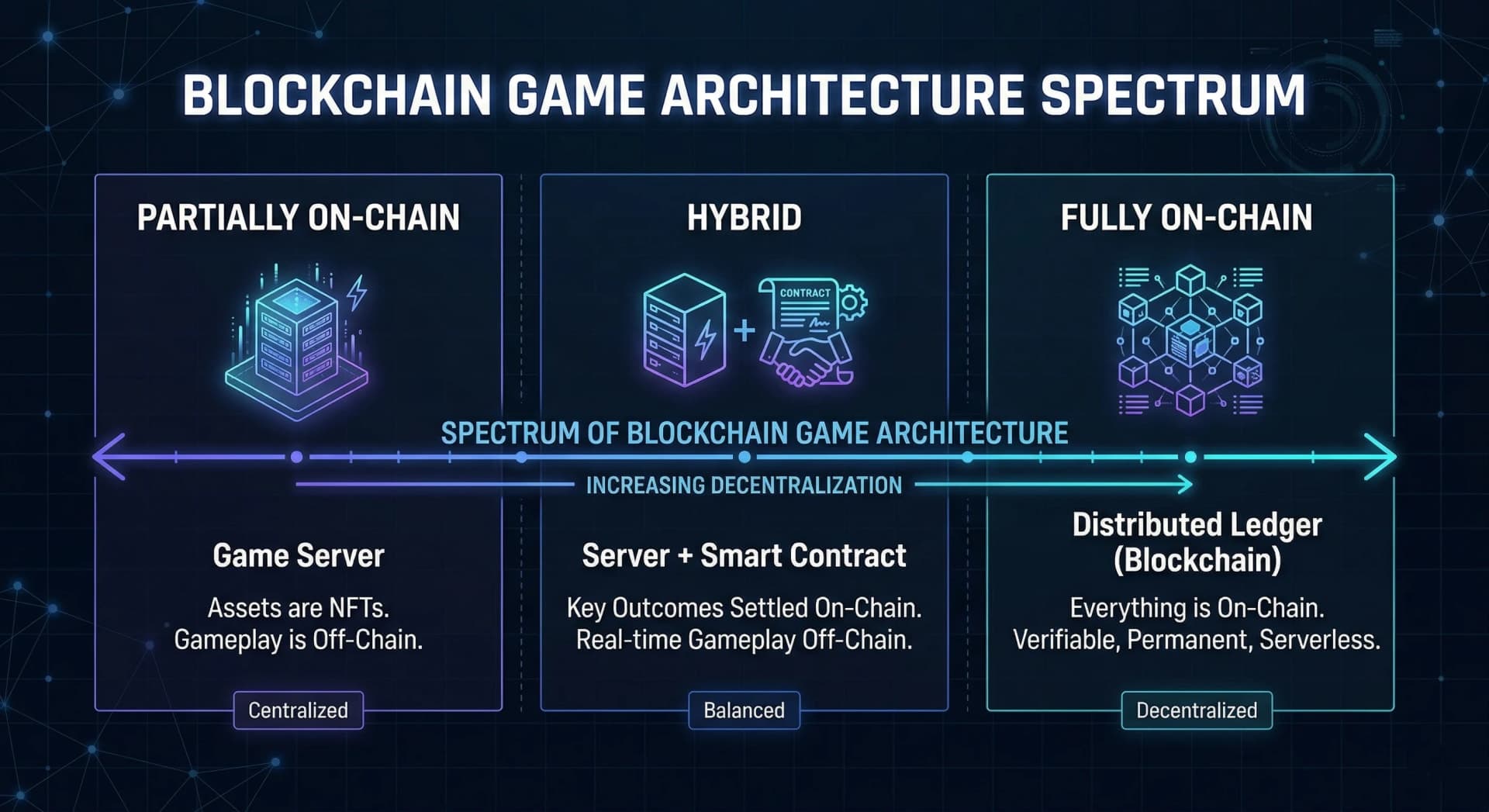
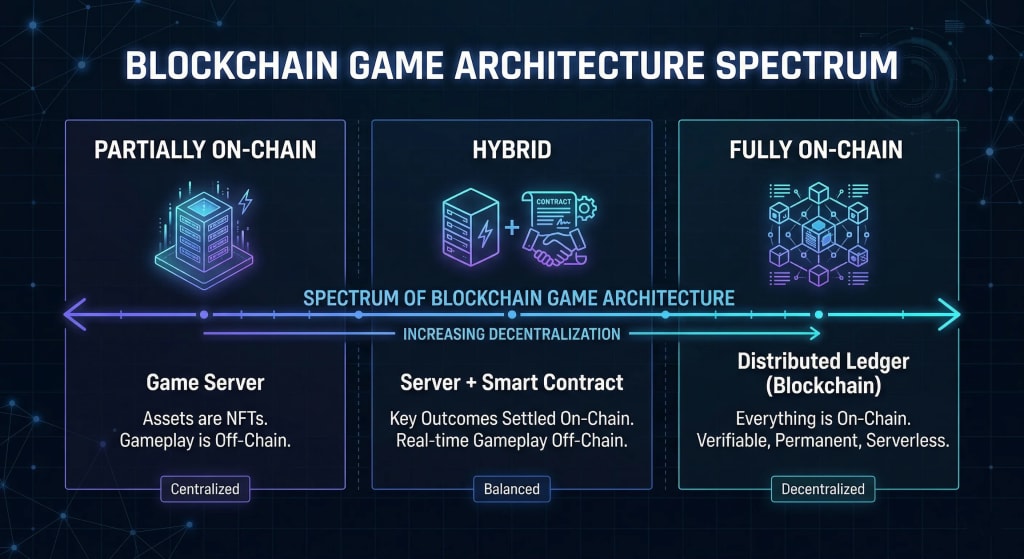
Technically, this means moving game state from a centralized server to a public blockchain. But not all crypto games do this equally. The spectrum looks like this:
- Partially onchain — assets like characters and items exist as NFTs, but gameplay runs on regular servers. Most NFT gaming projects today sit here.
- Hybrid — key outcomes (combat results, tournament winners) are settled onchain; real-time interaction happens off-chain
- Fully onchain — everything lives onchain. Every action is a transaction. The game world is entirely verifiable and no developer server is involved
Each approach has different trade-offs between decentralisation, performance, cost, and player experience. None is universally correct, it depends on what the game is trying to be.
How Fully Onchain Games Are Actually Built
Fully onchain games are the most ambitious category in blockchain game development and the most instructive for understanding where things are heading.
Most teams building in this space use something called an Entity Component System (ECS) architecture. Frameworks like MUD (on Ethereum) and Dojo (on Starknet) implement this natively. Here is what that means in plain terms:
- Entities are unique identifiers — a player, an item, a tile on a map
- Components are the data attached to those entities — a player's health points, a weapon's damage value, a tile's terrain type
- Systems are the rules that operate on that data — how combat resolves, how movement works, how crafting produces new items
In a fully onchain game, all of this lives on the blockchain. Every update is a state change. Every rule execution is a smart contract call. Anyone in the world can read the game state, verify what happened, and build on top of it.
The catch: writing to blockchain state costs gas. A game where every step is a transaction can get expensive fast, which is why fully onchain games tend to be turn-based or deployed on chains with very low costs.
NFT Gaming: What Lives Onchain and What Doesn't
For most crypto games in production today, the real question is not "fully onchain or not", it is "which parts go onchain and why."
The short answer: ownership lives onchain, everything else often does not.
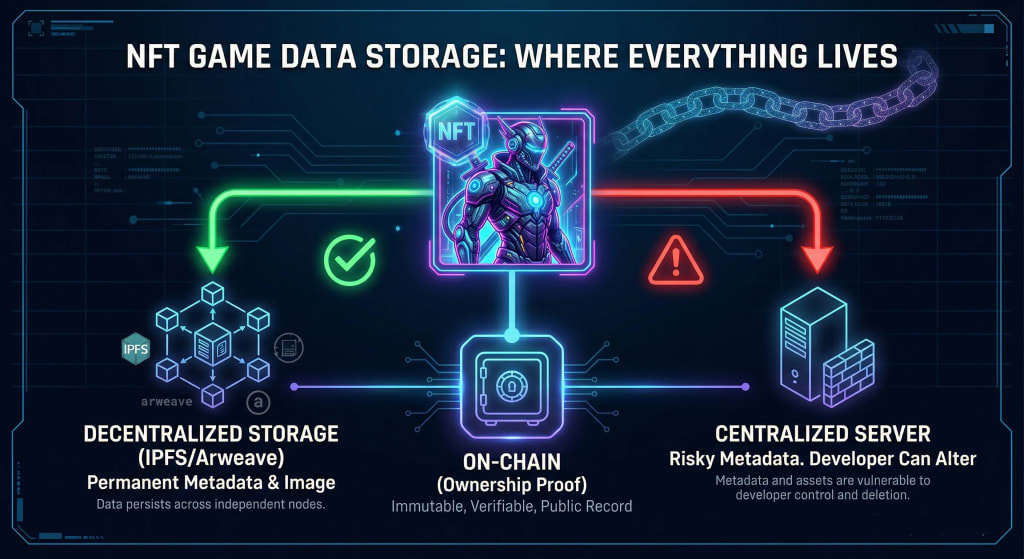
When a player owns a character NFT, what the blockchain actually records is: this wallet owns this token. The character's image, attributes, and stats are usually stored separately - on IPFS, Arweave, or sometimes a regular server.
This creates a layered picture:
- Onchain: Who owns what, transfer history, provable scarcity
- Decentralised storage (IPFS/Arweave): Images, attributes, metadata
- Game servers: Real-time gameplay, rendering, matchmaking
The risk worth understanding: if a game's NFT metadata lives on a server the developer controls, the developer can change what the NFT represents. "Onchain ownership" means less if the thing being owned can be quietly altered. Permanent storage on Arweave is the more robust approach for anything that matters.
The exciting frontier here is dynamic NFTs, tokens whose attributes actually change based on what happens in the game. A character that levels up. A weapon that degrades with use. This requires smart contracts that can update token state, which adds complexity but creates assets that are genuinely game-native rather than static collectibles. Check out EthElite's smart contract development services if you're thinking in the same direction.
How Play-to-Earn Crypto Games Actually Pay Players
Play to earn crypto games introduced something genuinely new: players generating real economic value through gameplay. Understanding how the reward flow works and why so many early versions collapsed is useful for anyone building or investing in this space.
The basic mechanism is straightforward. Players complete actions, those actions are verified, and smart contracts distribute token rewards automatically. But the architecture underneath that simple description determines whether the economy lasts.
The verification question is the first fork in the road. Fully onchain games can verify player actions trustlessly through smart contract logic, no one needs to trust anyone. Hybrid games rely on a game server to report what players did to the reward contract. That reintroduces a trust assumption: the server's honesty becomes a security dependency.
Token sinks are the part most teams underinvest in. A game economy that only creates tokens through rewards, through mining, without mechanisms to remove them creates inflation that eventually makes the rewards worthless. Repair costs, crafting fees, entry fees for competitive modes, these are not features. They are load-bearing economic infrastructure. Most early play to earn crypto games that collapsed did so because this was treated as an afterthought.
Dual-token models are the most common architectural response to this problem. One token handles in-game utility earned through play, spent on actions, high velocity. A second token handles governance and value accrual - lower velocity, investment-layer. Separating these two functions reduces the reflexive price pressure that destroyed single-token economies.
If you're designing the economic architecture for a crypto game, EthElite includes token economy design as part of the development process. Consult today to get started.
Choosing the Right Chain: What Actually Matters for Games
Chain selection is one of the earliest and most consequential decisions in blockchain game development. The wrong choice creates problems that compound throughout the entire project.
Ethereum mainnet has the deepest liquidity and the most established NFT ecosystem. Transaction costs make it impractical for frequent in-game interactions, it works best as a settlement layer for high-value assets rather than active gameplay infrastructure.
Immutable X was purpose-built for NFT gaming - zero gas fees for trades and mints, high throughput, Ethereum security through ZK rollup technology. The trade-off is less composability with the broader DeFi ecosystem.
Starknet has attracted significant fully onchain game development through Dojo because ZK proof architecture makes onchain computation genuinely cheaper. The ecosystem is smaller and tooling is less mature, but the technical capabilities are compelling for teams building complex game logic.
Solana offers very high throughput and low costs, making it viable for games with frequent small transactions. Several crypto game development companies have built on Solana specifically for these performance characteristics.
The decision should follow game design requirements like transaction frequency, asset economy scale, target audience and not chain popularity.
What to Look For in Blockchain Game Development Companies
The gap between a blockchain game development company that ships games people keep playing and one that ships a mint event followed by silence is large and usually invisible until after you have committed.
A few things that actually differentiate good blockchain game development companies:
- Game design expertise alongside blockchain expertise. The token economy is not the game. Teams that can only build the financial layer but not the gameplay loop will produce something with interesting tokenomics and nothing to do. The best crypto game development company partners have genuine game designers, not just smart contract developers.
- Chain-specific experience. Building on Starknet is different from building on Immutable X. Teams with deployed games on your target chain understand its quirks, its tooling failures, and its community norms in ways that generalist blockchain developers do not.
- A documented security approach. Given the financial exposure of onchain game assets, smart contract security is not optional. Ask specifically about audit history and what has gone wrong in previous projects — the answer tells you more than the portfolio does.
- Post-launch support. Token economies need active management as player behavior evolves. Studios that disappear after launch leave economies to collapse on their own.
Our custom Blockchain Development Services covers the full scope of what production game development requires from architecture through token economy design and ongoing support.
Frequently Asked Questions
Q: What is a fully onchain game?
A: A game where all state - every asset, rule, and action outcome lives on the blockchain with no dependency on a developer's server. The game world is verifiable, permanent, and permissionless. Frameworks like MUD and Dojo make this buildable today, though it works best for turn-based or low-frequency interaction genres due to transaction costs.
Q: How do NFTs work in blockchain games?
A: In NFT gaming, game assets are tokens owned by player wallets rather than entries in a developer's database. Ownership and transfer history are recorded onchain. The asset's visual appearance and attributes usually live off-chain — and where they are stored matters a lot for long-term permanence.
Q: Why did most play-to-earn games fail?
A: Primarily because their economies had no meaningful token sinks. Continuous reward emission without removal creates inflation that collapses reward value. The play to earn crypto games that survived are those that built genuine demand for the in-game token through gameplay, not just the expectation that the price would rise.
Q: What chain is best for blockchain game development?
A: There is no universal answer. High-frequency interaction games need low-cost chains like Immutable X, Starknet, or Solana. Games prioritising NFT liquidity and ecosystem composability may accept Ethereum's higher costs. Chain selection should follow game design requirements, not chain popularity.
Q: What should I look for in a blockchain game development company?
A: Game design capability alongside smart contract expertise, chain-specific deployment experience, a documented security approach, and evidence of post-launch support. Building the token economy is necessary but not sufficient, the game itself needs to be worth playing.
Conclusion
Blockchain game development has passed the infrastructure problem. Chains are fast enough and cheap enough. Frameworks like MUD and Dojo make fully onchain games buildable. NFT standards are well-established. The hard part now is game design, building something people genuinely want to play, where the blockchain layer adds to the experience rather than existing as a tax on it.
The crypto games that matter in five years will be the ones where players would miss the gameplay if the token rewards disappeared, not the ones where gameplay exists only to justify the token.
The architecture decisions covered here determine which category a game ends up in. Getting them right from the start is significantly easier than fixing them after launch, which is why some teams bring in experienced Web3 development partners such as EthElite before core systems are locked in.
Share with your community!