Loading blog post...


7 Proven Ways to Scale and Secure Your DeFi Application
Scaling and securing a DeFi application in 2025 requires more than smart contracts and audits. Modern DeFi platforms must be architected as resilient financial infrastructure, combining scalable protocol design, automated on-chain risk management, layered security controls, optimized UX, and enterprise-grade tooling. The protocols that succeed are built to handle volatility, adversarial behavior, and high-volume liquidity from day one.
Scaling and securing a DeFi application in 2025 is no longer about writing a few smart contracts and hoping an audit catches the rest. The DeFi ecosystem has matured into a high-stakes, adversarial, high-volume environment where thousands of users interact with your protocol simultaneously, liquidity moves at machine speed, and attackers watch every commit and parameter change you make.
A modern DeFi product must be architected like financial infrastructure, protected like a security operation, and optimized like a scaling engine. This is where the real difference between a fragile protocol and a long-term DeFi platform begins.
Below are the seven foundational pillars that determine whether your DeFi application can survive, scale, and dominate.
1. Build With Architecture First: The Foundation of Professional DeFi App Development
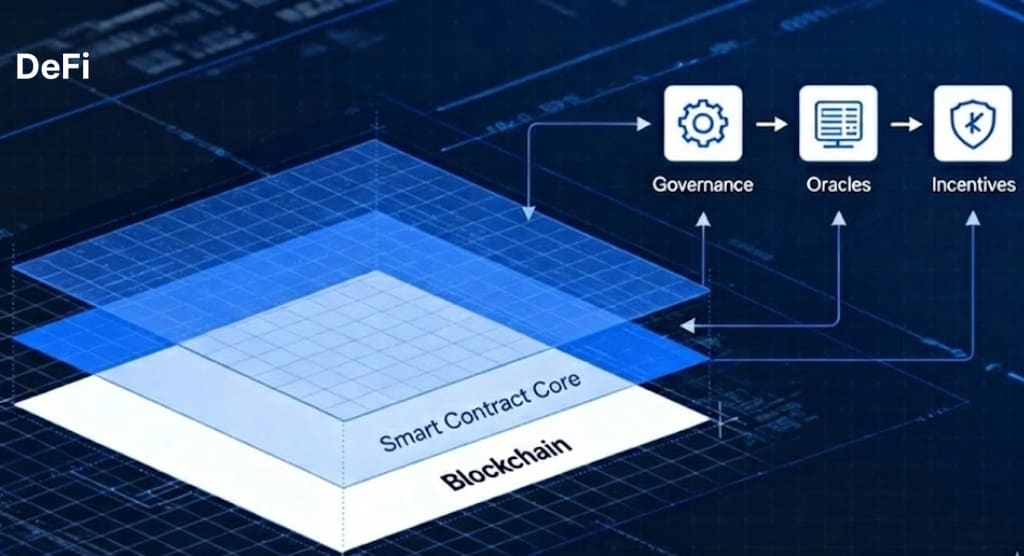
Most failures in DeFi app development start long before deployment. They begin at the architectural level where trust boundaries, upgrade paths, protocol flows, and liquidity assumptions are often poorly defined.
A high-quality DeFi application requires architecture that accounts for:
- economic incentive design
- oracle dependencies
- governance power distribution
- liquidation or penalty flows
- cross-protocol interactions
When architecture is threat-modeled and friction-free from the start, scaling becomes a natural outcome rather than a challenge. This is why mature DeFi products treat the architectural phase as the most important step in development.
2. Use Professional DeFi App Development Services to Avoid Technical Blind Spots
DeFi is not like building a standard Web2 app. It demands full-stack blockchain engineering knowledge, economic modeling expertise, and deep understanding of chain-level behaviors. This is where specialized DeFi app development services add exponential value.
Expert teams bring clarity to areas that most developers overlook, including:
- composability hazards
- gas-efficient design patterns
- attack vectors introduced by liquidity behavior
- multi-chain deployment risks
- governance configuration security
Scaling becomes easier when the underlying codebase is optimized by professionals who understand both the business model and the adversarial environment.
Our specialized Custom dApp development services bring expertise in gas optimization, multi-chain deployment, MEV behavior and risk-aware engineering that you could check out.
3. Partner With a DeFi App Development Company That Designs for High-Volume Scalability
Your protocol is only as strong as the company that builds it. A seasoned DeFi app development company understands that on-chain systems behave differently under pressure. Gas spikes, multi-oracle updates, liquidations, price swings, and user surges need infrastructure that can withstand volatility.
True scalability requires:
- modular contract design
- optimized execution flow
- safe batching mechanisms
- efficient state transitions
- upgrade-resistant storage layouts
When these elements are engineered early, your DeFi application can scale to millions in TVL without collapsing under traffic or pricing events.
4. Implement Multi-Layer Security Controls to Protect Your DeFi Application Under Stress
Security in DeFi is not a single event. It is a continuous system. A secure protocol doesn’t rely on one barrier, it layers protection across every component of the stack.
This includes:
- smart contract auditing for logic-level safety (Check out our Smart Contract Audit Services)
- oracle integrity checks to validate price feeds
- admin key governance controls to prevent internal compromise
- runtime monitoring to catch anomalies in real time
Attackers aren’t looking for complex vulnerabilities; they’re looking for the one surface you forgot to secure. Multi-layer protection removes that advantage.
5. Automate On-Chain Risk Management for Real-Time Resilience
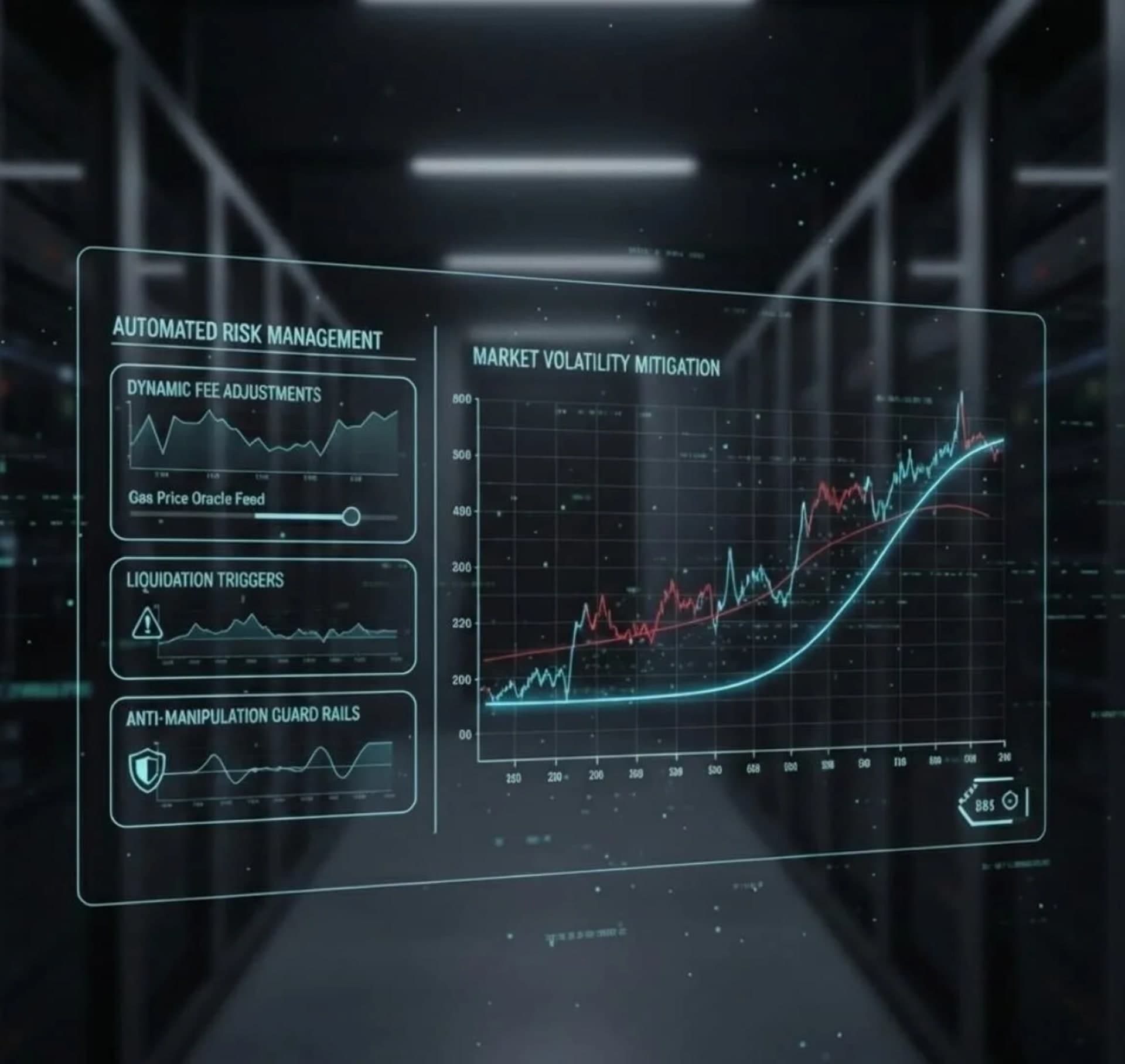
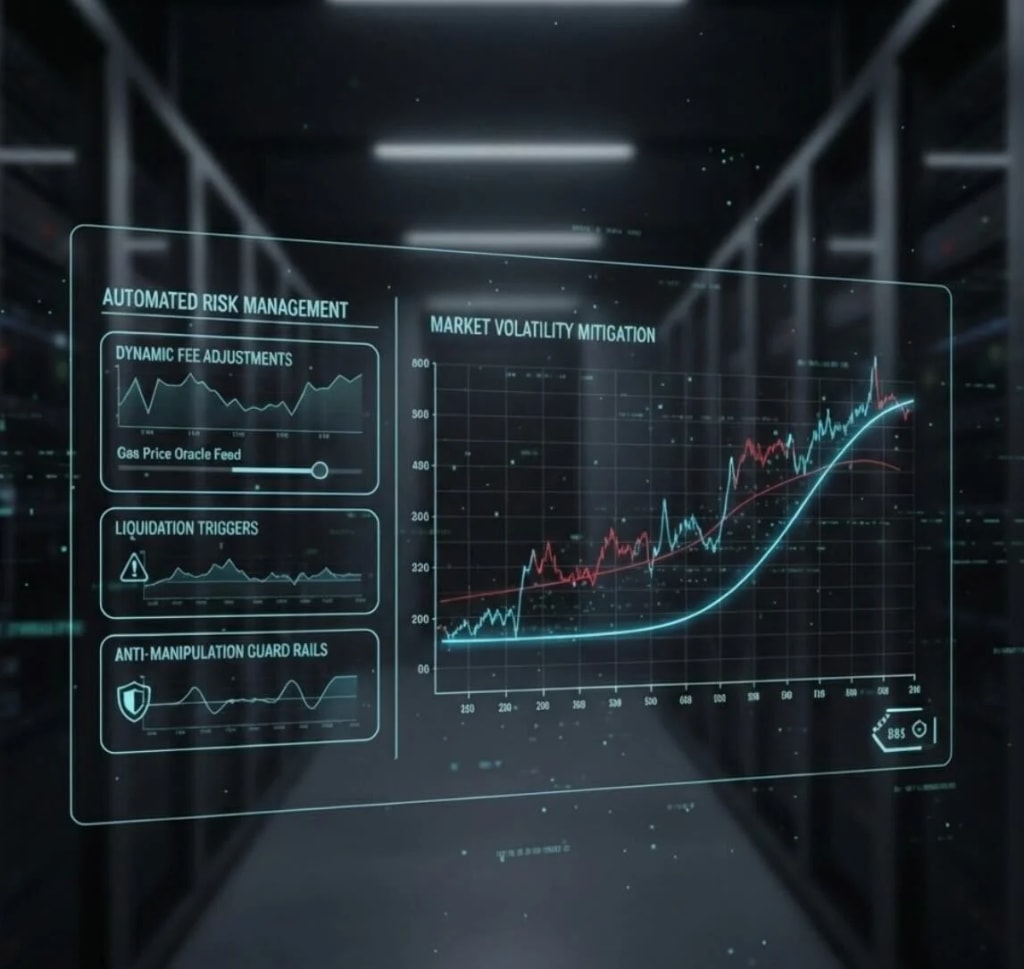
DeFi protocols move too fast for manual risk management. Liquidity surges, flash-loan activity, unexpected market conditions, or sharp price movements can break systems that don’t have automated defenses.
Automated risk management enables:
- dynamic fee adjustments
- liquidation triggers
- automated supply/demand adjustments
- anti-manipulation guard rails
When your protocol self-regulates on-chain, scaling doesn’t break stability, it strengthens it.
6. Optimize User Experience and Transaction Flow for High Retention
Even the most powerful DeFi application fails if users find it confusing, slow, or expensive to interact with. Scalable DeFi UX is built around frictionless action. The experience must guide the user effortlessly from the DeFi wallet connection to the final transaction confirmation, without exposing them to unnecessary complexity or risk.
To optimize usability:
- reduce unnecessary confirmations
- simplify transaction pathways
- minimize gas costs with efficient code patterns
When users trust the flow from their DeFi wallet to your protocol’s core functions, engagement increases naturally. A well-crafted UX boosts trust, conversion, and repeat usage, all crucial for scaling your DeFi brand and liquidity ecosystem.

7. Ensure Your Infrastructure and Tooling Match the Demands of a Modern DeFi Platform
A DeFi application doesn’t exist only on-chain. It relies on an entire ecosystem of infrastructure to function. RPC nodes, indexing layers, analytics engines, off-chain automation, and monitoring systems determine whether your protocol operates consistently under global load.
Resilient infrastructure must support:
- high throughput
- multi-chain interactions
- real-time block indexing
- hardening against RPC manipulation
Scaling is impossible without infrastructure engineered for a decentralized environment.
FAQ: Scaling & Securing DeFi Applications
Q: How can DeFi app development ensure both scalability and security at the same time?
A: By designing architecture that supports high-volume execution while layering security across contracts, oracles, governance, and infrastructure from the start.
Q: Why should startups use professional DeFi app development services instead of in-house developers?
A: Because specialized DeFi teams understand composability risks, liquidity behavior, gas optimization, and attack vectors that general developers usually overlook.
Q: What makes a DeFi app development company critical to long-term protocol success?
A: A seasoned company builds systems that withstand volatility, integrate secure upgrade patterns, and scale reliably as TVL grows.
Q: Do all DeFi applications need automated risk management?
A: Yes. DeFi markets move too fast for manual controls. Automated defenses are the only way to maintain protocol stability during sudden market shifts.
Q: Is UX really important in DeFi scaling?
A: Absolutely. Poor UX reduces retention, increases user error risk and limits liquidity inflow, all of which impact protocol growth.
Conclusion
Scaling and securing a DeFi application is a long-term commitment, not a feature you add at the end. When architecture is built intentionally, development is handled by experts, security becomes continuous and the user experience is seamless, a DeFi product transforms from fragile code into a resilient financial ecosystem.
A DeFi application that scales intelligently doesn’t just compete, it leads.
Share with your community!