Loading blog post...


6 Key Reasons AI and Blockchain Are Shaping the Future of Web3
The conversation is no longer about whether AI and blockchain belong together—it’s about how their integration is transforming digital economies. From providing a "trust layer" for opaque algorithms to enabling autonomous agents that manage DeFi strategies, the convergence of these two technologies is the structural backbone of the new Web3. We explore the six pivotal reasons why the future of the decentralized web will be built on systems that don't just execute rules, but reason, adapt, and evolve.
For years, blockchain and artificial intelligence evolved in parallel. Blockchain focused on decentralization and trust, while AI focused on automation and intelligence. Today, these two technologies are converging and their intersection is redefining what Web3 technology can become.
The conversation is no longer about whether AI and blockchain belong together. It’s about how their integration is transforming decentralized systems, digital economies, and autonomous applications.
To understand this shift, we need to move beyond buzzwords and examine the structural reasons why artificial intelligence and blockchain are becoming inseparable in modern Web3 ecosystems.
1. Blockchain Provides Trust for AI Systems
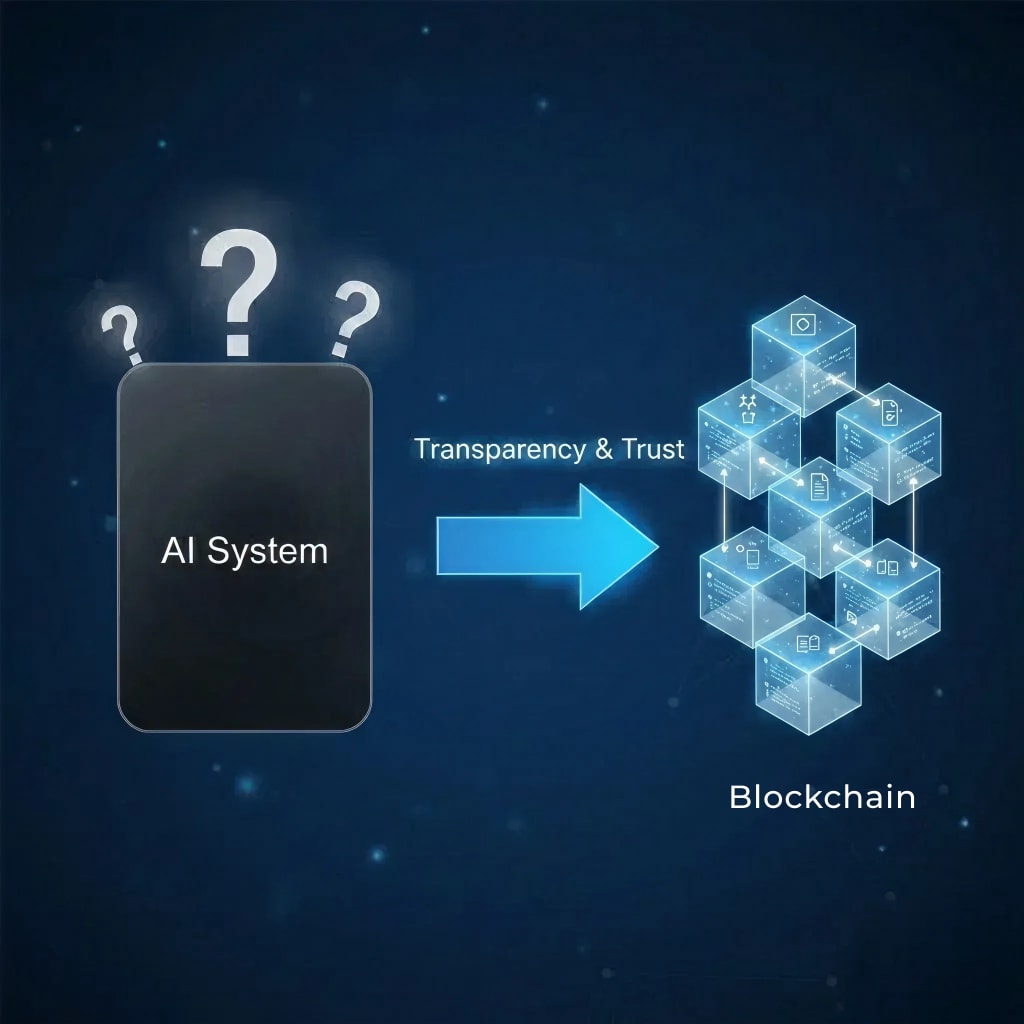
Artificial intelligence thrives on data and computation, but it often suffers from a trust problem. Users rarely know how AI models are trained, who controls them, or whether their outputs are manipulated.
This is where AI on blockchain changes the equation.
By recording model updates, data provenance, and decision logs on-chain, blockchain introduces transparency into AI workflows. Instead of trusting opaque algorithms, users can verify how AI systems evolve.
Here, pointers clarify the impact:
Blockchain enables:
- verifiable AI model history
- transparent data sources
- tamper-resistant decision records
This is why blockchain for AI is becoming a foundational layer for trustworthy intelligent systems.
Check out our blockchain consulting services that help design verifiable AI-blockchain frameworks.
2. AI Enhances Blockchain Performance and Scalability
While blockchain provides trust, it struggles with scalability and optimization. This is where AI for blockchain plays a transformative role.
AI models can optimize:
- transaction routing
- network congestion management
- validator performance prediction
In large networks, AI in blockchain helps identify inefficiencies that traditional rule-based systems cannot detect. Instead of static parameters, blockchain networks become adaptive systems.
This adaptive capability is critical for scaling Web3 infrastructure beyond experimental use cases.
3. AI on the Blockchain Enables Autonomous Web3 Agents
One of the most radical outcomes of combining AI with blockchain is the emergence of autonomous agents. These agents can operate independently within decentralized systems, executing tasks based on smart contract logic and AI-driven decision-making.
In AI on the blockchain systems, agents can:
- manage DeFi strategies
- execute governance actions
- coordinate decentralized workflows
These autonomous entities represent a new class of Web3 participants which are neither human nor centralized institutions.
This shift is redefining how web3 technology functions, moving from static protocols to self-operating systems.
4. Blockchain Creates Economic Incentives for AI Ecosystems
AI systems require massive computational resources and high-quality data. Traditional AI models are controlled by centralized corporations because they own these resources.
AI with blockchain introduces decentralized incentive mechanisms.
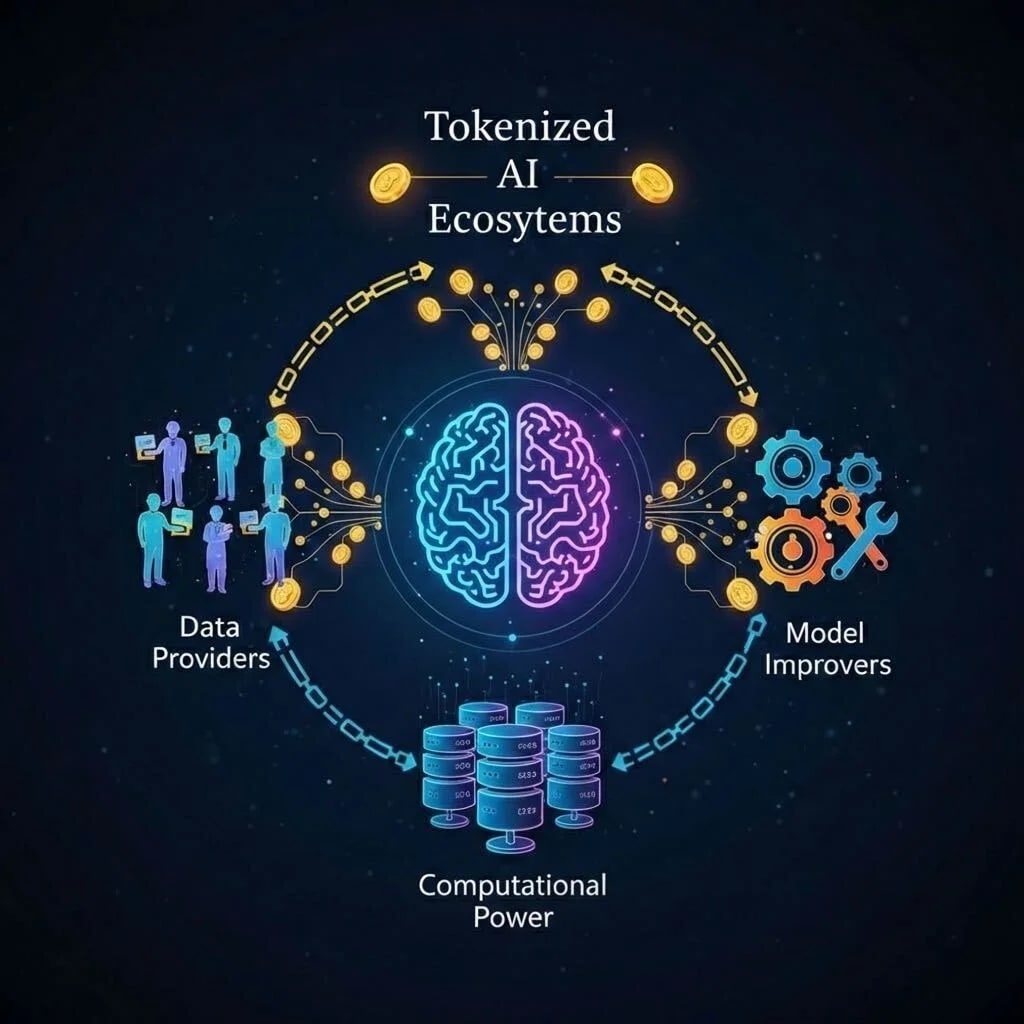
Through tokenized models, contributors can be rewarded for:
- providing training data
- offering computational power
- improving AI models
Here, pointers clarify the economic impact:
Blockchain enables:
- decentralized AI marketplaces
- tokenized participation models
- transparent reward distribution
This is why artificial intelligence and blockchain together are enabling new economic structures that were impossible in traditional systems.
For teams exploring tokenized AI ecosystems, our token launch services help structure sustainable incentive models.
5. AI and Blockchain Strengthen Security in Web3 Systems
Security is a core challenge in Web3. Smart contracts, wallets, and decentralized applications are vulnerable to sophisticated attacks.
AI and blockchain together create a multi-layered defense system.
AI can:
- detect abnormal transaction patterns
- predict exploit risks
- automate threat response
When combined with blockchain’s immutability, AI in blockchain environments enhances real-time security without compromising decentralization.
6. AI and Blockchain Redefine How Web3 Applications Are Built
Traditional Web3 applications are reactive—they respond to user actions. The integration of AI changes this paradigm.
In AI on blockchain systems, applications become proactive. They can anticipate user needs, optimize workflows, and adapt to changing conditions.
This evolution transforms Web3 applications into intelligent, self-optimizing systems.
In practice, web3 technology is shifting from static decentralized apps to dynamic intelligent networks powered by both blockchain and AI.
For teams building next-generation Web3 platforms, our custom dapp development services support integrated AI-blockchain architectures.
FAQ: AI and Blockchain in Web3
Q: How are AI and blockchain connected?
A: Blockchain provides trust and decentralization, while AI provides intelligence and automation.
Q: Is AI on blockchain practical today?
A: Yes, but it’s still evolving due to computational and scalability constraints.
Q: What is blockchain for AI used for?
A: It’s used to verify data, incentivize contributions, and decentralize AI systems.
Q: Will AI replace smart contracts?
A: No. AI complements smart contracts by adding adaptive decision-making.
Q: Is AI in blockchain essential for Web3 growth?
A: Increasingly yes, especially for scalability, security, and autonomy.
Conclusion
The convergence of AI and blockchain is not a futuristic concept, it is actively reshaping the core architecture of Web3. Blockchain provides trust, transparency, and decentralized coordination, while AI introduces intelligence, adaptability, and autonomous decision-making into decentralized systems.
Together, artificial intelligence and blockchain are redefining what Web3 can be, not just networks that execute rules, but systems that learn, optimize, and evolve. As Web3 technology matures, AI integration will shift from an enhancement to a structural layer powering protocols, dApps, DAOs, and digital economies.
For teams building at this intersection, the challenge is now system design - engineering Web3 architectures where intelligence and decentralization coexist by design. This is the direction EthElite focuses on when shaping next-generation Web3 infrastructure.
The future of Web3 will not be built on blockchain alone. It will be built on decentralized systems that can reason, adapt, and act autonomously.
Share with your community!